


50 litų – Lithuania
Add to wishlist
Non-circulating coins
Commemoration: Biržai Castle
Lithuania
Context
Material

References
KM: #
Numista: #30672
Value
Exchange value: 50 LTL
Bullion value: $65.55
Inflation-adjusted value: 84.16 LTL
Obverse
Description:
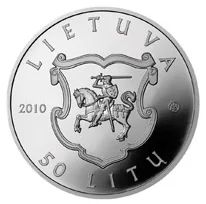
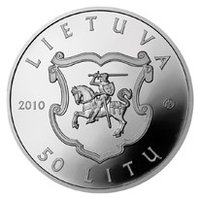
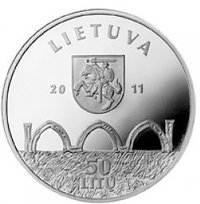
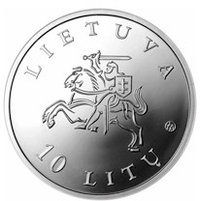
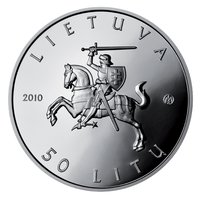
The obverse features a stylized Vytis, encircled by "LIETUVA," the denomination (50 litas), the year 2010, and the Lithuanian Mint mark.
Inscription:
LIETUVA
2010 LMK
50 LITŲ
2010 LMK
50 LITŲ
Translation:
LIETUVA
2010 LMK
50 LITAS
2010 LMK
50 LITAS
Script: Latin
Language: Lithuanian
Designer: Vytautas Narutis
Reverse
Description:
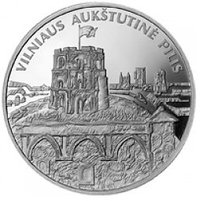
The reverse depicts Biržai Castle, inscribed BIRŽŲ PILIS, and a rider.
Inscription:
BIRŽŲ PILIS
Translation:
Castle of Biržai
Script: Latin
Language: Lithuanian
Designer: Vytautas Narutis
Edge
Lettered
Legend:
ISTORIJOS IR ARCHITEKTŪROS PAMINKLAI
Translation:
Historical and Architectural Monuments
Language: Lithuanian
Categories
| Building> Castle or fortification |
Mints
| Name | Mark |
|---|---|
| Lithuanian Mint | (LMK) |
Mintings
| Year | Mint Mark | Mintage | Quality | Collection |
|---|---|---|---|---|
| 2010 | LMK | 10,000 | Proof |
Historical background
In 2010, Lithuania was in the final phase of its determined path to adopt the euro, operating under a strict currency board arrangement. Since 2002, the national currency, the litas (LTL), had been irrevocably pegged to the euro at a fixed rate of 3.4528 LTL to 1 EUR. This regime provided crucial stability after the economic turbulence of the 1990s, but it also meant Lithuania ceded control over its independent monetary policy, effectively importing the interest rate decisions of the European Central Bank.
The year was dominated by the country's second attempt to join the Eurozone, following an unsuccessful bid in 2007 when Lithuania narrowly missed the Maastricht inflation criterion. The 2008-2009 global financial crisis and a severe domestic recession complicated this goal, causing a sharp GDP contraction and a ballooning budget deficit. However, the government, led by Prime Minister Andrius Kubilius, implemented harsh austerity measures to consolidate public finances, aiming to meet the strict convergence criteria for euro adoption, particularly focusing on reducing the fiscal deficit to below 3% of GDP.
Ultimately, 2010 ended in disappointment on the euro front. While progress was made on fiscal consolidation, the European Commission's convergence report in May concluded that Lithuania did not fulfill the price stability criterion, as its average inflation rate was above the reference value. This setback delayed formal entry into the Eurozone. Nevertheless, the fixed peg held firm, providing a bedrock of exchange rate stability as the economy began a slow, export-led recovery from the depths of the recession.
The year was dominated by the country's second attempt to join the Eurozone, following an unsuccessful bid in 2007 when Lithuania narrowly missed the Maastricht inflation criterion. The 2008-2009 global financial crisis and a severe domestic recession complicated this goal, causing a sharp GDP contraction and a ballooning budget deficit. However, the government, led by Prime Minister Andrius Kubilius, implemented harsh austerity measures to consolidate public finances, aiming to meet the strict convergence criteria for euro adoption, particularly focusing on reducing the fiscal deficit to below 3% of GDP.
Ultimately, 2010 ended in disappointment on the euro front. While progress was made on fiscal consolidation, the European Commission's convergence report in May concluded that Lithuania did not fulfill the price stability criterion, as its average inflation rate was above the reference value. This setback delayed formal entry into the Eurozone. Nevertheless, the fixed peg held firm, providing a bedrock of exchange rate stability as the economy began a slow, export-led recovery from the depths of the recession.
💎 Very Rare