


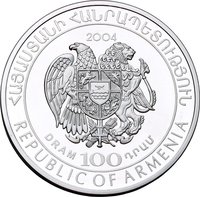
100 Dram (Armenian National Bank) – Armenia
Non-circulating coins
Commemoration: Armenian National Bank 110 years
Armenia
Context
Year: 2003
Issuer: Armenia 
Issuing organization: Central Bank of Armenia
Period:
(since 1991)
Currency:
(since 1993)
Total mintage: 300
Material

References
KM: #Click to copy to clipboard110
Numista: #30600
Value
Exchange value: 100 AMD
Bullion value: $90.88
Obverse
Reverse
Description:
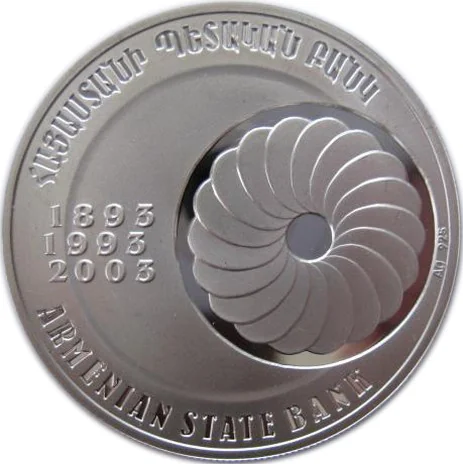
Left: Dates mark the 110th anniversary of Armenia's State Bank and the 10th year of its national currency, the Dram. Below left: An eternity symbol ornament.
Inscription:
ՀԱՅԱՍՏԱՆԻ ՊԵՏԱԿԱՆ ԲԱՆԿ
1893
1993
2003
ARMENIA STATE BANK
1893
1993
2003
ARMENIA STATE BANK
Translation:
ARMENIA STATE BANK
1893
1993
2003
1893
1993
2003
Language: Armenian
Edge
Reeded
Categories
| Building |
Mints
| Name | Mark |
|---|---|
| Saint Petersburg | — |
Mintings
| Year | Mint Mark | Mintage | Quality | Collection |
|---|---|---|---|---|
| 2003 | — | 300 | Proof |
Historical background
In 2003, Armenia's currency situation was characterized by a period of remarkable stability and gradual appreciation of the national currency, the dram (AMD), under a managed floating exchange rate regime. This stability was a significant achievement following the severe economic contractions and hyperinflation of the early post-Soviet years. The Central Bank of Armenia (CBA) successfully maintained tight monetary control, with inflation falling to a manageable low single-digit level (around 3-4% by some estimates). This environment fostered growing public confidence in the dram, which had been introduced in 1993 to replace the Soviet ruble.
The dram's strength in 2003 was primarily driven by two sustained inflows: substantial remittances from the large Armenian diaspora and significant foreign direct investment (FDI), particularly in sectors like telecommunications and mining. These inflows created a consistent supply of foreign currency, chiefly US dollars and Russian rubles, which increased demand for the dram and allowed the CBA to build up its foreign exchange reserves. This reserve accumulation provided a crucial buffer against external shocks and reinforced monetary stability.
However, this stability was not without underlying vulnerabilities. The economy was heavily dollarized, with a large portion of savings and many major transactions conducted in US dollars, reflecting lingering public memory of past instability. Furthermore, the economy's dependence on remittances and a narrow export base (dominated by precious metals and diamonds) made it sensitive to external economic conditions in Russia and other key partner countries. Thus, while 2003 represented a calm and successful chapter in Armenia's monetary history, the currency situation remained exposed to potential regional economic shifts.
The dram's strength in 2003 was primarily driven by two sustained inflows: substantial remittances from the large Armenian diaspora and significant foreign direct investment (FDI), particularly in sectors like telecommunications and mining. These inflows created a consistent supply of foreign currency, chiefly US dollars and Russian rubles, which increased demand for the dram and allowed the CBA to build up its foreign exchange reserves. This reserve accumulation provided a crucial buffer against external shocks and reinforced monetary stability.
However, this stability was not without underlying vulnerabilities. The economy was heavily dollarized, with a large portion of savings and many major transactions conducted in US dollars, reflecting lingering public memory of past instability. Furthermore, the economy's dependence on remittances and a narrow export base (dominated by precious metals and diamonds) made it sensitive to external economic conditions in Russia and other key partner countries. Thus, while 2003 represented a calm and successful chapter in Armenia's monetary history, the currency situation remained exposed to potential regional economic shifts.

✨ Legendary