

100 francs – French Polynesia
Add to wishlist
France
Context
Years: 1976–2005
Country: France
Issuer: French Polynesia
Issuing organization: Overseas Institution of Issue
Period:
(1957—2003)
Currency:
(since 1945)
Demonetization: 30 November 2022
Total mintage: 9,973,100
Material
References
KM: #
Numista: #1356
Value
Exchange value: 100 XPF
Inflation-adjusted value: 553.15 XPF
Obverse
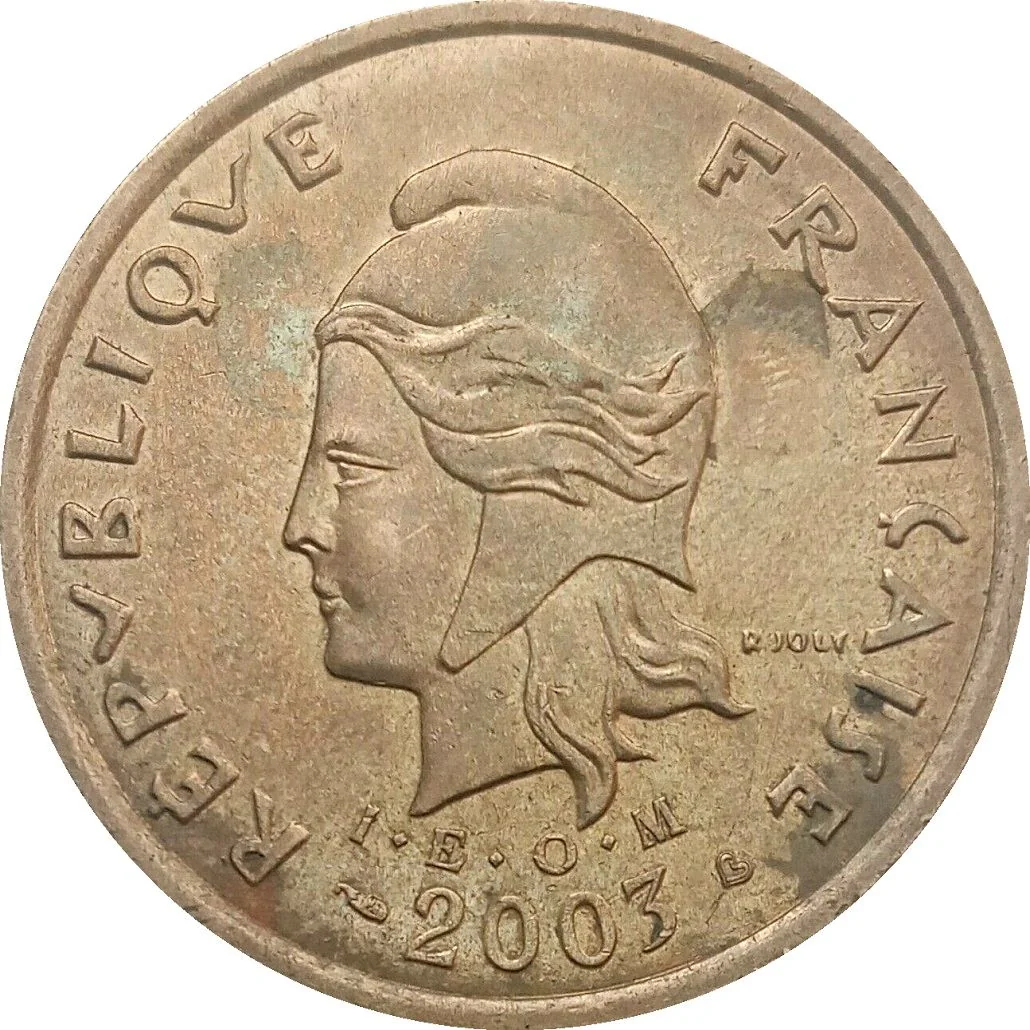
Description:
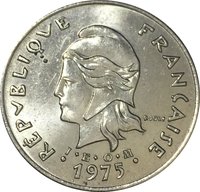
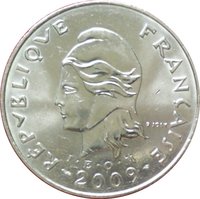
Marianne's left-facing bust with date below.
Inscription:
RÉPUBLIQUE FRANÇAISE
R. JOLY
I·E·O·M
2003
R. JOLY
I·E·O·M
2003
Translation:
FRENCH REPUBLIC
R. JOLY
I.E.O.M.
2003
R. JOLY
I.E.O.M.
2003
Script: Latin
Language: French
Engraver: Raymond Joly
Reverse
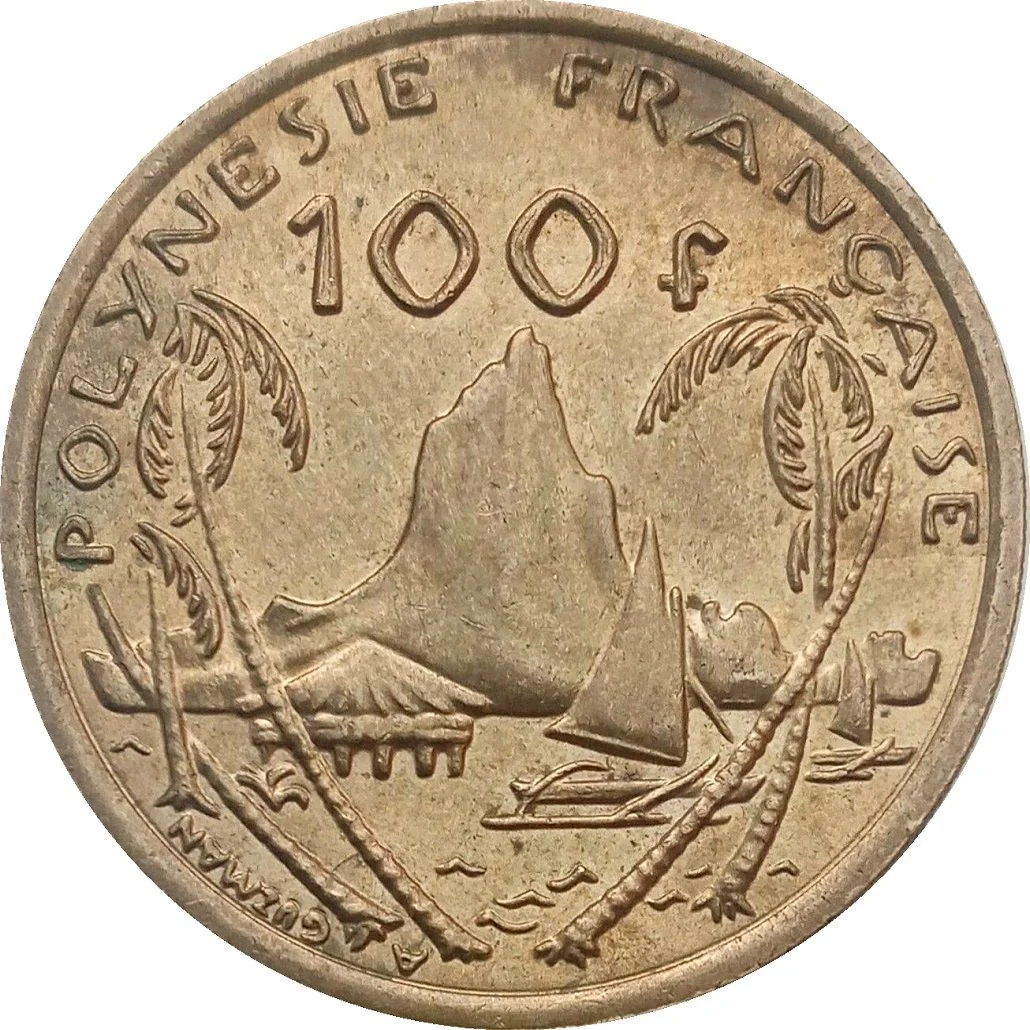
Description:
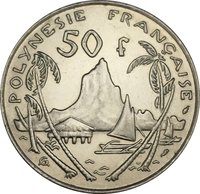
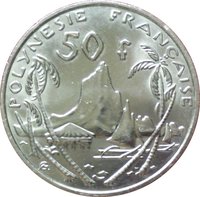
Moorea's harbor overlook.
Inscription:
POLYNESIE FRANÇAISE
100 f
A GUZMAN
100 f
A GUZMAN
Translation:
French Polynesia
100 francs
A Guzman
100 francs
A Guzman
Script: Latin
Engraver: Aleth Guzman-Nageotte
Edge
Reeded
Categories
| Symbol> Allegory |
| Geography> Mountain |
| Symbol> Phrygian cap |
| Plant> Tree |
| Transportation> Watercraft |
Mints
| Name | Mark |
|---|---|
| Monnaie de Paris | — |
Mintings
| Year | Mint Mark | Mintage | Quality | Collection |
|---|---|---|---|---|
| 1976 | — | 2,000,200 | ||
| 1982 | — | 1,000,200 | ||
| 1984 | — | 500,200 | ||
| 1986 | — | 400,000 | ||
| 1987 | — | 500,000 | ||
| 1988 | — | 500,000 | ||
| 1991 | — | 250,000 | ||
| 1992 | — | 500,000 | ||
| 1995 | — | 407,500 | ||
| 1996 | — | 200,000 | ||
| 1997 | — | 150,000 | ||
| 1998 | — | 400,000 | ||
| 1999 | — | 400,000 | ||
| 2000 | — | 762,500 | ||
| 2001 | — | 207,500 | ||
| 2002 | — | 450,000 | ||
| 2003 | — | 600,000 | ||
| 2004 | — | 450,000 | ||
| 2005 | — | 295,000 |
Historical background
In 1976, French Polynesia's currency situation was firmly embedded within the framework of its political status as an overseas territory of France. The official legal tender was the CFP franc (franc des Colonies Françaises du Pacifique), a currency created in 1945 and guaranteed by the French Treasury. This arrangement ensured monetary stability and fixed parity with the French franc, insulating the territory from local inflationary pressures and facilitating trade and subsidy flows from the metropole. The issuing institute was the Institut d’Émission d’Outre-Mer (IEOM), which operated under strict French oversight, meaning local authorities had no independent monetary policy.
This period followed a decade of significant economic transformation, driven largely by France's establishment of the Centre d'Expérimentation du Pacifique (CEP)—its nuclear testing facility in Moruroa and Fangataufa atolls. Beginning in the 1960s, the CEP generated a massive influx of French public investment and personnel, creating an artificial economic boom and making the territory heavily dependent on French financial transfers. By 1976, this "nuclear rent" was the dominant feature of the economy, further cementing the necessity of a stable, French-guaranteed currency to manage this influx and pay for the imports required to sustain the growing population and administrative center in Papeete.
Consequently, there was no serious debate or movement for a independent Polynesian currency in 1976. The economic model was one of deep dependency, and the CFP franc was a critical instrument of that integration. Any discussion of monetary autonomy would have been seen as destabilizing to the economic lifeline provided by the testing program and French subsidies. The currency situation thus reflected the broader political reality: French Polynesia was financially and monetarily integrated with France, a relationship that was both reinforced and complicated by the economic dynamics of the nuclear era.
This period followed a decade of significant economic transformation, driven largely by France's establishment of the Centre d'Expérimentation du Pacifique (CEP)—its nuclear testing facility in Moruroa and Fangataufa atolls. Beginning in the 1960s, the CEP generated a massive influx of French public investment and personnel, creating an artificial economic boom and making the territory heavily dependent on French financial transfers. By 1976, this "nuclear rent" was the dominant feature of the economy, further cementing the necessity of a stable, French-guaranteed currency to manage this influx and pay for the imports required to sustain the growing population and administrative center in Papeete.
Consequently, there was no serious debate or movement for a independent Polynesian currency in 1976. The economic model was one of deep dependency, and the CFP franc was a critical instrument of that integration. Any discussion of monetary autonomy would have been seen as destabilizing to the economic lifeline provided by the testing program and French subsidies. The currency situation thus reflected the broader political reality: French Polynesia was financially and monetarily integrated with France, a relationship that was both reinforced and complicated by the economic dynamics of the nuclear era.
🌱 Very Common