

50 groszy – Congress Kingdom of Poland
Add to wishlist
Poland
Context
Years: 1842–1850
Country: Poland
Issuer: Congress Kingdom of Poland
Ruler: Nicholas I
Currency:
(1815—1841)
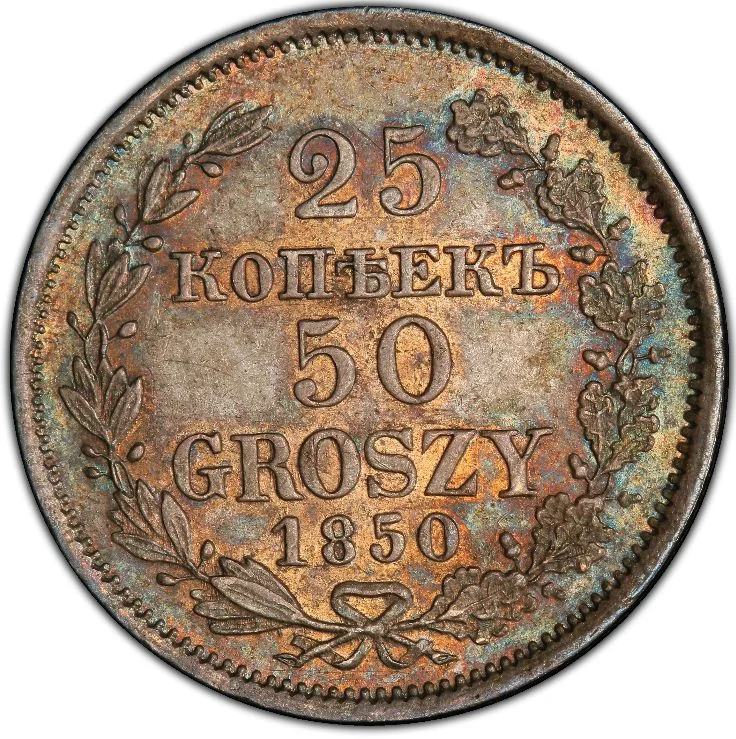
Subdivision: 50 groszy = 25 Kopěek
Demonetized: Yes
Total mintage: 1,498,114
Material
References
Numista: #30354
Value
Bullion value: $11.50
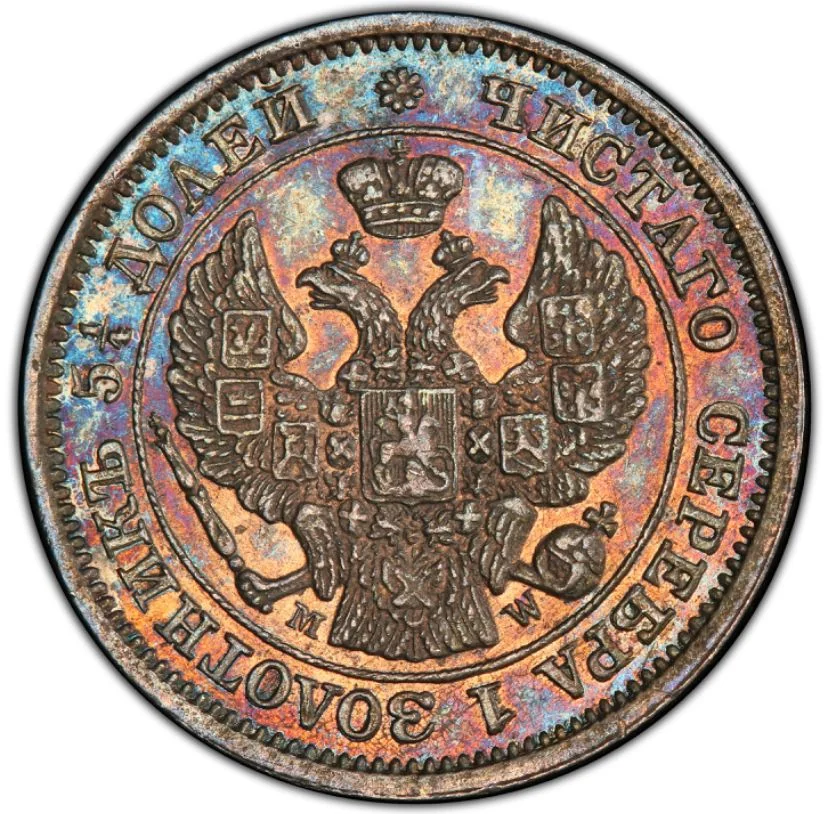
Obverse
Description:
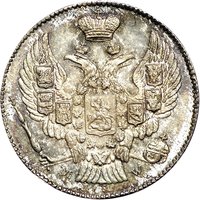
Crowned double-headed eagle.
Inscription:
ЧИСТАГО СЕРЕБРА 1 ЗОЛОТНИКЪ 5 ¼ ДОЛЕЙ
M W
M W
Translation:
Pure Silver 1 Zolotnik 5 ¼ Dolya
M W
M W
Language: Russian
Reverse
Edge
Slant reeded
Mintings
| Year | Mint Mark | Mintage | Quality | Collection |
|---|---|---|---|---|
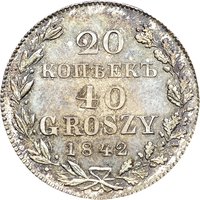
| 1842 | MW | 56,518 | ||
| 1843 | MW | 27,616 | ||
| 1844 | MW | — | ||
| 1845 | MW | 51,738 | ||
| 1846 | MW | 561,263 | ||
| 1847 | MW | 484,511 | ||
| 1848 | MW | 167,605 | ||
| 1850 | MW | 148,863 |
Historical background
In 1842, the currency situation in the Congress Kingdom of Poland was defined by its integration into the Russian monetary system, a process of enforced unification following the crushed November Uprising (1830-1831). Prior to this, the Kingdom had operated its own monetary system with the Polish złoty, established by the Bank of Poland in 1828. However, in the uprising's aftermath, the Russian Empire systematically dismantled the Kingdom's autonomy, including its financial independence. A key step was the 1841 decree that abolished the Bank of Poland's right of issue, setting the stage for a full currency replacement.
Consequently, 1842 marked the final implementation of this policy. By imperial decree, the Russian silver ruble was introduced as the sole legal tender within the Congress Kingdom, completely replacing the Polish złoty at a fixed exchange rate. The former Polish coins were withdrawn from circulation and melted down. This move was not merely an economic adjustment but a potent political symbol, intended to erase a marker of separate Polish statehood and bind the Kingdom's economy more tightly to the Russian Empire, facilitating tax collection and trade on Russian terms.
The result was a simplified but subjugated monetary landscape. For the Polish population, it meant daily economic life was now conducted in a foreign currency, a constant reminder of lost autonomy. For the Russian authorities, it achieved greater administrative and fiscal control, furthering the "Russification" policies of Tsar Nicholas I. Thus, the currency situation of 1842 stands as a clear example of how monetary policy was wielded as a tool of imperial consolidation in the post-uprising period.
Consequently, 1842 marked the final implementation of this policy. By imperial decree, the Russian silver ruble was introduced as the sole legal tender within the Congress Kingdom, completely replacing the Polish złoty at a fixed exchange rate. The former Polish coins were withdrawn from circulation and melted down. This move was not merely an economic adjustment but a potent political symbol, intended to erase a marker of separate Polish statehood and bind the Kingdom's economy more tightly to the Russian Empire, facilitating tax collection and trade on Russian terms.
The result was a simplified but subjugated monetary landscape. For the Polish population, it meant daily economic life was now conducted in a foreign currency, a constant reminder of lost autonomy. For the Russian authorities, it achieved greater administrative and fiscal control, furthering the "Russification" policies of Tsar Nicholas I. Thus, the currency situation of 1842 stands as a clear example of how monetary policy was wielded as a tool of imperial consolidation in the post-uprising period.

💎 Very Rare