

3 pence – New Guinea
Add to wishlist
Papua New Guinea
Context
Year: 1935
Country: Papua New Guinea
Issuer: New Guinea
Ruler: George V
Currency:
(1915—1966)
Demonetized: Yes
Total mintage: 1,200,000
Material
Diameter: 16.34 mm
Weight: 1.3 g
Thickness: 1 mm
Shape: Round with a round hole
Composition: Copper-nickel
Technique: Milled
Alignment: Medal alignment
flip
References
KM: #
Numista: #30329
Obverse
Description:
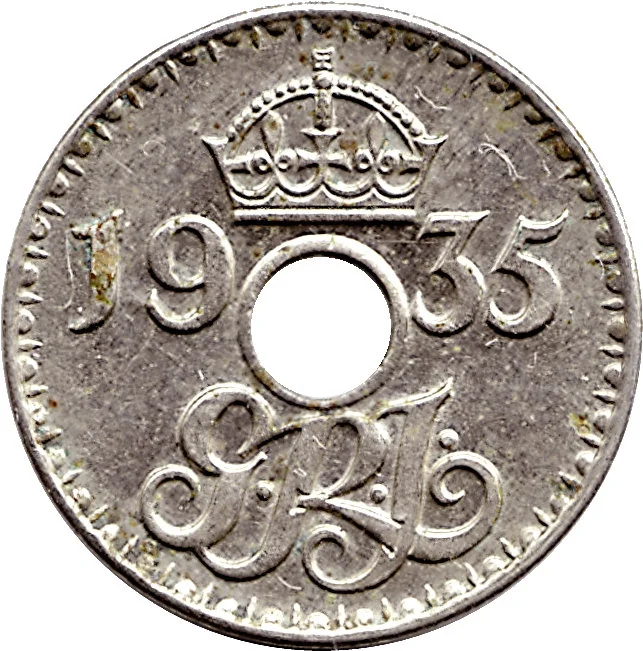
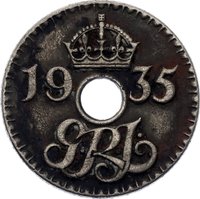
Crowned monogram, date split by hole.
Inscription:
19 35
G·R·I·
G·R·I·
Script: Latin
Engraver: George Kruger Gray
Reverse
Description:
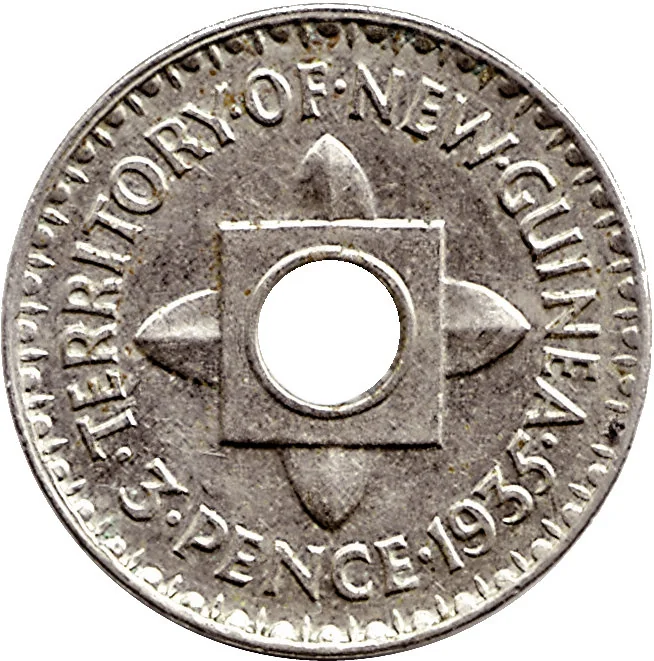
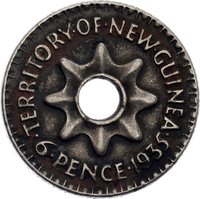
Lettering border design
Inscription:
TERRITORY·OF·NEW·GUINEA
·3·PENCE·1935·
·3·PENCE·1935·
Script: Latin
Edge
Plain
Mints
| Name | Mark |
|---|---|
| Royal Mint | — |
Mintings
| Year | Mint Mark | Mintage | Quality | Collection |
|---|---|---|---|---|
| 1935 | — | 1,200,000 | ||
| 1935 | — | — | Proof |
Historical background
In 1935, the island of New Guinea was divided into three separate political territories, each with its own distinct currency system tied to a colonial power. The eastern half of the island was administered by Australia under a League of Nations mandate as the Territory of New Guinea (formerly German New Guinea). This territory used the Australian pound as its official currency, facilitating trade and administrative integration with its southern administrator. In the southeast, the Australian Territory of Papua, a British possession since 1906, also operated on the Australian pound, creating a unified monetary zone in the Australian-administered regions.
The western half of the island, known as Dutch New Guinea, was controlled by the Netherlands as part of the Dutch East Indies. Its currency was the Dutch East Indies gulden, which was linked to the Netherlands' monetary system. This created a clear economic divide along the colonial border, separating the Australian and Dutch spheres of influence. Meanwhile, traditional shell money and barter systems persisted in remote highland and interior villages, especially in regions where colonial administration and the cash economy had only recently begun to penetrate, following the discovery of gold and the expansion of plantations.
The overall currency situation was therefore characterized by fragmentation and colonial dependency. There was no single "New Guinea" currency; rather, the monetary landscape reflected the island's political partition. The systems in place were designed primarily to serve the export-oriented colonial economies (copra, gold, rubber) and to simplify administrative and commercial transactions for the governing powers, with little consideration for a unified indigenous economy across the island.
The western half of the island, known as Dutch New Guinea, was controlled by the Netherlands as part of the Dutch East Indies. Its currency was the Dutch East Indies gulden, which was linked to the Netherlands' monetary system. This created a clear economic divide along the colonial border, separating the Australian and Dutch spheres of influence. Meanwhile, traditional shell money and barter systems persisted in remote highland and interior villages, especially in regions where colonial administration and the cash economy had only recently begun to penetrate, following the discovery of gold and the expansion of plantations.
The overall currency situation was therefore characterized by fragmentation and colonial dependency. There was no single "New Guinea" currency; rather, the monetary landscape reflected the island's political partition. The systems in place were designed primarily to serve the export-oriented colonial economies (copra, gold, rubber) and to simplify administrative and commercial transactions for the governing powers, with little consideration for a unified indigenous economy across the island.
🌟 Uncommon