

1 Banu – Romania
Romania

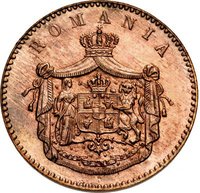
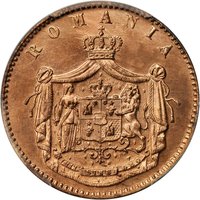
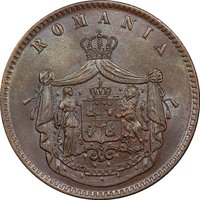
Obverse
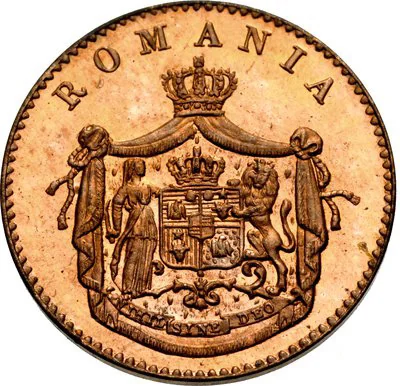
Description:
Arms with supporters under a crowned mantle.
Inscription:
ROMANIA
NIHIL SINE DEO
NIHIL SINE DEO
Translation:
Nothing without God
Script: Latin
Language: Latin
Engraver: William Wyon
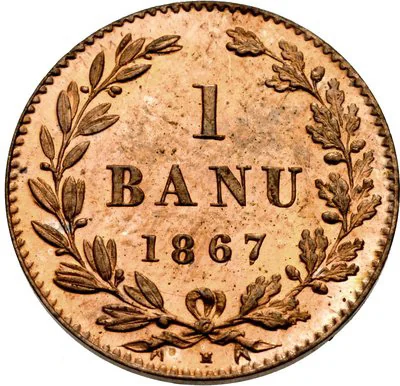
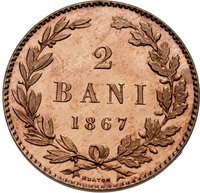
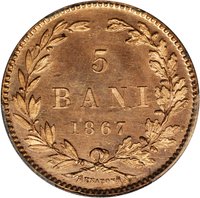
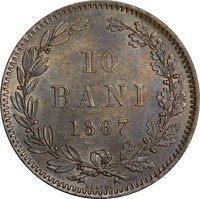
Reverse
Edge
Plain
Categories
| Symbols> Coat of Arms |
| Symbol> Wreath |
Mints
| Name | Mark |
|---|---|
| Heaton and Sons / The Mint Birmingham | H |
| James Watt & Co. | WATT & CO. |
Mintings
| Year | Mint Mark | Mintage | Quality | Collection |
|---|---|---|---|---|
| 1867 | H | 2,500,000 | ||
| 1867 | WATT | 2,500,000 |
Historical background
In 1867, Romania was in a complex monetary transition, shaped by its recent political unification and economic ambitions. The principalities of Wallachia and Moldavia had united in 1859 under Alexandru Ioan Cuza, and by 1867, the new state, still nominally under Ottoman suzerainty, was consolidating its institutions. The currency landscape was fragmented, with several foreign and historical coins circulating simultaneously. The official currency was the Romanian Leu, but in practice, Austrian florins (gulden), Ottoman piastres (especially in the form of Turkish gold lira), Russian rubles, and older local coins like the parale all saw use in daily transactions. This multiplicity created confusion for commerce and state finance, hindering economic development.
The core monetary issue was the absence of a strong, unified national coinage. While the leu was established on a bimetallic standard (gold and silver) by law, the state lacked the bullion reserves and minting capacity to produce enough coin to drive out foreign currencies. Consequently, foreign gold coins, particularly the French 20-franc gold piece (the "napoleon") and the British sovereign, became the preferred medium for large transactions and state reserves, effectively placing Romania on a de facto gold standard dominated by foreign mintings. This reliance underscored the country's economic dependence on Western European capital and markets.
This unstable situation set the stage for significant monetary reform. The political will to create a stable, modern currency was strong, culminating just four years later in the Law for the Minting of National Gold Currency in 1870. This law authorized the minting of the first Romanian gold coins (20-lei and 10-lei pieces), which were aligned with the Latin Monetary Union standards, pegging the leu to the French franc. Therefore, the currency situation of 1867 represents the final years of a fragmented system, immediately preceding the decisive steps toward a unified national currency integrated with the European financial system.
The core monetary issue was the absence of a strong, unified national coinage. While the leu was established on a bimetallic standard (gold and silver) by law, the state lacked the bullion reserves and minting capacity to produce enough coin to drive out foreign currencies. Consequently, foreign gold coins, particularly the French 20-franc gold piece (the "napoleon") and the British sovereign, became the preferred medium for large transactions and state reserves, effectively placing Romania on a de facto gold standard dominated by foreign mintings. This reliance underscored the country's economic dependence on Western European capital and markets.
This unstable situation set the stage for significant monetary reform. The political will to create a stable, modern currency was strong, culminating just four years later in the Law for the Minting of National Gold Currency in 1870. This law authorized the minting of the first Romanian gold coins (20-lei and 10-lei pieces), which were aligned with the Latin Monetary Union standards, pegging the leu to the French franc. Therefore, the currency situation of 1867 represents the final years of a fragmented system, immediately preceding the decisive steps toward a unified national currency integrated with the European financial system.
🌟 Limited