

5 Pfennigs – German Democratic Republic
Germany
Context
Years: 1948–1950
Country: Germany 
Issuer: German Democratic Republic 
Period:
(1949—1990)
Currency:
(1948—1990)
Demonetization: 31 December 1970
Total mintage: 205,072,430
Material
References
KM: #Click to copy to clipboard2
Numista: #3022
Value
Exchange value: 0.05 DDM
Obverse
Description:
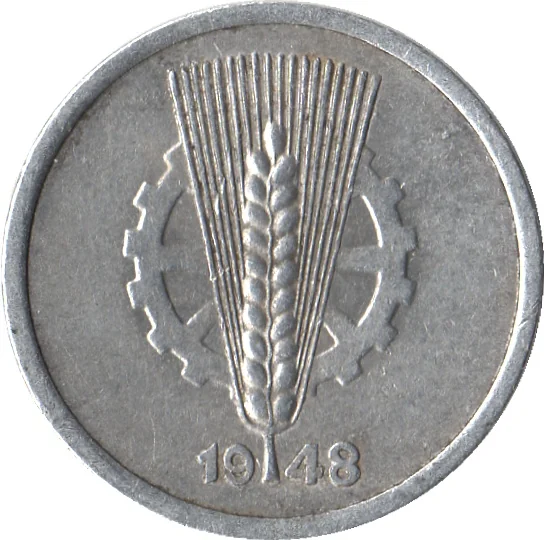
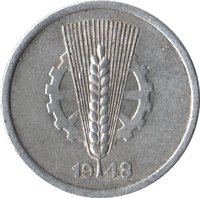
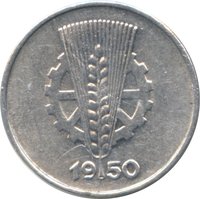
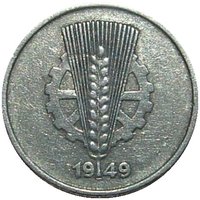
A wheat ear and gear wheel, symbolizing the worker-farmer alliance of the Two-Year Plan emblem.
Inscription:
1948
Script: Latin
Engraver: Franz Paul Krischker
Reverse
Description:
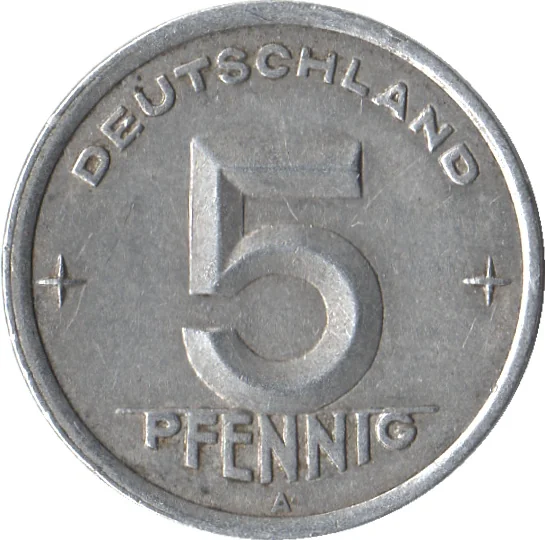
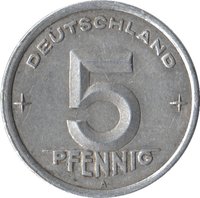
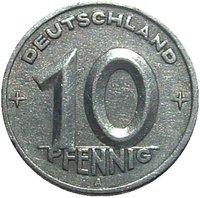
Lettering encircles denomination.
Inscription:
DEUTSCHLAND
5
PFENNIG
A
5
PFENNIG
A
Translation:
Germany
5
Pfennig
A
5
Pfennig
A
Script: Latin
Language: German
Engraver: Franz Paul Krischker
Edge
Plain
Categories
| Industry |
| Agriculture |
Mintings
| Year | Mint Mark | Mintage | Quality | Collection |
|---|---|---|---|---|
| 1948 | A | 205,072,430 | ||
| 1949 | A | — | ||
| 1950 | A | — |
Historical background
In the immediate aftermath of World War II, the currency situation in the Soviet-occupied zone of Germany, which would become the German Democratic Republic (GDR) in 1949, was one of profound crisis. The existing Reichsmark was virtually worthless due to wartime financing through massive printing, leading to a thriving barter economy and a severe lack of consumer goods. All four Allied powers recognized the need for a currency reform to stabilize economic life, but deep-seated political disagreements between the Soviet Union and the Western Allies over Germany's future prevented a joint solution.
Consequently, in June 1948, the Western Allies introduced the Deutsche Mark (DM) in their zones, including West Berlin. The Soviet Union, viewing this as a unilateral step toward permanently splitting Germany, responded within days with its own currency reform in the East. On June 23, 1948, the "Deutsche Mark der Deutschen Notenbank" (later the "Mark der DDR") was introduced in the Soviet zone and, critically, across all of Berlin. This move aimed to drive the now-invalid Reichsmark and the new Western DM out of the Soviet sphere and gain full monetary control.
The simultaneous introduction of two rival currencies in Berlin triggered the Berlin Blockade the very next day, as the Soviets cut off all land and water access to the western sectors of the city to force the Western Allies out. The currency reform of 1948 thus became the direct economic and political catalyst for the division of Berlin and, subsequently, of Germany itself. It cemented the economic separation of East and West, setting the GDR on a path toward a centrally planned economy under Soviet control, distinct from the emerging social market economy in the Federal Republic.
Consequently, in June 1948, the Western Allies introduced the Deutsche Mark (DM) in their zones, including West Berlin. The Soviet Union, viewing this as a unilateral step toward permanently splitting Germany, responded within days with its own currency reform in the East. On June 23, 1948, the "Deutsche Mark der Deutschen Notenbank" (later the "Mark der DDR") was introduced in the Soviet zone and, critically, across all of Berlin. This move aimed to drive the now-invalid Reichsmark and the new Western DM out of the Soviet sphere and gain full monetary control.
The simultaneous introduction of two rival currencies in Berlin triggered the Berlin Blockade the very next day, as the Soviets cut off all land and water access to the western sectors of the city to force the Western Allies out. The currency reform of 1948 thus became the direct economic and political catalyst for the division of Berlin and, subsequently, of Germany itself. It cemented the economic separation of East and West, setting the GDR on a path toward a centrally planned economy under Soviet control, distinct from the emerging social market economy in the Federal Republic.
🌱 Very Common