

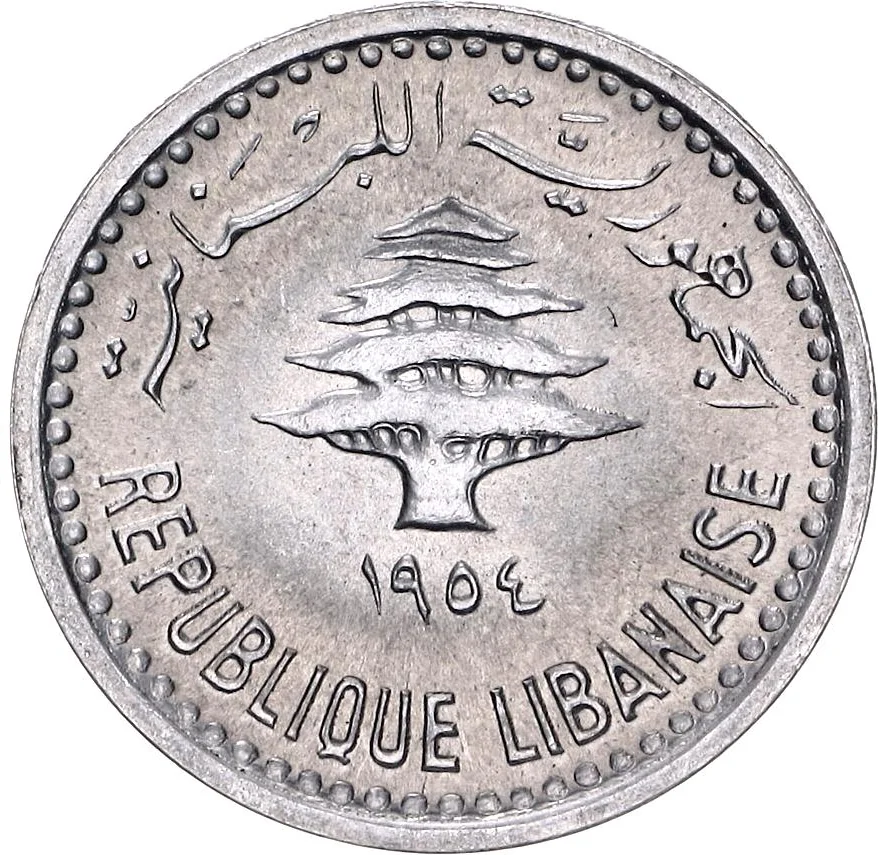
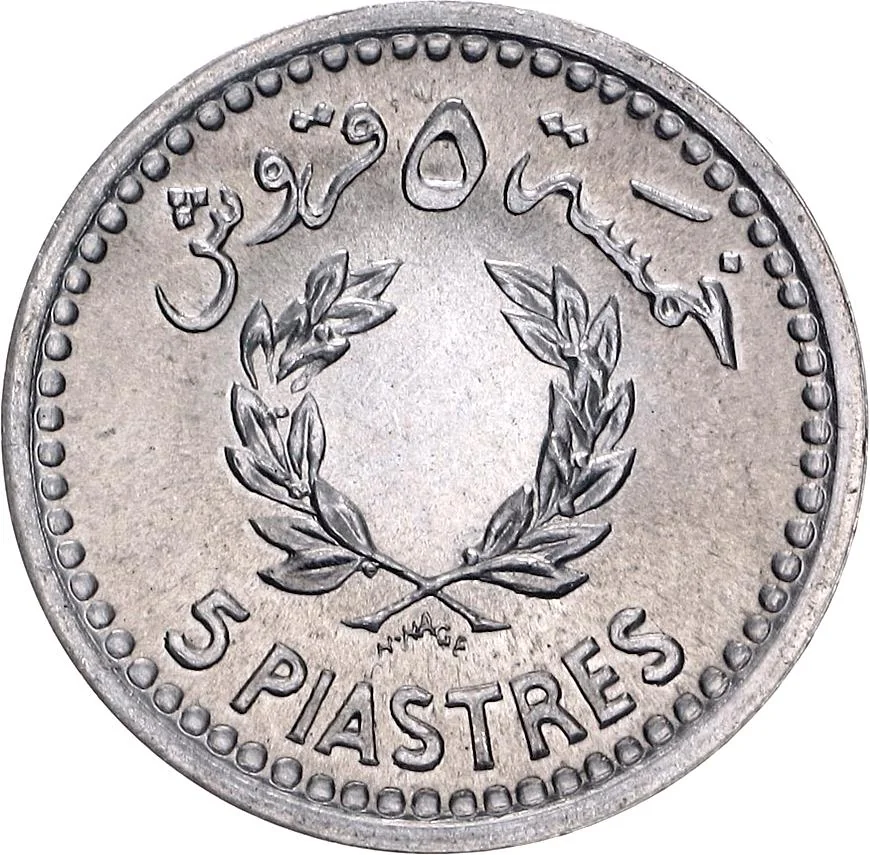
5 Piastres – Lebanon
Lebanon

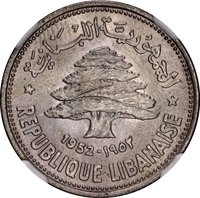
Obverse
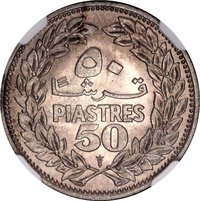
Reverse
Edge
Plain
Mints
| Name | Mark |
|---|---|
| SOMP | — |
Mintings
| Year | Mint Mark | Mintage | Quality | Collection |
|---|---|---|---|---|
| 1954 | — | 4,440,000 |
Historical background
In 1954, Lebanon's currency situation was one of relative stability and strength, underpinned by a robust and conservative banking sector. The Lebanese pound (or lira) was pegged to the French franc as a legacy of the French Mandate, but this link was formally abandoned in 1948. By the early 1950s, the currency operated under a de facto peg to the US dollar, maintained by the Banque du Liban (central bank), which was established in 1964 but whose monetary functions were precursors were managed by the "Bank of Syria and Lebanon" until then. This peg fostered confidence and facilitated Lebanon's emerging role as a regional trade and financial services hub.
This stability was supported by a significant and growing influx of foreign capital. Lebanon's laissez-faire economic policies, strict banking secrecy laws, and political neutrality during the early Cold War attracted capital flight from other regional nations, as well as remittances from a large global diaspora. The country ran a chronic trade deficit, but this was comfortably offset by a surplus in "invisible" earnings from banking, insurance, tourism, and transit trade, allowing for a healthy balance of payments and substantial gold and foreign exchange reserves.
Consequently, 1954 represents a high-water mark of pre-war monetary confidence, situated in the prosperous "Switzerland of the Middle East" era. The economy was dollarized in practice for large transactions, and the Lebanese pound was considered a fully convertible and strong currency. However, this model contained latent vulnerabilities, including an economy increasingly reliant on speculative inflows and services rather than productive sectors, and a fiscal policy that avoided taxation and deficit spending—a delicate equilibrium that would be severely tested in the coming decades.
This stability was supported by a significant and growing influx of foreign capital. Lebanon's laissez-faire economic policies, strict banking secrecy laws, and political neutrality during the early Cold War attracted capital flight from other regional nations, as well as remittances from a large global diaspora. The country ran a chronic trade deficit, but this was comfortably offset by a surplus in "invisible" earnings from banking, insurance, tourism, and transit trade, allowing for a healthy balance of payments and substantial gold and foreign exchange reserves.
Consequently, 1954 represents a high-water mark of pre-war monetary confidence, situated in the prosperous "Switzerland of the Middle East" era. The economy was dollarized in practice for large transactions, and the Lebanese pound was considered a fully convertible and strong currency. However, this model contained latent vulnerabilities, including an economy increasingly reliant on speculative inflows and services rather than productive sectors, and a fiscal policy that avoided taxation and deficit spending—a delicate equilibrium that would be severely tested in the coming decades.
🌱 Very Common