

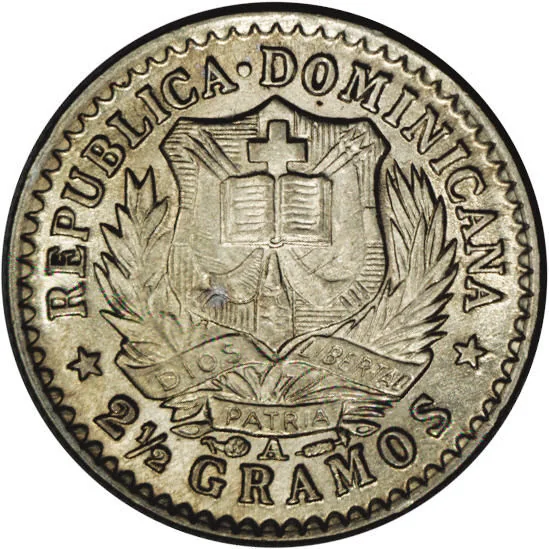
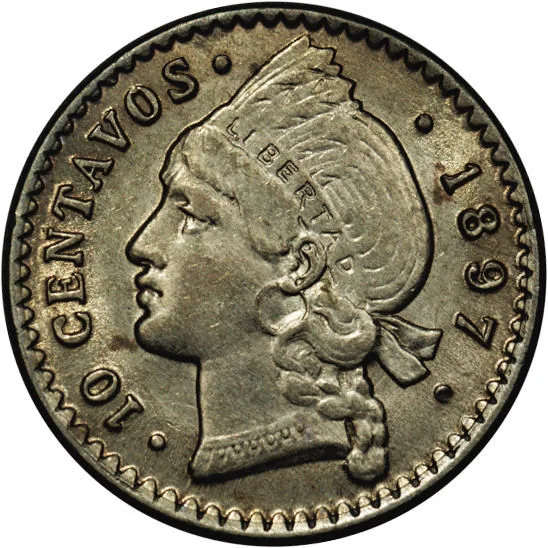
10 Centavos – Dominican Republic
Dominican Republic
Context
Year: 1897
Issuer: Dominican Republic 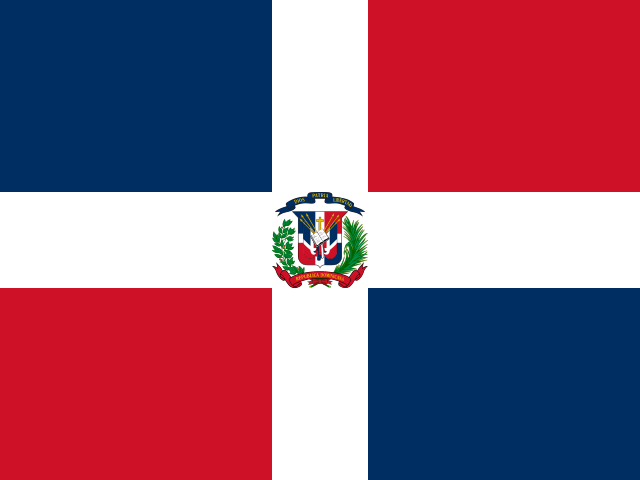
Period:
(1863—1916)
Currency:
(1844—1905)
Demonetized: Yes
Total mintage: 764,387
Material
References
KM: #Click to copy to clipboard13
Numista: #3000
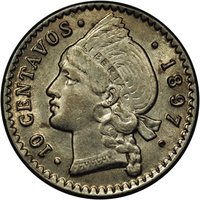
Obverse
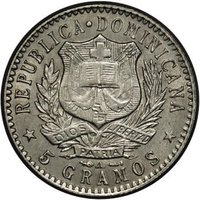
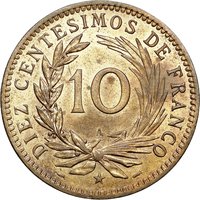
Reverse
Description:
Left-facing bust, denomination left, date right.
Inscription:
10 CENTAVOS 1897
Script: Latin
Edge
Plain
Categories
| Symbol> Allegory |
| Symbols> Coat of Arms |
Mints
| Name | Mark |
|---|---|
| United States Mint of Philadelphia | — |
Mintings
| Year | Mint Mark | Mintage | Quality | Collection |
|---|---|---|---|---|
| 1897 | A | 764,387 |
Historical background
In 1897, the Dominican Republic operated under a complex and unstable monetary system, a legacy of economic turmoil and foreign intervention. The national currency, the Dominican peso, was not trusted domestically or internationally due to a history of severe depreciation and arbitrary issuance by successive governments. Consequently, the economy functioned on a de facto dual-currency system. While the paper peso was used for everyday transactions, foreign silver coins—particularly the U.S. dollar, the British sovereign, and French francs—were the preferred mediums for significant business, international trade, and savings, as they held reliable intrinsic value.
This monetary fragmentation was a direct symptom of the country's profound political instability and crippling debt. Decades of internal conflict and the failure to develop a robust export economy (beyond sugar, tobacco, and cacao) had left the treasury perpetually empty. The government's response was often to print more unbacked paper money to cover deficits, leading to inflation and further eroding public confidence. The situation was exacerbated by the looming shadow of foreign creditors, especially from the United States and Europe, who held claims over Dominican customs revenues, the state's primary source of income.
Therefore, the currency situation in 1897 was one of precarious transition and external pressure. It reflected a nation struggling to assert its economic sovereignty. This fragile environment set the stage for the more extreme financial crises and increased American oversight that would follow in the early 20th century, culminating in the U.S. customs receivership of 1905 and the eventual adoption of the U.S. dollar as the official currency in 1947. The monetary disarray of 1897 was thus a critical point in the long trajectory from post-colonial instability toward a dollarized economy.
This monetary fragmentation was a direct symptom of the country's profound political instability and crippling debt. Decades of internal conflict and the failure to develop a robust export economy (beyond sugar, tobacco, and cacao) had left the treasury perpetually empty. The government's response was often to print more unbacked paper money to cover deficits, leading to inflation and further eroding public confidence. The situation was exacerbated by the looming shadow of foreign creditors, especially from the United States and Europe, who held claims over Dominican customs revenues, the state's primary source of income.
Therefore, the currency situation in 1897 was one of precarious transition and external pressure. It reflected a nation struggling to assert its economic sovereignty. This fragile environment set the stage for the more extreme financial crises and increased American oversight that would follow in the early 20th century, culminating in the U.S. customs receivership of 1905 and the eventual adoption of the U.S. dollar as the official currency in 1947. The monetary disarray of 1897 was thus a critical point in the long trajectory from post-colonial instability toward a dollarized economy.
🌟 Limited