

1 franc – Tunisia
Add to wishlist
Tunisia
Context
Material
Diameter: 23 mm
Weight: 4 g
Thickness: 1.59 mm
Shape: Round
Composition: Aluminium bronze
Magnetic: No
Technique: Milled
Alignment: Coin alignment
flip
References
KM: #
Numista: #821
Value
Exchange value: 1 TNF
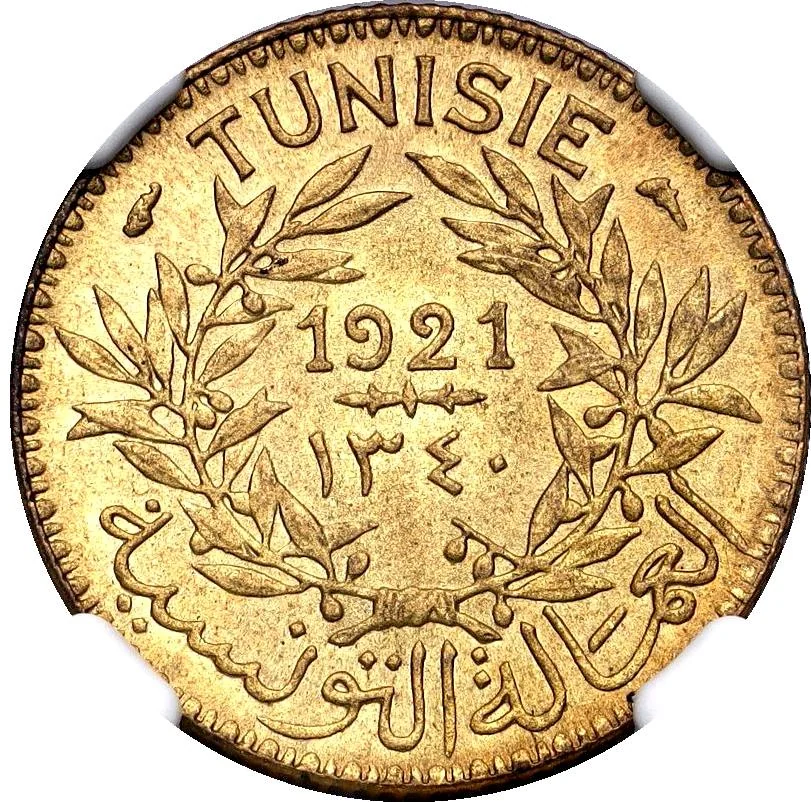
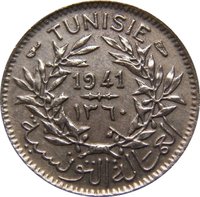
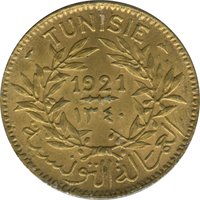
Obverse
Description:
Date range
Inscription:
TUNISIE
1941
١٣٦٠
العمالة التونسية
1941
١٣٦٠
العمالة التونسية
Translation:
Tunisia
1941
1360
The Tunisian Workers
1941
1360
The Tunisian Workers
Engraver: Henri-Auguste Patey
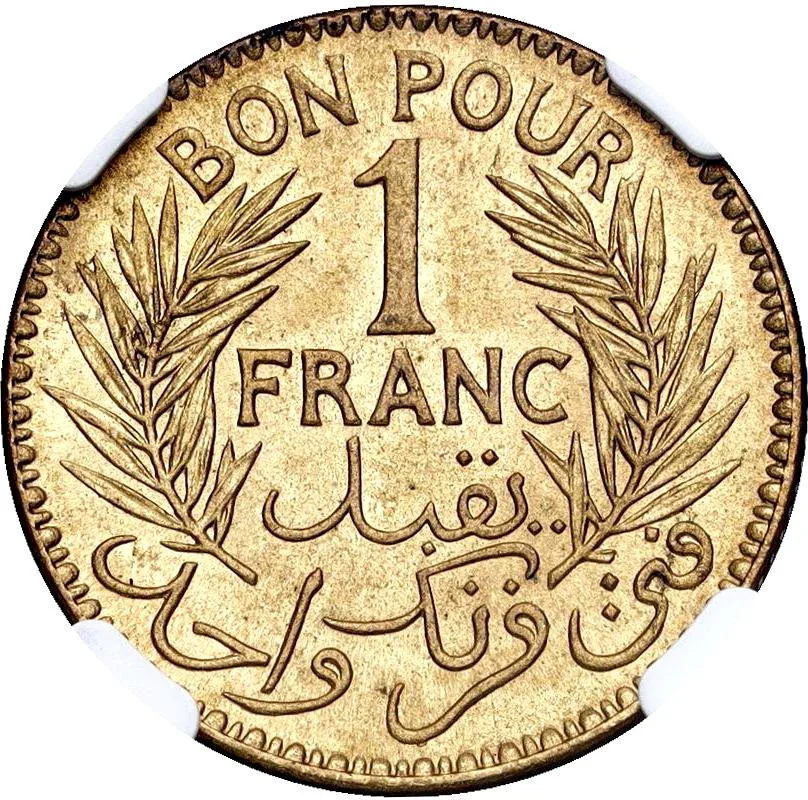
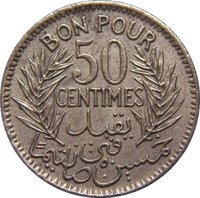
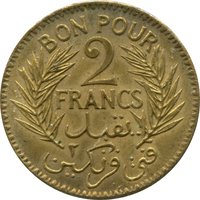
Reverse
Description:
Valuable
Inscription:
BON POUR
1
FRANC
يقبل
في فرنك واحد
1
FRANC
يقبل
في فرنك واحد
Translation:
Good for
1
Franc
Accepted
for one franc
1
Franc
Accepted
for one franc
Engraver: Henri-Auguste Patey
Edge
Reeded
Mints
| Name | Mark |
|---|---|
| Monnaie de Paris | — |
Mintings
| Year | Mint Mark | Mintage | Quality | Collection |
|---|---|---|---|---|
| 1921 | — | 5,000,027 | ||
| 1926 | — | 1,000,000 | ||
| 1926 | — | 1,000,000 | ||
| 1941 | — | 6,611,868 | ||
| 1945 | — | 10,699,132 |
Historical background
In 1921, Tunisia's currency situation was defined by its status as a French protectorate, established in 1881. The monetary system was under the direct control of the French administration, which had replaced the former Ottoman and local currencies with the Tunisian franc. This currency was pegged at par to the French franc, effectively integrating Tunisia into the French Franc Zone. This arrangement facilitated colonial trade and financial extraction, ensuring that Tunisia's economy was tightly bound to and dependent on that of metropolitan France.
The primary institution governing currency was the Banque de l'Algérie et de la Tunisie, a private French bank granted the privilege of issuing banknotes for both territories. While this provided a degree of monetary stability, it meant that Tunisia had no independent monetary policy; decisions were made in the interest of the colonial power and the bank's shareholders. In practice, alongside the official banknotes, French coins and older metallic currencies often circulated, especially in rural areas, reflecting the incomplete and imposed nature of the monetary unification.
Economically, the fixed parity and linked currency system streamlined the export of Tunisian agricultural products (like wheat and phosphates) to France and the import of French manufactured goods, reinforcing a colonial economic structure. However, it also left Tunisia vulnerable to monetary policies set for France's needs, not its own. The stability of the 1921 period was thus a colonial stability, predicated on the subordination of local financial sovereignty, a system that would remain largely unchanged until the struggle for independence decades later.
The primary institution governing currency was the Banque de l'Algérie et de la Tunisie, a private French bank granted the privilege of issuing banknotes for both territories. While this provided a degree of monetary stability, it meant that Tunisia had no independent monetary policy; decisions were made in the interest of the colonial power and the bank's shareholders. In practice, alongside the official banknotes, French coins and older metallic currencies often circulated, especially in rural areas, reflecting the incomplete and imposed nature of the monetary unification.
Economically, the fixed parity and linked currency system streamlined the export of Tunisian agricultural products (like wheat and phosphates) to France and the import of French manufactured goods, reinforcing a colonial economic structure. However, it also left Tunisia vulnerable to monetary policies set for France's needs, not its own. The stability of the 1921 period was thus a colonial stability, predicated on the subordination of local financial sovereignty, a system that would remain largely unchanged until the struggle for independence decades later.
🌱 Very Common