

2 lire – Vatican City
Add to wishlist
Vatican City
Context
Years: 1947–1949
Issuer: Vatican City
Ruler: Pius XII
Currency:
(1929—2001)
Demonetized: Yes
Total mintage: 85,000
Material
References
KM: #
Numista: #29826
Value
Exchange value: 2 VAL
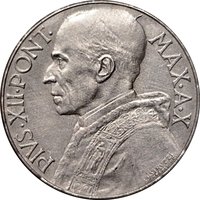
Obverse
Description:
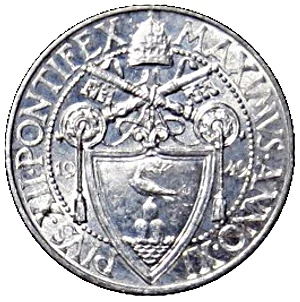
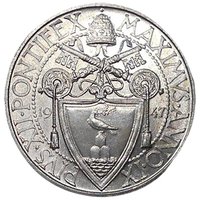
Pius XII's coat of arms.
Inscription:
PIVS·XII·PONTIFEX MAXIMVS·ANNO·X·
19 48
19 48
Script: Latin
Engraver: A. Mistruzzi
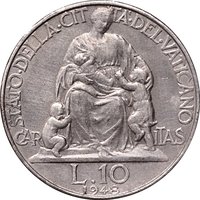
Reverse
Inscription:
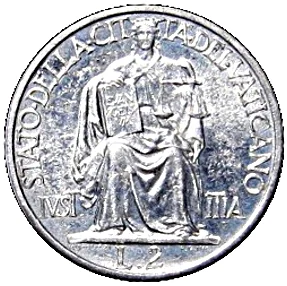
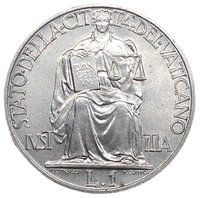
STATO·DELLA·CIT TA'·DEL·VATICANO·
L.2
L.2
Script: Latin
Edge
Plain
Mintings
| Year | Mint Mark | Mintage | Quality | Collection |
|---|---|---|---|---|
| 1947 | — | 65,000 | ||
| 1948 | — | 10,000 | ||
| 1949 | — | 10,000 |
Historical background
Following World War II, Vatican City faced a unique and constrained currency situation rooted in the 1929 Lateran Treaties, which established its sovereignty. The treaties granted the Holy See the right to issue its own coinage, the Vatican lira, which was pegged at par and circulated interchangeably with the Italian lira. However, in practice, the Vatican's monetary system was entirely dependent on Italy. It lacked a central bank and could not print banknotes; its coin minting was limited by treaty and conducted at the Italian Mint in Rome. Consequently, the Italian lira remained the de facto everyday currency for transactions within the tiny city-state.
By 1947, this dependency was acutely felt amidst Italy's own severe postwar economic crisis. The country was grappling with rampant inflation, a devalued currency, and reconstruction costs, which directly impacted the Vatican's financial operations. The purchasing power of the lira—both Italian and Vatican—had plummeted, straining the budget of the Holy See, which relied on investments, donations, and income from properties. While the Vatican's sovereign coinage held symbolic and numismatic value, its economic reality was one of operating within a destabilized Italian monetary zone without the tools of an independent monetary policy.
Therefore, the currency situation in 1947 was one of legal sovereignty but practical vulnerability. The Vatican lira existed as a token of statehood, yet the Holy See's financial stability was tied to the fortunes of the Italian lira. This period underscored the necessity for the Vatican to develop its more robust and diversified financial administration in the coming decades, eventually leading to reforms that would lessen its reliance on any single national currency system.
By 1947, this dependency was acutely felt amidst Italy's own severe postwar economic crisis. The country was grappling with rampant inflation, a devalued currency, and reconstruction costs, which directly impacted the Vatican's financial operations. The purchasing power of the lira—both Italian and Vatican—had plummeted, straining the budget of the Holy See, which relied on investments, donations, and income from properties. While the Vatican's sovereign coinage held symbolic and numismatic value, its economic reality was one of operating within a destabilized Italian monetary zone without the tools of an independent monetary policy.
Therefore, the currency situation in 1947 was one of legal sovereignty but practical vulnerability. The Vatican lira existed as a token of statehood, yet the Holy See's financial stability was tied to the fortunes of the Italian lira. This period underscored the necessity for the Vatican to develop its more robust and diversified financial administration in the coming decades, eventually leading to reforms that would lessen its reliance on any single national currency system.
⭐ Somewhat Rare