

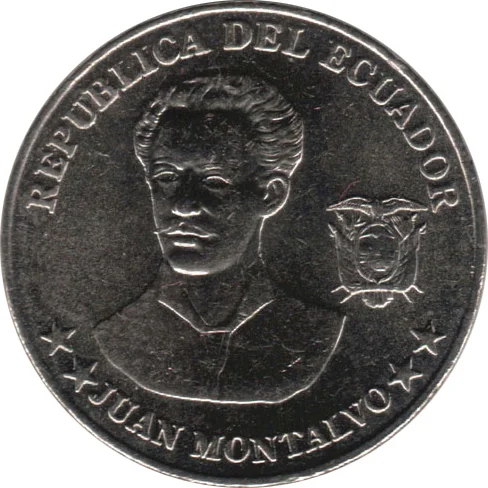
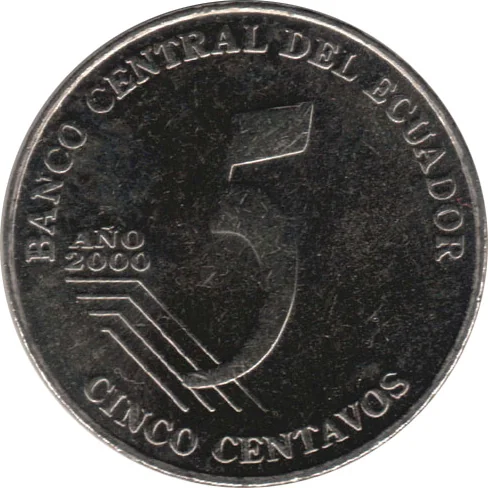
5 centavos – Ecuador
Add to wishlist
Ecuador
Context
Years: 2000–2005
Issuer: Ecuador
Issuing organization: Central Bank of Ecuador
Period:
(since 1830)
Currency:
(since 2000)
Material
Diameter: 21.2 mm
Weight: 4.95 g
Thickness: 1.9 mm
Shape: Round
Composition: Stainless steel
Technique: Milled
Alignment: Coin alignment
flip
References
KM: #
Numista: #2982
Value
Exchange value: 0.05 USD = $0.05
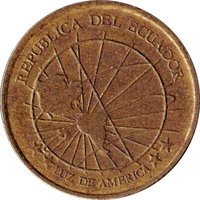
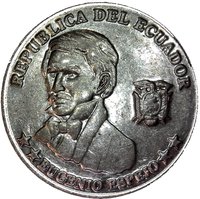
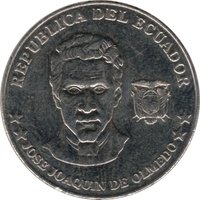
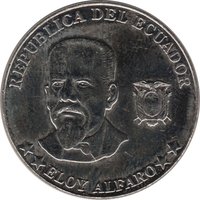
Obverse
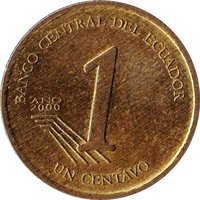
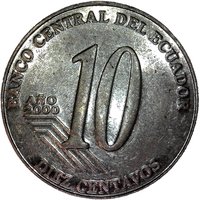
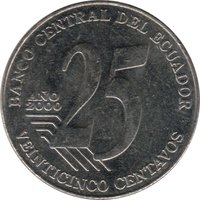
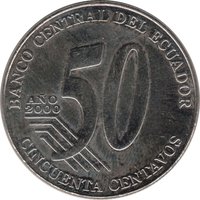
Reverse
Edge
Plain
Categories
| Art> Literature |
Mints
| Name | Mark |
|---|---|
| Mexican Mint | — |
Mintings
| Year | Mint Mark | Mintage | Quality | Collection |
|---|---|---|---|---|
| 2000 | — | — | ||
| 2003 | — | — | ||
| 2005 | — | — |
Historical background
In 2000, Ecuador faced a profound economic and political crisis that culminated in the dramatic abandonment of its national currency, the sucre, and the adoption of the US dollar. The decade leading up to this decision was marked by chronic instability: a banking crisis, hyperinflation that peaked at over 90%, a massive public debt burden, and a sharp contraction in GDP following a devastating El Niño phenomenon and a drop in global oil prices. By early 1999, the sucre had lost two-thirds of its value, poverty rates soared, and the government defaulted on its foreign debt, leading to a complete loss of confidence in both the financial system and the national currency.
Faced with social unrest and the imminent collapse of the economy, President Jamil Mahuad announced on January 9, 2000, that the US dollar would become Ecuador's official currency. This policy, known as dollarization, was a desperate measure to halt hyperinflation, restore stability, and attract foreign investment by permanently eliminating the central bank's ability to print money. The transition was set at a fixed rate of 25,000 sucres to one US dollar, effectively ending the sucre's existence. Although the announcement contributed to Mahuad's ouster in a coup just days later, his successor, Gustavo Noboa, implemented the dollarization process in March 2000.
The immediate effects were severe but stabilizing. Dollarization quickly tamed inflation and ended the currency's freefall, providing a foundation for economic recovery. However, it came at a significant cost: Ecuador relinquished control over its monetary policy, making the economy dependent on US Federal Reserve decisions and the inflow of physical US dollars. It also imposed strict fiscal discipline, as the government could no longer finance deficits by printing money, leading to pressures on public spending and wages. Thus, the year 2000 marked a pivotal and irreversible turning point, where Ecuador traded monetary sovereignty for stability in an effort to escape a deep national crisis.
Faced with social unrest and the imminent collapse of the economy, President Jamil Mahuad announced on January 9, 2000, that the US dollar would become Ecuador's official currency. This policy, known as dollarization, was a desperate measure to halt hyperinflation, restore stability, and attract foreign investment by permanently eliminating the central bank's ability to print money. The transition was set at a fixed rate of 25,000 sucres to one US dollar, effectively ending the sucre's existence. Although the announcement contributed to Mahuad's ouster in a coup just days later, his successor, Gustavo Noboa, implemented the dollarization process in March 2000.
The immediate effects were severe but stabilizing. Dollarization quickly tamed inflation and ended the currency's freefall, providing a foundation for economic recovery. However, it came at a significant cost: Ecuador relinquished control over its monetary policy, making the economy dependent on US Federal Reserve decisions and the inflow of physical US dollars. It also imposed strict fiscal discipline, as the government could no longer finance deficits by printing money, leading to pressures on public spending and wages. Thus, the year 2000 marked a pivotal and irreversible turning point, where Ecuador traded monetary sovereignty for stability in an effort to escape a deep national crisis.
Series: 2000 Ecuador circulation coins
🌱 Very Common