

50 Cash – Northwest Anhwei Soviet
China
Context
Year: 1932
Country: China 
Issuer: Northwest Anhwei Soviet
Issuing organization: Northwest Anhwei Special District Soviet Bank
Currency:
(1930—1936)
Demonetized: Yes
Material
References
KM: #Click to copy to clipboard2
Numista: #298002
Obverse
Description:
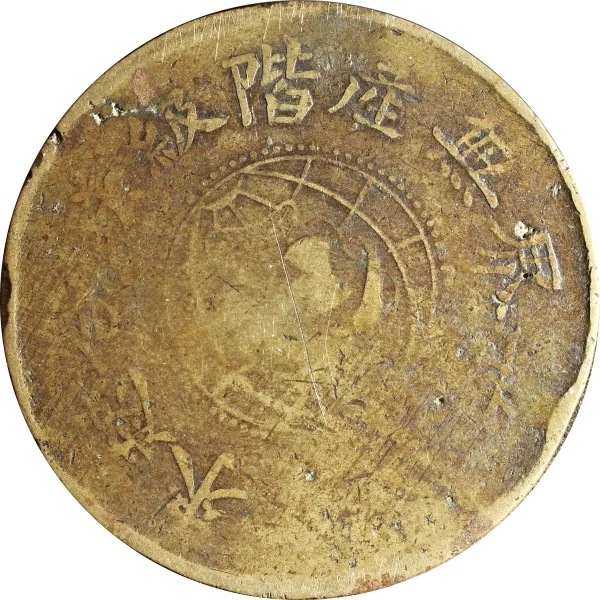
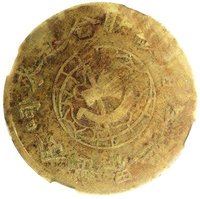
Hammer and sickle over a map and globe, encircled by Chinese characters.
Inscription:
全世界無產階級聯合起來呵
Translation:
Workers of the world, unite!
Language: Chinese
Reverse
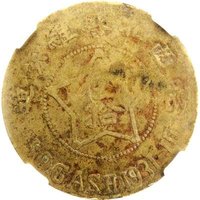
Inscription:
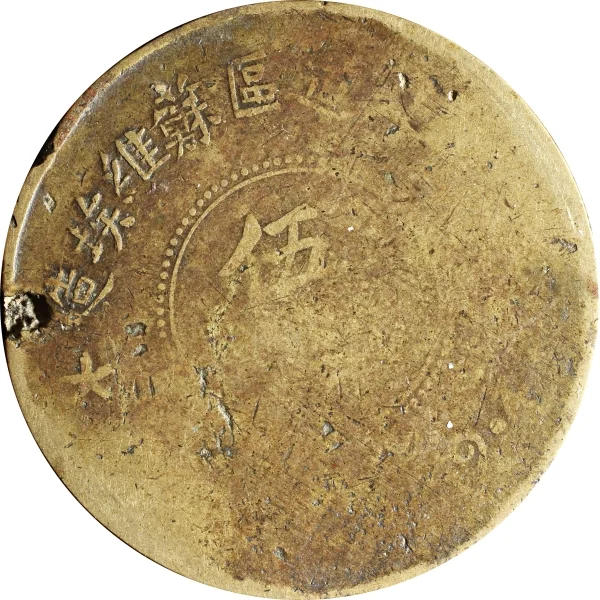
造埃维苏区道北西皖
五
十
T 50 CAH 1932-4
五
十
T 50 CAH 1932-4
Translation:
Made in the West Anhui Road, Northern District, Soviet Area
Five
Ten
T 50 Cash 1932-4
Five
Ten
T 50 Cash 1932-4
Language: Chinese
Edge
Categories
| Map |
| Symbol> Hammer and sickle |
Mintings
| Year | Mint Mark | Mintage | Quality | Collection |
|---|---|---|---|---|
| 1932 | — | — |
Historical background
In 1932, the currency situation within the Northwest Anhui Soviet, a base area of the Chinese Red Army during the Chinese Civil War, was defined by severe instability and experimental measures born of necessity. The region, under pressure from Kuomintang military encirclement and economic blockade, faced hyperinflation. The soviet government issued its own paper currency, but it competed with various forms of money in circulation, including Kuomintang fabi, silver dollars, and even barter. The lack of substantial reserves and public confidence, coupled with the constant threat of the area being overrun, led to rapid depreciation of the soviet notes, severely hampering economic cohesion and trade.
To combat this crisis, the soviet authorities implemented a dual approach. First, they attempted to enforce the use of their own currency for all transactions within their controlled territory, while strictly prohibiting the circulation of Kuomintang currency. Second, and more crucially, they tied the value of their paper notes to a tangible commodity: grain. The government established "grain banks," where peasants could deposit their harvest and receive soviet currency in return, effectively backing the money with a staple food reserve. This innovative, if rudimentary, attempt at commodity-backed currency aimed to build trust and ensure the notes had a stable, real-world value.
Despite these efforts, the currency system remained fragile and localized. The constant military upheaval, fluctuating control over territory, and the sheer difficulty of managing a complex financial system under wartime conditions meant that success was limited. The experience in Northwest Anhui reflected the broader challenges faced by the Chinese Soviets in establishing independent economic systems, highlighting a reliance on practical, agrarian-based solutions rather than sophisticated financial mechanisms. This period served as a formative, though tumultuous, chapter in the Communist Party's experimentation with currency management, which would later inform policies in the Yan'an period and beyond.
To combat this crisis, the soviet authorities implemented a dual approach. First, they attempted to enforce the use of their own currency for all transactions within their controlled territory, while strictly prohibiting the circulation of Kuomintang currency. Second, and more crucially, they tied the value of their paper notes to a tangible commodity: grain. The government established "grain banks," where peasants could deposit their harvest and receive soviet currency in return, effectively backing the money with a staple food reserve. This innovative, if rudimentary, attempt at commodity-backed currency aimed to build trust and ensure the notes had a stable, real-world value.
Despite these efforts, the currency system remained fragile and localized. The constant military upheaval, fluctuating control over territory, and the sheer difficulty of managing a complex financial system under wartime conditions meant that success was limited. The experience in Northwest Anhui reflected the broader challenges faced by the Chinese Soviets in establishing independent economic systems, highlighting a reliance on practical, agrarian-based solutions rather than sophisticated financial mechanisms. This period served as a formative, though tumultuous, chapter in the Communist Party's experimentation with currency management, which would later inform policies in the Yan'an period and beyond.
✨ Legendary