

50 Cash – Northwest Anhwei Soviet
China
Context
Year: 1931
Country: China 
Issuer: Northwest Anhwei Soviet
Issuing organization: Northwest Anhwei Special District Soviet Bank
Currency:
(1930—1936)
Demonetized: Yes
Material
References
KM: #Click to copy to clipboard1 var.
Numista: #298001
Obverse
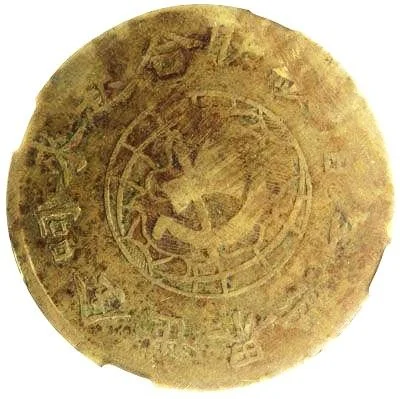
Description:
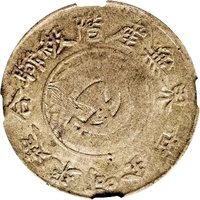
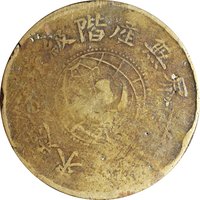
Hammer and sickle over a map and globe, encircled by Chinese characters.
Inscription:
全世界無產階級聯合起來呵
Translation:
Workers of the world, unite!
Language: Chinese
Reverse
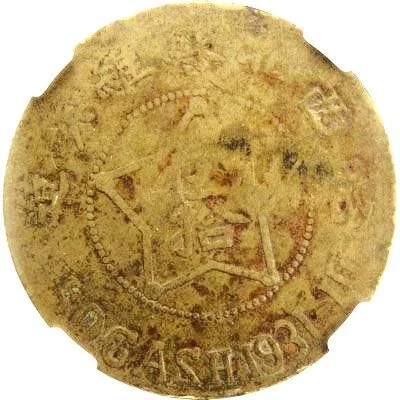
Description:
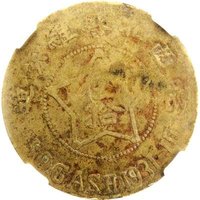
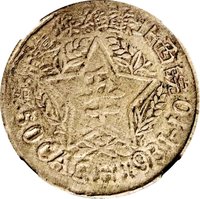
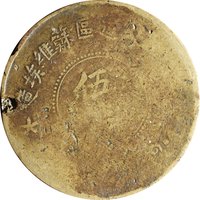
Star with central "fifty" ideogram, surrounded by dot-collared circle, corner dots, and outer Chinese/English text.
Inscription:
造埃维苏北西皖
伍
拾
50 CASH 1931-10
伍
拾
50 CASH 1931-10
Translation:
Made in Northern Anhui Soviet of the Eyuwan
Five
Ten
50 CASH 1931-10
Five
Ten
50 CASH 1931-10
Language: Chinese
Edge
Plain
Categories
| Map |
| Symbol> Hammer and sickle |
Mintings
| Year | Mint Mark | Mintage | Quality | Collection |
|---|---|---|---|---|
| 1931 | — | — |
Historical background
The currency situation in the Northwest Anhui Soviet in 1931 was a critical and experimental component of the Chinese Communist Party's (CCP) early efforts at financial governance in a rural base area. Established in the broader Hubei-Henan-Anhui Soviet region, this border area faced severe economic blockade and military pressure from Kuomintang (KMT) forces. In response, the soviet government, led by figures like Zhang Guotao, moved to establish an independent financial system to break from the KMT's monetary control, stabilize the local economy, and fund the Red Army. The primary goal was to replace the circulating Kuomintang fabi and various local notes with a unified, soviet-issued currency to assert economic sovereignty and combat hyperinflation imported from the KMT-controlled areas.
Practically, the Northwest Anhui Soviet Bank issued its own paper notes, often simply denominated as "Soviet Currency" or bearing the name of the Hubei-Henan-Anhui Soviet Bank. These notes were rudimentary, printed on simple paper with woodblock or lithograph techniques, and their value was initially pegged to a silver standard to gain public trust. However, issuance was fraught with challenges. The currency's credibility relied heavily on the military and political fortunes of the Red Army, and its circulation was largely confined to areas under firm soviet control. A major, persistent problem was counterfeiting by KMT agents to destabilize the soviet economy, forcing the authorities to frequently change note designs and implement harsh penalties for forgery.
Ultimately, the currency's existence was tenuous and directly tied to the military front. While it succeeded in facilitating internal trade and procurement for a time, the intense encirclement campaigns by the KMT in 1932 placed the entire Northwest Anhui Soviet under immense strain. As the Red Army was forced into strategic retreats and the base area shrank, the currency's zone of circulation collapsed, and it rapidly lost all value. The experiment, though short-lived, provided the CCP with invaluable experience in managing finance under conditions of war and blockade, lessons that would be refined in later base areas like the Shaanxi-Gansu-Ningxia Border Region during the Yan'an period.
Practically, the Northwest Anhui Soviet Bank issued its own paper notes, often simply denominated as "Soviet Currency" or bearing the name of the Hubei-Henan-Anhui Soviet Bank. These notes were rudimentary, printed on simple paper with woodblock or lithograph techniques, and their value was initially pegged to a silver standard to gain public trust. However, issuance was fraught with challenges. The currency's credibility relied heavily on the military and political fortunes of the Red Army, and its circulation was largely confined to areas under firm soviet control. A major, persistent problem was counterfeiting by KMT agents to destabilize the soviet economy, forcing the authorities to frequently change note designs and implement harsh penalties for forgery.
Ultimately, the currency's existence was tenuous and directly tied to the military front. While it succeeded in facilitating internal trade and procurement for a time, the intense encirclement campaigns by the KMT in 1932 placed the entire Northwest Anhui Soviet under immense strain. As the Red Army was forced into strategic retreats and the base area shrank, the currency's zone of circulation collapsed, and it rapidly lost all value. The experiment, though short-lived, provided the CCP with invaluable experience in managing finance under conditions of war and blockade, lessons that would be refined in later base areas like the Shaanxi-Gansu-Ningxia Border Region during the Yan'an period.
✨ Legendary