

Obverse
Description:
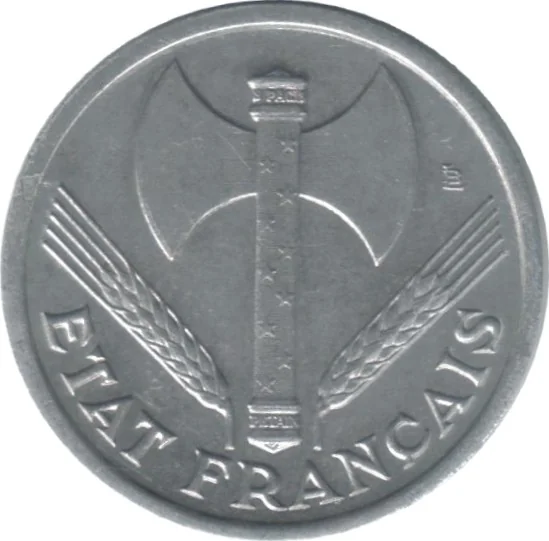
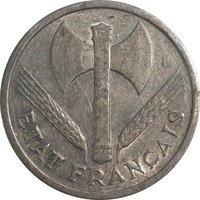
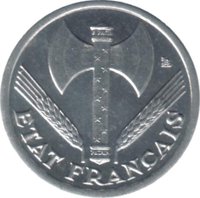
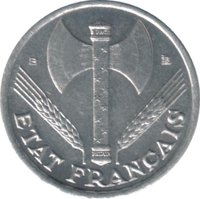
A double-headed axe, flanked by wheat, with lettering above, below, and to its left.
Inscription:
S PACIS
LB
PETAIN
ETAT FRANÇAIS
LB
PETAIN
ETAT FRANÇAIS
Translation:
Peace
French State
Pétain
French State
Pétain
Script: Latin
Engraver: Lucien Georges Bazor
Reverse
Description:
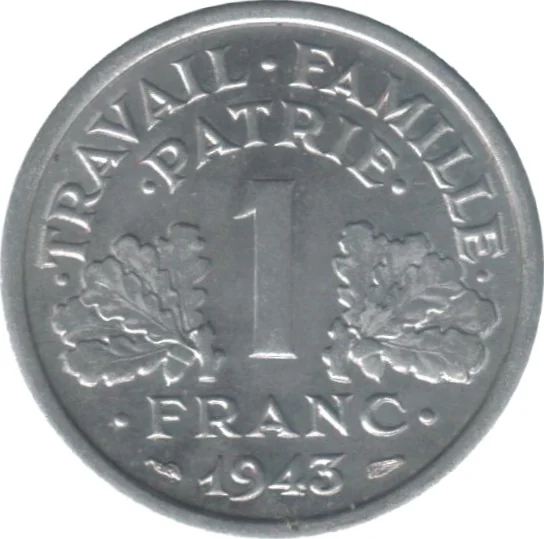
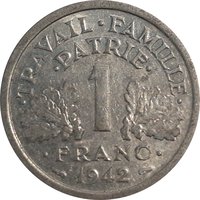
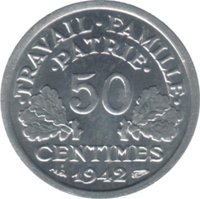
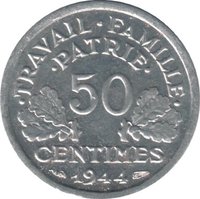
Oak leaves flank the central numeral, with lettering above and the date below.
Inscription:
TRAVAIL·FAMILLE·
·PATRIE·
1
·FRANC·
1943
·PATRIE·
1
·FRANC·
1943
Translation:
Work Family Fatherland
1 Franc 1943
1 Franc 1943
Script: Latin
Language: French
Engraver: Lucien Georges Bazor
Edge
PlainThe image shows both heavy KM#902.1 (bottom) and light KM#902.1-3 (top) type
Categories
| Symbol> Wreath |
| Object> Cold weapons |
Mints
| Name | Mark |
|---|---|
| Monnaie de Paris | — |
| Beaumont-le-Roger | B |
| Castelsarrasin | C |
Mintings
Historical background
In 1942, France existed under a complex and strained dual currency system as a consequence of its 1940 defeat and occupation by Nazi Germany. The northern and western zones were under direct German military administration, while the southeastern "Zone Libre" was governed from Vichy by the collaborationist regime of Marshal Philippe Pétain. Officially, the French Franc remained the legal tender, but its value and management were subordinated to German economic demands. The occupying authorities imposed an artificially high and devastating exchange rate of 20 Francs to 1 Reichsmark, which systematically bled the French economy to finance the German war effort through massive occupation costs.
This period saw severe inflation and growing scarcity, exacerbated by the systematic German requisitioning of resources, Allied blockades, and the breakdown of normal trade. The Vichy government, seeking to maintain a facade of sovereignty, managed monetary policy but was compelled to collaborate with the German Reichsbank. It financed its own activities and the occupation costs by increasing the money supply, leading to a sharp decline in the Franc's purchasing power. The black market flourished as a necessary but illegal means of survival for many citizens, operating with vastly different prices and further undermining the official currency's stability.
Furthermore, the currency situation was a tool of political division. In Alsace-Lorraine, annexed de facto to the Reich, the Reichsmark was imposed. Across all zones, the population also had to contend with the introduction of special occupation currency notes, which served as a constant physical reminder of subjugation. By 1942, the economic pillage was accelerating, and the deteriorating value of the Franc mirrored the deepening hardship of the French populace, setting the stage for the even more severe economic crises of the following years of occupation.
This period saw severe inflation and growing scarcity, exacerbated by the systematic German requisitioning of resources, Allied blockades, and the breakdown of normal trade. The Vichy government, seeking to maintain a facade of sovereignty, managed monetary policy but was compelled to collaborate with the German Reichsbank. It financed its own activities and the occupation costs by increasing the money supply, leading to a sharp decline in the Franc's purchasing power. The black market flourished as a necessary but illegal means of survival for many citizens, operating with vastly different prices and further undermining the official currency's stability.
Furthermore, the currency situation was a tool of political division. In Alsace-Lorraine, annexed de facto to the Reich, the Reichsmark was imposed. Across all zones, the population also had to contend with the introduction of special occupation currency notes, which served as a constant physical reminder of subjugation. By 1942, the economic pillage was accelerating, and the deteriorating value of the Franc mirrored the deepening hardship of the French populace, setting the stage for the even more severe economic crises of the following years of occupation.
Series: 1942 France circulation coins
🌱 Very Common