

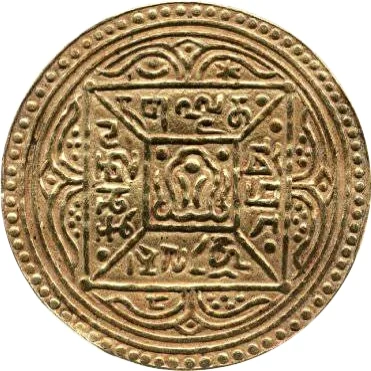

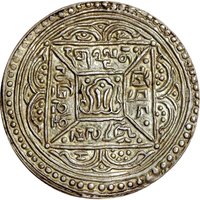
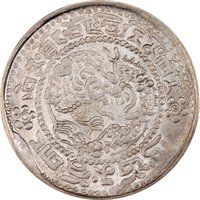
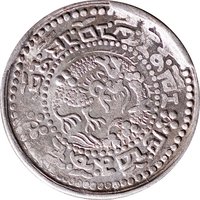
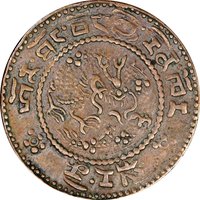
Obverse
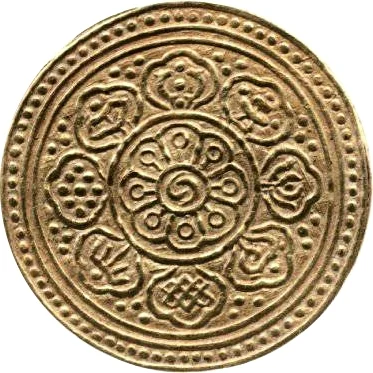
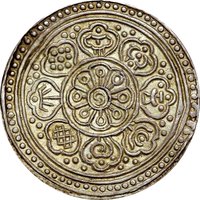
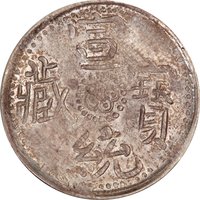
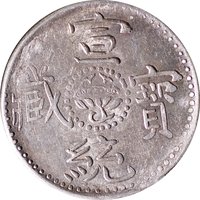
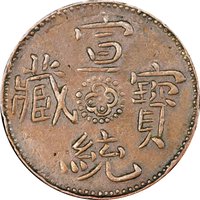
Reverse
Description:
An eight-spoked wheel encircled by the Eight Auspicious Symbols, all set within an eight-petalled lotus.
Edge
Plain
Mints
| Name | Mark |
|---|---|
| Dodé Mint | — |
Mintings
| Year | Mint Mark | Mintage | Quality | Collection |
|---|---|---|---|---|
| 1910 | — | — |
Historical background
In 1910, Tibet's currency situation was a complex reflection of its contested political status between the declining Qing Empire and growing British influence. The primary circulating medium was the Tibetan silver tangka coin, minted locally in Lhasa and other mints, often with varying purity and weight. Alongside these, Chinese silver yuan coins (often called "Dayang") circulated, particularly in the east, as did significant quantities of Indian rupees, especially in southern regions near British India and Sikkim, due to cross-border trade. This multi-currency system created a chaotic monetary environment where exchange rates fluctuated based on metal content and trader confidence.
Politically, the year was pivotal. The Qing's ambitious military expedition under Zhao Erfeng arrived in Lhasa in early 1910, forcing the 13th Dalai Lama to flee to India. The Qing administration sought to reassert direct control and integrate Tibet fiscally, introducing new coinage that bore both Tibetan and Chinese inscriptions to symbolize imperial authority. However, this attempt at monetary consolidation was superficial and unstable. The Qing's presence was militarily focused and resented by much of the Tibetan populace and establishment, meaning their coinage did not displace the existing heterogeneous system.
Ultimately, the currency landscape of 1910 was one of transition and uncertainty. The simultaneous circulation of Tibetan, Chinese, and Indian coins mirrored the broader geopolitical struggle for influence over the region. The Qing's efforts to impose a unified currency were short-lived, as their administration collapsed with the Chinese Revolution of 1911 just a year later, leading to the expulsion of Chinese forces and leaving Tibet's monetary system fragmented and locally managed once again throughout the following decades.
Politically, the year was pivotal. The Qing's ambitious military expedition under Zhao Erfeng arrived in Lhasa in early 1910, forcing the 13th Dalai Lama to flee to India. The Qing administration sought to reassert direct control and integrate Tibet fiscally, introducing new coinage that bore both Tibetan and Chinese inscriptions to symbolize imperial authority. However, this attempt at monetary consolidation was superficial and unstable. The Qing's presence was militarily focused and resented by much of the Tibetan populace and establishment, meaning their coinage did not displace the existing heterogeneous system.
Ultimately, the currency landscape of 1910 was one of transition and uncertainty. The simultaneous circulation of Tibetan, Chinese, and Indian coins mirrored the broader geopolitical struggle for influence over the region. The Qing's efforts to impose a unified currency were short-lived, as their administration collapsed with the Chinese Revolution of 1911 just a year later, leading to the expulsion of Chinese forces and leaving Tibet's monetary system fragmented and locally managed once again throughout the following decades.
Series: 1910 Tibet circulation coins
✨ Legendary