

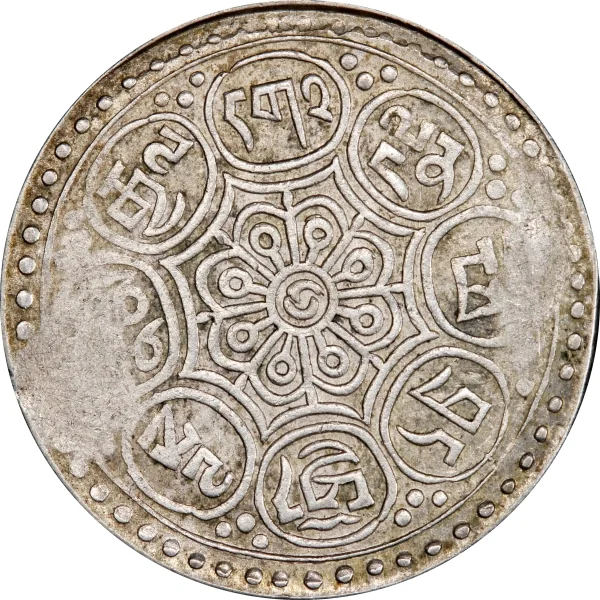
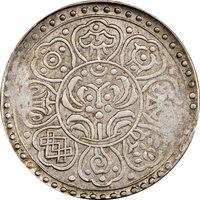
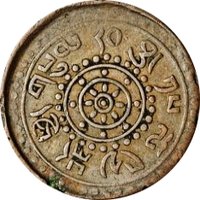
Obverse
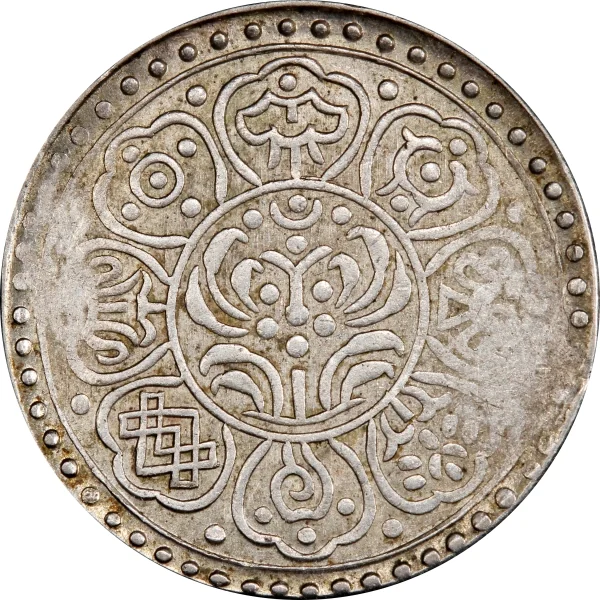
Reverse
Description:
Ornate lotus with the Eight Auspicious Symbols in its petals.
Edge
Plain
Mintings
| Year | Mint Mark | Mintage | Quality | Collection |
|---|---|---|---|---|
| 1912 | — | — |
Historical background
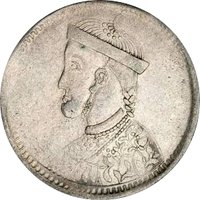
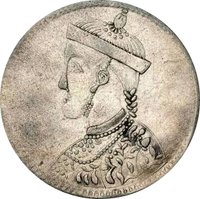
In 1912, Tibet's currency situation was a direct reflection of its turbulent political status following the collapse of the Qing Dynasty. The region was asserting de facto independence under the 13th Dalai Lama, who had returned from exile in India. This political shift created an urgent need for a sovereign monetary system to replace the Chinese silver tael and copper cash coins that had circulated under Qing authority. The Tibetan government sought to establish economic autonomy and legitimacy through the issuance of its own currency.
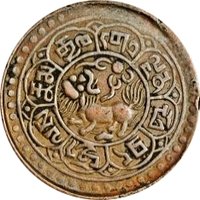
The primary currency introduced was the Tibetan silver tangka (or srang), struck at the Dode (or Drapchi) mint in Lhasa. These coins bore traditional Buddhist symbols—such as the "Eight Auspicious Symbols" and a snow lion—and the year "Tibetan Year 15" or "16" (corresponding to 1912-1913), pointedly omitting any reference to China. Alongside these, copper shokang coins were minted for smaller transactions. However, the system was challenged by a severe shortage of silver bullion, leading to the production of lower-quality, debased silver coins and even crude, emergency paper notes, which undermined public confidence.
Despite these efforts, the currency landscape remained complex and fragmented. Older Chinese coins, Indian rupees (especially near trade routes), and even Nepalese mohars continued to circulate alongside the new Tibetan issues. This monetary plurality highlighted Tibet's precarious position: while actively forging a separate identity, it remained embedded within regional trade networks and faced persistent economic pressures, including inflation and counterfeiting. The currency of 1912 thus stands as a tangible symbol of Tibet's brief and contested period of self-rule, caught between its imperial past and an uncertain future.
The primary currency introduced was the Tibetan silver tangka (or srang), struck at the Dode (or Drapchi) mint in Lhasa. These coins bore traditional Buddhist symbols—such as the "Eight Auspicious Symbols" and a snow lion—and the year "Tibetan Year 15" or "16" (corresponding to 1912-1913), pointedly omitting any reference to China. Alongside these, copper shokang coins were minted for smaller transactions. However, the system was challenged by a severe shortage of silver bullion, leading to the production of lower-quality, debased silver coins and even crude, emergency paper notes, which undermined public confidence.
Despite these efforts, the currency landscape remained complex and fragmented. Older Chinese coins, Indian rupees (especially near trade routes), and even Nepalese mohars continued to circulate alongside the new Tibetan issues. This monetary plurality highlighted Tibet's precarious position: while actively forging a separate identity, it remained embedded within regional trade networks and faced persistent economic pressures, including inflation and counterfeiting. The currency of 1912 thus stands as a tangible symbol of Tibet's brief and contested period of self-rule, caught between its imperial past and an uncertain future.
💎 Extremely Rare