

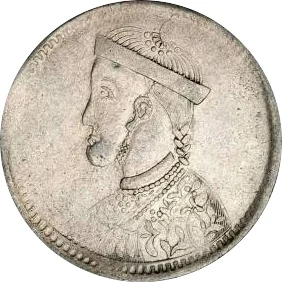
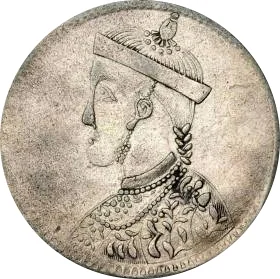

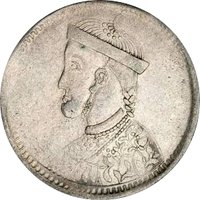
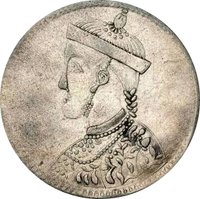
Obverse
Description:
Guangxu bust in cap and floral robe, facing left.
Reverse
Description:
Guangxu bust in cap and floral robe, facing left.
Edge
Reeded.
Mintings
| Year | Mint Mark | Mintage | Quality | Collection |
|---|---|---|---|---|
| — | — | — | BU |
Historical background
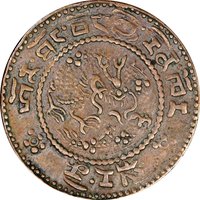
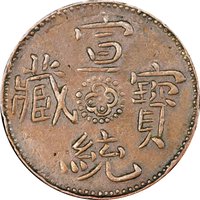
Following the collapse of the Qing Dynasty in 1911, Tibet entered a period of de facto political independence, which was immediately reflected in its chaotic and fragmented currency situation. The region was left with a legacy of multiple, competing currencies. The primary circulating medium was the Tibetan tangka silver coin, first minted in 1792 under Qing authority, but post-1911 these were produced locally in Lhasa without imperial insignia. Alongside these, Chinese silver yuan coins, Indian rupees, and even Nepalese mohars remained in circulation, creating a complex and unstable monetary environment.
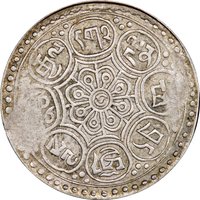
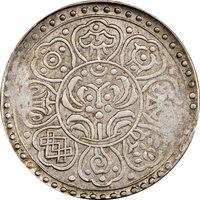
The 13th Dalai Lama’s government sought to assert economic sovereignty by establishing a new, centralized currency system. In 1912-1913, the Lhasa Mint began issuing new silver tangka coins, known as gaden tangka, featuring Buddhist symbols and the year of the "Iron Pig" (1911) in the Tibetan calendar, deliberately marking a break from the Qing era. However, these coins varied in silver purity and weight, and their production was insufficient to unify the monetary sphere. Crucially, the government lacked the bullion reserves to back a stable currency, leading to frequent debasement and public distrust.
Consequently, the Tibetan economy struggled with a severe lack of standardized currency, which hampered trade and government finance. The continued circulation of foreign coins, particularly Indian rupees in the southern border regions, underscored Tibet's economic vulnerability and the limitations of its fledgling statehood. This monetary disarray, characterized by competing metallic currencies and weak central control, mirrored the broader political uncertainties Tibet faced in the decade after the 1911 Revolution, caught between its historical autonomy and the emerging pressures of modern state-building.
The 13th Dalai Lama’s government sought to assert economic sovereignty by establishing a new, centralized currency system. In 1912-1913, the Lhasa Mint began issuing new silver tangka coins, known as gaden tangka, featuring Buddhist symbols and the year of the "Iron Pig" (1911) in the Tibetan calendar, deliberately marking a break from the Qing era. However, these coins varied in silver purity and weight, and their production was insufficient to unify the monetary sphere. Crucially, the government lacked the bullion reserves to back a stable currency, leading to frequent debasement and public distrust.
Consequently, the Tibetan economy struggled with a severe lack of standardized currency, which hampered trade and government finance. The continued circulation of foreign coins, particularly Indian rupees in the southern border regions, underscored Tibet's economic vulnerability and the limitations of its fledgling statehood. This monetary disarray, characterized by competing metallic currencies and weak central control, mirrored the broader political uncertainties Tibet faced in the decade after the 1911 Revolution, caught between its historical autonomy and the emerging pressures of modern state-building.
✨ Legendary