

5 Gulden – Free city of Danzig
Poland
Context
Years: 1923–1927
Country: Poland 
Issuer: Free city of Danzig
Period:
(1920—1939)
Currency:
(1923—1939)
Demonetization: 30 September 1939
Total mintage: 860,500
Material
References
KM: #Click to copy to clipboard147
Numista: #29706
Value
Bullion value: $53.04
Obverse
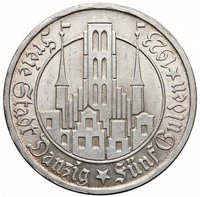
Description:
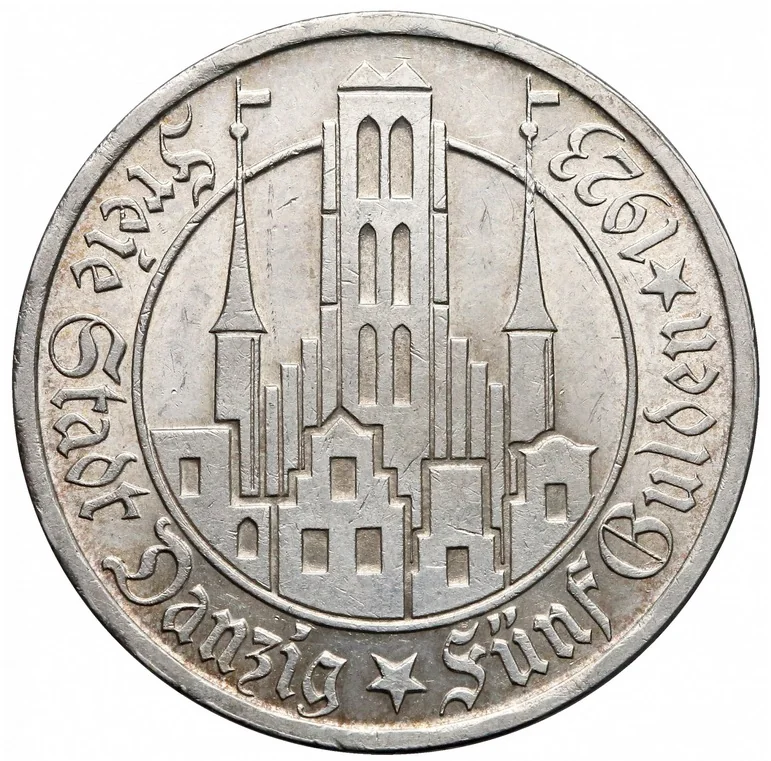
Basilica encircled by text.
Inscription:
FREIE STADT DANZIG * FÜNF GULDEN *
Translation:
FREE CITY OF DANZIG * FIVE GULDEN *
Script: Latin (Fraktur blackletter)
Language: German
Engraver: O. Fischer
Reverse
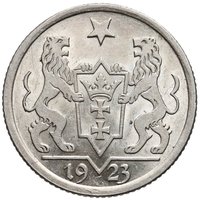
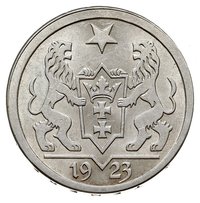
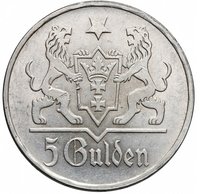
Description:
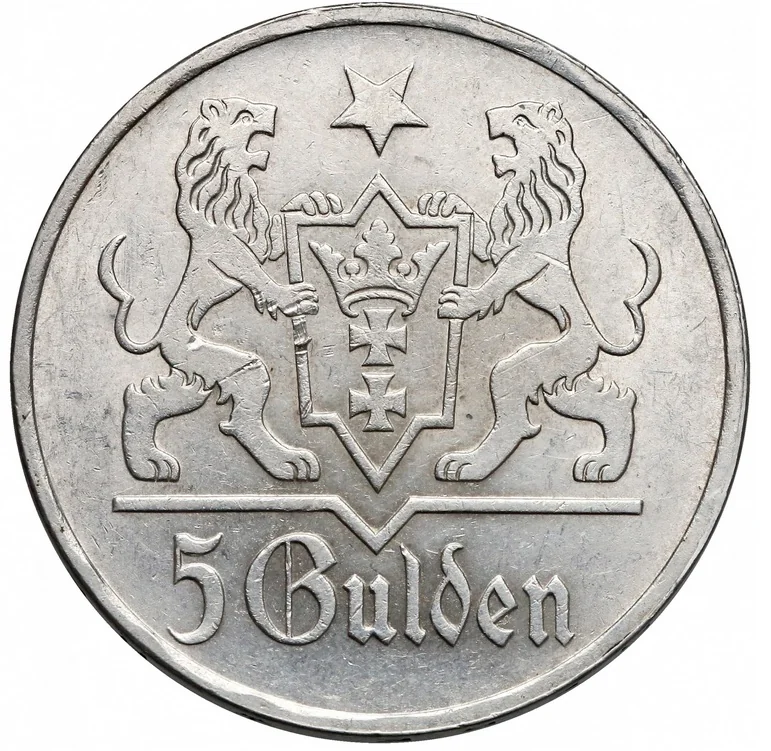
Arms with lion supporters, value beneath.
Inscription:
5 GULDEN
Script: Latin (Fraktur blackletter)
Engraver: O. Fischer
Edge
Smooth with inscription
Legend:
NEC * TEMERE * NEC * TIMIDE *
Translation:
Neither rashly nor timidly.
Language: Latin
Mintings
| Year | Mint Mark | Mintage | Quality | Collection |
|---|---|---|---|---|
| 1923 | — | 700,500 | ||
| 1923 | — | — | Proof | |
| 1927 | — | 160,000 | ||
| 1927 | — | — | Proof |
Historical background
In 1923, the Free City of Danzig, a semi-autonomous city-state under League of Nations protection, faced a severe currency crisis mirroring and exacerbated by the hyperinflation raging in neighboring Weimar Germany. Although Danzig had its own parliament and administration, its economy was deeply intertwined with Germany's. The official currency was the Danzig gulden (or florin), pegged to the British pound sterling and managed by the Bank of Danzig, established in 1924. However, prior to the bank's creation and the introduction of this stable currency, the German Papiermark circulated widely and was used for most everyday transactions, making Danzig acutely vulnerable to Germany's monetary collapse.
As the German mark plummeted in value throughout 1923, its catastrophic devaluation flooded into Danzig, destabilizing prices and wages and eroding savings. The local gulden, still in its early stages of establishment, struggled to assert itself as a reliable alternative while the German currency became virtually worthless. This period saw prices soaring within the city, causing immense social hardship and economic chaos for its residents, who watched their purchasing power evaporate almost overnight despite being under a separate political administration.
The crisis of 1923 directly precipitated a decisive monetary reform. In 1924, with the hyperinflation climaxing, the Danzig Senate, advised by British financial experts, moved to fully separate from the German currency zone. The Bank of Danzig was founded and introduced a new, stable Danzig gulden, which was firmly pegged at 25 gulden to 1 pound sterling. This successful reform, coupled with the simultaneous introduction of the Rentenmark and later Reichsmark in Germany, finally ended the hyperinflation in Danzig, allowing its economy to recover and establishing monetary sovereignty distinct from its powerful neighbor.
As the German mark plummeted in value throughout 1923, its catastrophic devaluation flooded into Danzig, destabilizing prices and wages and eroding savings. The local gulden, still in its early stages of establishment, struggled to assert itself as a reliable alternative while the German currency became virtually worthless. This period saw prices soaring within the city, causing immense social hardship and economic chaos for its residents, who watched their purchasing power evaporate almost overnight despite being under a separate political administration.
The crisis of 1923 directly precipitated a decisive monetary reform. In 1924, with the hyperinflation climaxing, the Danzig Senate, advised by British financial experts, moved to fully separate from the German currency zone. The Bank of Danzig was founded and introduced a new, stable Danzig gulden, which was firmly pegged at 25 gulden to 1 pound sterling. This successful reform, coupled with the simultaneous introduction of the Rentenmark and later Reichsmark in Germany, finally ended the hyperinflation in Danzig, allowing its economy to recover and establishing monetary sovereignty distinct from its powerful neighbor.
⭐ Somewhat Rare