

7 qian – Hunan Province
Add to wishlist
China
Context
Year: 1906
Country: China
Issuer: Hunan Province
Ruler: Guangxu
Currency:
(1906—1912)
Demonetized: Yes
Material
References
Numista: #296875
Value
Bullion value: $66.18
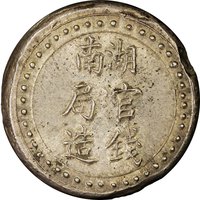
Obverse
Description:
Six Chinese characters.
Inscription:
南湖
局官
造錢
局官
造錢
Translation:
South Lake
Mint Official
Coinage
Mint Official
Coinage
Language: Chinese
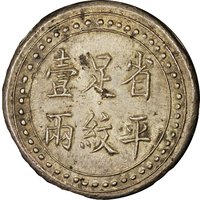
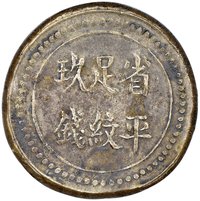
Reverse
Description:
Six Chinese characters.
Inscription:
柒足省
錢紋平
錢紋平
Translation:
Seven Zhu Provincial Coin,
Patterned and Standard.
Patterned and Standard.
Language: Classical Chinese
Edge
Plain
Mintings
| Year | Mint Mark | Mintage | Quality | Collection |
|---|---|---|---|---|
| 1906 | — | — |
Historical background
In 1906, Hunan Province, like much of late Qing China, operated within a complex and chaotic multi-currency system. The primary medium for large transactions and tax payments remained the silver tael (liang), but it existed not as a coin but as a weight of metal, with varying purity standards between different cities like Changsha and Xiangtan. For everyday commerce, the province relied on a flood of copper cash coins (wen), but their quality and value were highly unstable. Furthermore, a severe shortage of official minting led to widespread circulation of privately minted and often debased copper coins, as well as "foreign" copper coins from other provinces, causing confusion and eroding public trust in the monetary base.
This fragmented system was further strained by the increasing intrusion of foreign silver dollars, particularly the Mexican Eagle dollar, which circulated at a premium due to their standardized weight and purity. Simultaneously, modern Chinese banking was in its infancy. While native banks (qianzhuang) facilitated local exchange and provided credit, the first modern Chinese bank, the Bank of the Ministry of Revenue (Hubu Bank), had only just opened a branch in Changsha in 1906. Its banknotes, intended to create a uniform currency, faced deep public skepticism and competed with notes issued by foreign banks and even local merchants.
The monetary disarray in 1906 was more than a commercial inconvenience; it was a symptom of dynastic weakness and a direct burden on the population. Fluctuating exchange rates between silver and copper hurt peasants, who earned copper but often had to pay taxes in silver. This economic pressure, combined with growing anti-Qing sentiment, contributed to the fertile ground for unrest. Within a year, these tensions would erupt in local protests, and the currency chaos itself became a focal point of reformist and revolutionary critique against the Qing state's inability to provide economic stability.
This fragmented system was further strained by the increasing intrusion of foreign silver dollars, particularly the Mexican Eagle dollar, which circulated at a premium due to their standardized weight and purity. Simultaneously, modern Chinese banking was in its infancy. While native banks (qianzhuang) facilitated local exchange and provided credit, the first modern Chinese bank, the Bank of the Ministry of Revenue (Hubu Bank), had only just opened a branch in Changsha in 1906. Its banknotes, intended to create a uniform currency, faced deep public skepticism and competed with notes issued by foreign banks and even local merchants.
The monetary disarray in 1906 was more than a commercial inconvenience; it was a symptom of dynastic weakness and a direct burden on the population. Fluctuating exchange rates between silver and copper hurt peasants, who earned copper but often had to pay taxes in silver. This economic pressure, combined with growing anti-Qing sentiment, contributed to the fertile ground for unrest. Within a year, these tensions would erupt in local protests, and the currency chaos itself became a focal point of reformist and revolutionary critique against the Qing state's inability to provide economic stability.

✨ Legendary