

10 cash – Hunan Province
Add to wishlist
China
Context
Year: 1912
Country: China
Issuer: Hunan Province
Period:
(1912—1949)
Currency:
(1897—1949)
Demonetized: Yes
Material
References
Y: #
Numista: #296831
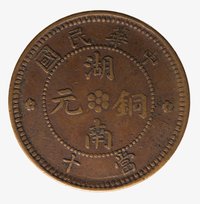
Obverse
Description:
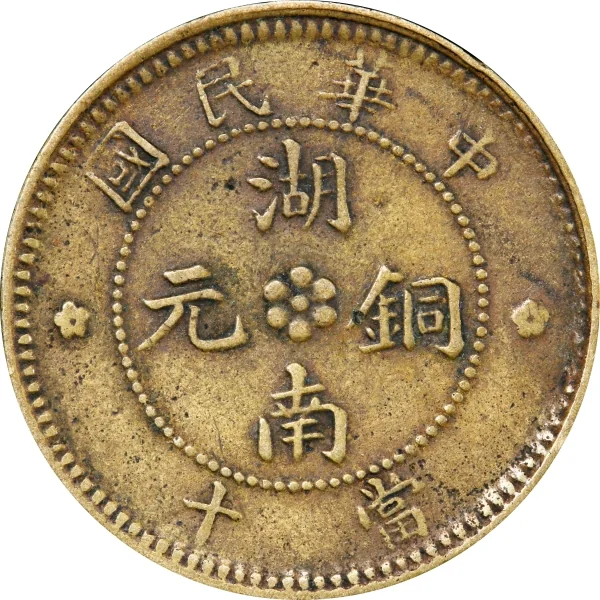
Four Chinese ideograms arranged vertically around a central flower, surrounded by additional characters.
Inscription:
國民華中
湖
元 銅
南
十當
湖
元 銅
南
十當
Translation:
CENTRAL CHINA
LAKE
TEN CASH COIN
SOUTH
LAKE
TEN CASH COIN
SOUTH
Language: Chinese
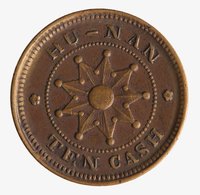
Reverse
Description:
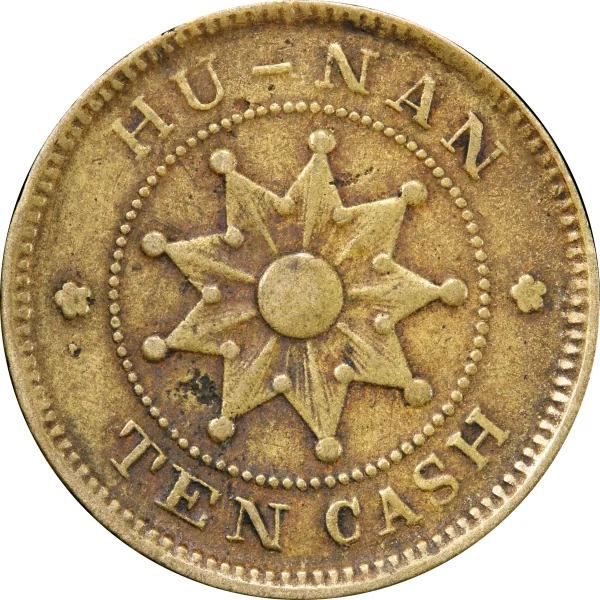
Nine-pointed star with English inscription.
Inscription:
HU-NAN
TEN CASH
TEN CASH
Edge
Plain
Mintings
| Year | Mint Mark | Mintage | Quality | Collection |
|---|---|---|---|---|
| 1912 | — | — |
Historical background
In 1912, Hunan Province, like much of China, was in a state of profound monetary disarray following the collapse of the Qing Dynasty and the declaration of the Republic. The traditional system, based on silver sycee (shoe-shaped ingots weighed in taels) and copper-alloy cash coins, had fragmented. Provincial mints, including the one in Changsha, operated with little central oversight, producing coins of inconsistent weight and purity. Crucially, a flood of debased copper "small cash" (xiaopingqian) and privately issued merchant scrip (qianpiao) circulated to fill the gap, leading to severe local inflation and eroding public trust in the monetary system.
The new Republican government in Nanjing, and later Beijing, aimed to impose unity by promulgating the "Yuan Dollar" (Yuan Dayang) as the national silver standard. However, Hunan's economy struggled to adapt. While some new Yuan coins were minted, they competed with a chaotic mix of old Qing dragon dollars, foreign silver (especially Mexican and British trade dollars), and the persistent tidal wave of private notes and inferior copper coins. The provincial authority, financially strained and politically unstable, lacked the power to recall or regulate this heterogeneous media of exchange, leaving commerce to rely on a cumbersome system of daily exchange rates between different forms of money.
This currency anarchy was both a symptom and a cause of Hunan's broader crisis. It hampered trade, complicated tax collection for the new government, and exacerbated social unrest. The instability provided fertile ground for local militarists to assert control, often by seizing mint revenues or issuing their own military scrip. Thus, in 1912, Hunan’s monetary landscape was not one of unified reform but a contested and transitional space, reflecting the province’s precarious position between a defunct imperial order and a not-yet-functional republican one.
The new Republican government in Nanjing, and later Beijing, aimed to impose unity by promulgating the "Yuan Dollar" (Yuan Dayang) as the national silver standard. However, Hunan's economy struggled to adapt. While some new Yuan coins were minted, they competed with a chaotic mix of old Qing dragon dollars, foreign silver (especially Mexican and British trade dollars), and the persistent tidal wave of private notes and inferior copper coins. The provincial authority, financially strained and politically unstable, lacked the power to recall or regulate this heterogeneous media of exchange, leaving commerce to rely on a cumbersome system of daily exchange rates between different forms of money.
This currency anarchy was both a symptom and a cause of Hunan's broader crisis. It hampered trade, complicated tax collection for the new government, and exacerbated social unrest. The instability provided fertile ground for local militarists to assert control, often by seizing mint revenues or issuing their own military scrip. Thus, in 1912, Hunan’s monetary landscape was not one of unified reform but a contested and transitional space, reflecting the province’s precarious position between a defunct imperial order and a not-yet-functional republican one.

✨ Legendary