

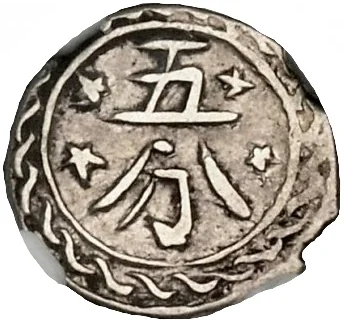
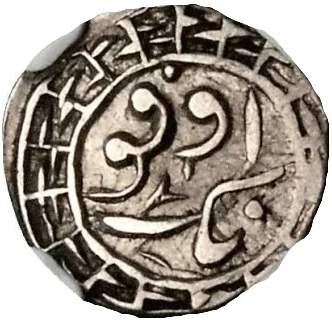
½ Miscal / 5 Fen – Sinkiang Province
China
Context
Year: 1896
Islamic (Hijri) Year: 1313
Country: China 
Issuer: Sinkiang Province
Ruler: Guangxu
Demonetized: Yes
Material
Diameter: 13 mm
Weight: 1.45 g
Silver weight: 1.45 g
Thickness: 1.4 mm
Shape: Irregular round
Composition: Silver
Magnetic: No
References
Y: #Click to copy to clipboardA7.8
Numista: #296703
Value
Bullion value: $4.12
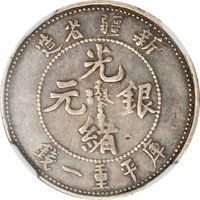
Obverse
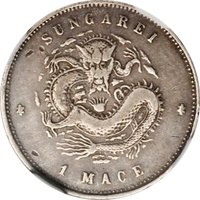
Reverse
Description:
Arabic myth.
Inscription:
ناك
قو
بش
قو
بش
Translation:
Victorious
and
Eternal
and
Eternal
Language: Ottoman Turkish
Edge
Plain
Mintings
| Year | Mint Mark | Mintage | Quality | Collection |
|---|---|---|---|---|
| 1896 | — | — | ||
| 1896 | — | — |
Historical background
In 1896, Sinkiang (Xinjiang) Province operated under a complex and unstable monetary system, a direct legacy of its position as a contested frontier region of the Qing Empire. The official currency was the Xinjiang red cash (Hongqian), a locally minted copper coin with a square hole. However, its value and metal content were inferior to the standard cash coins used in China proper, leading to a severe discount when exchanging between the regions. This system was further strained by chronic shortages of small-denomination coinage for daily trade, causing hardship for common people and merchants alike.
Alongside the debased red cash, the province's economy was saturated with a variety of foreign and unofficial currencies due to its role on the Silk Road. Russian rubles, particularly silver tsarist rubles and gold coins, circulated widely, especially in the north and in major trade centers like Ili (Ghulja). These were often preferred for larger transactions due to their reliable silver content. Additionally, silver sycees (ingots) from China proper and even Kashgari tangas (silver coins from the former Khanate of Khotan) persisted in southern oases, creating a fragmented monetary landscape where exchange rates fluctuated constantly.
This chaotic situation was a symptom of broader Qing administrative and fiscal weakness in its far western territory. The local Xinjiang government, under Governor Tao Mo at the time, had limited capacity to standardize currency or control inflation. The reliance on imported Russian silver also gave St. Petersburg significant economic influence, mirroring its growing political ambitions in the region. Consequently, the currency turmoil of 1896 reflected Xinjiang’s transitional and vulnerable position, caught between a declining imperial center and expanding foreign powers, with a local economy struggling to function under the weight of multiple, competing mediums of exchange.
Alongside the debased red cash, the province's economy was saturated with a variety of foreign and unofficial currencies due to its role on the Silk Road. Russian rubles, particularly silver tsarist rubles and gold coins, circulated widely, especially in the north and in major trade centers like Ili (Ghulja). These were often preferred for larger transactions due to their reliable silver content. Additionally, silver sycees (ingots) from China proper and even Kashgari tangas (silver coins from the former Khanate of Khotan) persisted in southern oases, creating a fragmented monetary landscape where exchange rates fluctuated constantly.
This chaotic situation was a symptom of broader Qing administrative and fiscal weakness in its far western territory. The local Xinjiang government, under Governor Tao Mo at the time, had limited capacity to standardize currency or control inflation. The reliance on imported Russian silver also gave St. Petersburg significant economic influence, mirroring its growing political ambitions in the region. Consequently, the currency turmoil of 1896 reflected Xinjiang’s transitional and vulnerable position, caught between a declining imperial center and expanding foreign powers, with a local economy struggling to function under the weight of multiple, competing mediums of exchange.
✨ Legendary