

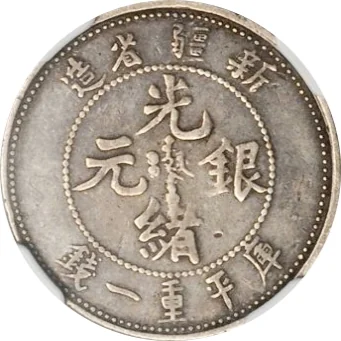
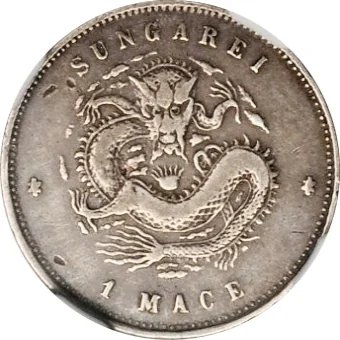

Obverse
Description:
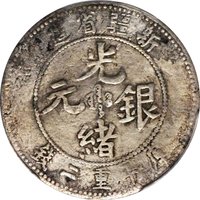
Chinese ideograms read vertically, right to left, with Manchu text in the center, all encircled by more Chinese characters.
Inscription:
造省疆新
光
ᠪᠠᡩᠠᡵᠠᠩᡤᠠ
元 ᠶᡠᠸᠠᠨ ᠪᠣᠣ 銀
ᡩᠣᡵᠣ
緒
錢一重平庫
光
ᠪᠠᡩᠠᡵᠠᠩᡤᠠ
元 ᠶᡠᠸᠠᠨ ᠪᠣᠣ 銀
ᡩᠣᡵᠣ
緒
錢一重平庫
Translation:
Made in Xinjiang
Guangxu
Badaranga
Yuan Yuanbao Silver
Doro
Reign
One Coin Weight, Pingku
Guangxu
Badaranga
Yuan Yuanbao Silver
Doro
Reign
One Coin Weight, Pingku
Scripts: Chinese, Mongolian / Manchu
Engraver: Otto Bleh
Reverse
Edge
Categories
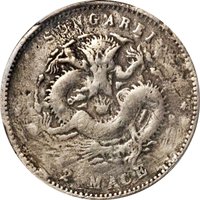
| Mythology> Fantastic animal |
Mintings
| Year | Mint Mark | Mintage | Quality | Collection |
|---|---|---|---|---|
| 1897 | — | — |
Historical background
In 1897, the currency situation in Sinkiang (Xinjiang) Province was complex and fragmented, reflecting the region's position as a crossroads of empires and a periphery of Qing control. The official currency was the Xinjiang pūl coin, a small, debased copper coin minted locally in Kashgar, Yarkand, and other centers. However, its value was unstable and hyperinflation was a persistent problem, driven by chronic over-minting by local authorities to cover fiscal shortfalls. This created a severe disconnect with the central Qing monetary system, as the pūl circulated at a wildly fluctuating discount against the standard cash (wén) coins of China proper.
Alongside this faltering official currency, a multitude of other mediums of exchange circulated freely, demonstrating the region's economic diversity. Russian Imperial rubles and gold tillas (from the Khanate of Khiva) were highly trusted, especially for larger transactions and foreign trade, due to their consistent silver and gold content. Chinese silver sycees (ingots) and Yarkand tangas (silver coins) were also used, alongside barter in goods like tea and livestock. This multi-currency environment placed merchants and peasants at the mercy of volatile exchange rates and the costs of currency conversion.
The root of this monetary chaos lay in Sinkiang's geographical isolation from Beijing, the weak integration of its economy with China proper, and the considerable autonomy exercised by local Qing officials and Muslim begs (administrators). The Qing state's broader financial difficulties following the Taiping Rebellion further limited its ability to impose a unified currency. Consequently, the 1897 monetary landscape was one of localized inflation, competing currencies, and economic vulnerability, underscoring the tenuous nature of Qing administrative and economic control in its far northwestern frontier.
Alongside this faltering official currency, a multitude of other mediums of exchange circulated freely, demonstrating the region's economic diversity. Russian Imperial rubles and gold tillas (from the Khanate of Khiva) were highly trusted, especially for larger transactions and foreign trade, due to their consistent silver and gold content. Chinese silver sycees (ingots) and Yarkand tangas (silver coins) were also used, alongside barter in goods like tea and livestock. This multi-currency environment placed merchants and peasants at the mercy of volatile exchange rates and the costs of currency conversion.
The root of this monetary chaos lay in Sinkiang's geographical isolation from Beijing, the weak integration of its economy with China proper, and the considerable autonomy exercised by local Qing officials and Muslim begs (administrators). The Qing state's broader financial difficulties following the Taiping Rebellion further limited its ability to impose a unified currency. Consequently, the 1897 monetary landscape was one of localized inflation, competing currencies, and economic vulnerability, underscoring the tenuous nature of Qing administrative and economic control in its far northwestern frontier.
✨ Legendary