

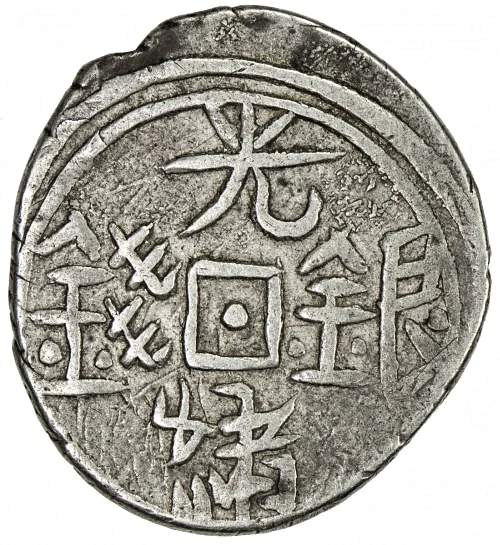
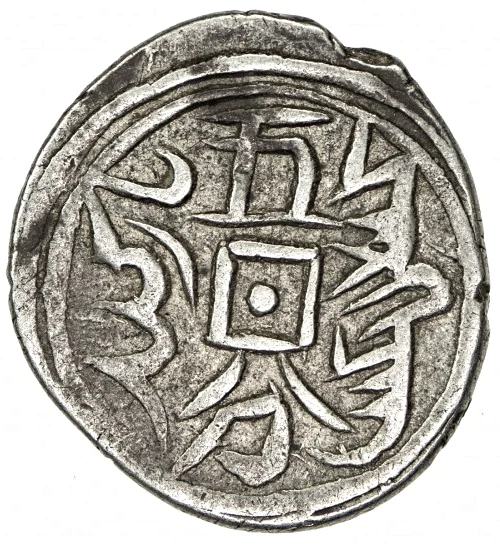
½ Miscal / 5 Fen – Sinkiang Province
China
Context

Material
Diameter: 13 mm
Weight: 1.3 g
Silver weight: 1.30 g
Thickness: 1.4 mm
Shape: Irregular round
Composition: Silver
Magnetic: No
References
Y: #Click to copy to clipboardA7.18
Numista: #296691
Value
Bullion value: $3.78
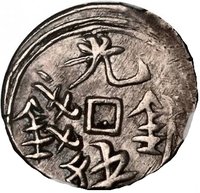
Obverse
Description:
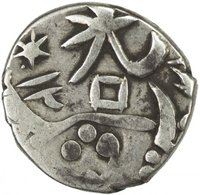
Four Chinese characters arranged around a central square, read top-down, right-left.
Inscription:
光
錢 銀
緒
錢 銀
緒
Translation:
Guangxu
Tongbao
Tongbao
Language: Chinese
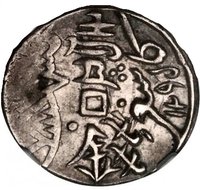
Reverse
Edge
Plain
Mintings
| Year | Mint Mark | Mintage | Quality | Collection |
|---|---|---|---|---|
| 1879 | — | — |
Historical background
In 1879, the currency situation in Sinkiang (Xinjiang) was chaotic and reflected the region's turbulent political state following the suppression of the Yakub Beg-led Dungan Revolt (1864-1877). The Qing dynasty, under the military leadership of Zuo Zongtang, had recently reconquered the territory, but its administrative and economic systems were in disarray. The monetary landscape was a fragmented patchwork of old Qing copper cash coins (wen), silver sycees (taels), and vast quantities of debased coins and paper notes issued by the defeated rebel regime, all circulating with wildly fluctuating values. This instability severely hampered trade and daily life, as trust in any form of money was low.
The primary currency problem stemmed from the legacy of Yakub Beg's rule. To finance his regime, he had minted large volumes of low-quality copper pul coins and issued paper currency (khān notes) with little backing, leading to severe inflation. After the Qing reconquest, these nearly worthless rebel currencies remained in circulation alongside older, genuine Qing coins from the pre-rebellion era, creating a multi-tiered and confusing system. Furthermore, the region's deep economic ties to Central Asia meant Russian silver rubles, Indian rupees, and local silver yambu bars also circulated, especially in major trade centers, adding another layer of complexity.
Recognizing that monetary control was essential for stable governance, the Qing authorities in 1879 were in the early stages of implementing a standardized currency system as part of Zuo Zongtang's broader reconstruction program. The initial focus was on reintroducing reliable, full-weight Qing copper cash coins from mint facilities in Gansu to gradually drive the debased rebel currency out of circulation. However, this process was slow and logistical, and a unified provincial system was still years away. Thus, in 1879, Sinkiang remained in a transitional period, grappling with the monetary detritus of war while the Qing state labored to reimpose a uniform standard, a critical step in reaffirming Beijing's political and economic sovereignty over the strategic frontier.
The primary currency problem stemmed from the legacy of Yakub Beg's rule. To finance his regime, he had minted large volumes of low-quality copper pul coins and issued paper currency (khān notes) with little backing, leading to severe inflation. After the Qing reconquest, these nearly worthless rebel currencies remained in circulation alongside older, genuine Qing coins from the pre-rebellion era, creating a multi-tiered and confusing system. Furthermore, the region's deep economic ties to Central Asia meant Russian silver rubles, Indian rupees, and local silver yambu bars also circulated, especially in major trade centers, adding another layer of complexity.
Recognizing that monetary control was essential for stable governance, the Qing authorities in 1879 were in the early stages of implementing a standardized currency system as part of Zuo Zongtang's broader reconstruction program. The initial focus was on reintroducing reliable, full-weight Qing copper cash coins from mint facilities in Gansu to gradually drive the debased rebel currency out of circulation. However, this process was slow and logistical, and a unified provincial system was still years away. Thus, in 1879, Sinkiang remained in a transitional period, grappling with the monetary detritus of war while the Qing state labored to reimpose a uniform standard, a critical step in reaffirming Beijing's political and economic sovereignty over the strategic frontier.
✨ Legendary