

½ New Sheqel – Israel
Non-circulating coins
Commemoration: Holyland Sites Series - Jaffa Harbor
Series: Sites in the Holy Land
Israel
Context
Year: 1990
Hebrew Year: 5750
Issuer: Israel 
Issuing organization: Israel Government Coins and medals Corp.
Period:
(since 1948)
Currency:
(since 1986)
Total mintage: 4,940
Material
Diameter: 23 mm
Weight: 7.2 g
Silver weight: 6.12 g
Shape: Dodecagonal
Composition: 85% Silver
Magnetic: No
Technique: Milled
Alignment: Medal alignment
flip
References
KM: #Click to copy to clipboard202
Numista: #13510
Value
Exchange value: ½ ILS = $0.16
Bullion value: $17.75
Inflation-adjusted value: 2.22 ILS
Obverse
Description:
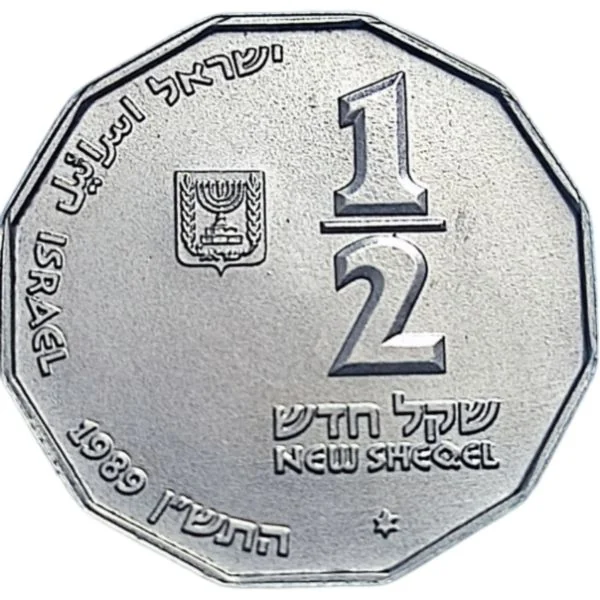
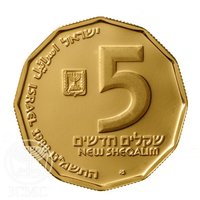
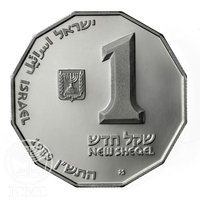
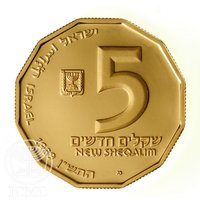
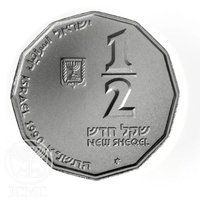
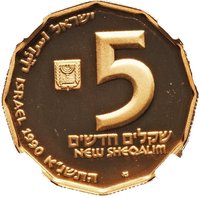
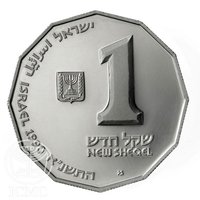
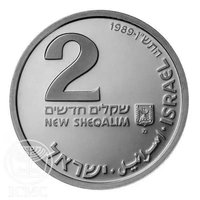
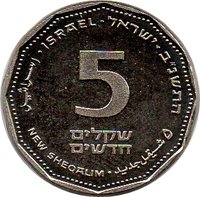
Face value in Hebrew and English: ½, 1, or 5 New Sheqalim (depending on coin). Features the State Emblem, "ISRAEL" in three languages, and the mint year 1989/5750.
Inscription:
ישראל اسرائيل ISRAEL
התש"ן 1989
1/2
שקל חדש
NEW SHEQEL
✡
התש"ן 1989
1/2
שקל חדש
NEW SHEQEL
✡
Translation:
Israel Israel ISRAEL
The 5749 1989
1/2
New Sheqel
NEW SHEQEL
✡
The 5749 1989
1/2
New Sheqel
NEW SHEQEL
✡
Engravers: Gideon Keich, Tidhar Dagan
Reverse
Description:
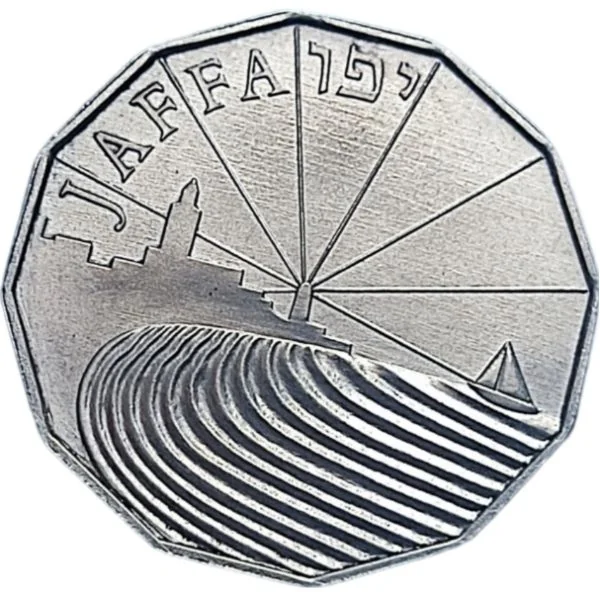
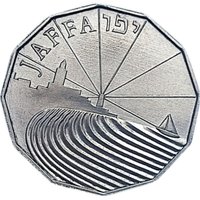
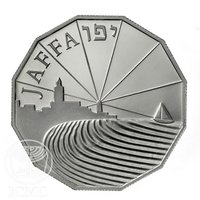
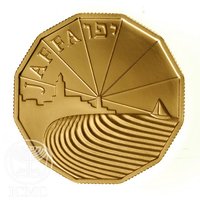
Jaffa's port silhouette from the sea, featuring the lighthouse, a sailboat, and houses. "JAFFA" in Hebrew and English above.
Inscription:
JAFFA יפו
Translation:
JAFFA Jaffa
Engravers: Ehud Shafrir, Tidhar Dagan
Edge
Mints
| Name | Mark |
|---|---|
| Staatliche Münze Baden-Württemberg | — |
Mintings
| Year | Mint Mark | Mintage | Quality | Collection |
|---|---|---|---|---|
| 1990 | — | 4,940 |
Historical background
In 1990, Israel's currency situation was characterized by the ongoing struggle to stabilize the shekel and control rampant inflation, a legacy of the economic crises of the 1980s. The New Israeli Shekel (NIS), introduced in 1985 as part of a comprehensive stabilization plan, had replaced the hyper-inflated old shekel. While the drastic reforms of 1985 had successfully curbed triple-digit inflation, by 1990 inflationary pressures were resurging, with the annual rate climbing to around 20%. This period was one of managed floating, where the Bank of Israel actively intervened in foreign exchange markets to guide the shekel's value, primarily against a basket of currencies rather than just the US dollar, aiming to maintain export competitiveness.
The economic context was heavily influenced by a major demographic shock: the mass immigration of over one million Jews from the former Soviet Union between 1989 and 1991. This influx, while promising long-term growth, placed immense short-term strain on the economy, requiring vast government expenditure on housing, infrastructure, and absorption services. To finance this, the government increased borrowing and monetary expansion, which exerted downward pressure on the shekel and fueled inflation. Consequently, the Bank of Israel was forced to maintain high interest rates throughout the period in a difficult balancing act—trying to support economic absorption while defending the currency and restraining price rises.
Overall, 1990 represented a transitional and challenging year for Israeli currency policy. The shekel was not in free fall as it had been in the early 1980s, but it faced persistent devaluation pressures. Policymakers were caught between the imperative to support a booming population and the need to maintain the hard-won stability of the late 1980s. This tension set the stage for the continued focus on inflation targeting and liberalization of capital controls that would more fully define Israeli monetary policy in the years to follow.
The economic context was heavily influenced by a major demographic shock: the mass immigration of over one million Jews from the former Soviet Union between 1989 and 1991. This influx, while promising long-term growth, placed immense short-term strain on the economy, requiring vast government expenditure on housing, infrastructure, and absorption services. To finance this, the government increased borrowing and monetary expansion, which exerted downward pressure on the shekel and fueled inflation. Consequently, the Bank of Israel was forced to maintain high interest rates throughout the period in a difficult balancing act—trying to support economic absorption while defending the currency and restraining price rises.
Overall, 1990 represented a transitional and challenging year for Israeli currency policy. The shekel was not in free fall as it had been in the early 1980s, but it faced persistent devaluation pressures. Policymakers were caught between the imperative to support a booming population and the need to maintain the hard-won stability of the late 1980s. This tension set the stage for the continued focus on inflation targeting and liberalization of capital controls that would more fully define Israeli monetary policy in the years to follow.
Series: Sites in the Holy Land
💎 Very Rare