

10000 Pesetas – Spain
Non-circulating coins
Commemoration: Discoverers and Explorers
Spain
Context
Year: 1991
Issuer: Spain 
Ruler: Juan Carlos I
Currency:
(1868—2001)
Demonetization: 28 February 2002
Total mintage: 17,024
Material

References
KM: #Click to copy to clipboard896
Numista: #102206
Value
Exchange value: 10000 ESP
Bullion value: $439.36
Inflation-adjusted value: 25640.40 ESP
Obverse
Description:
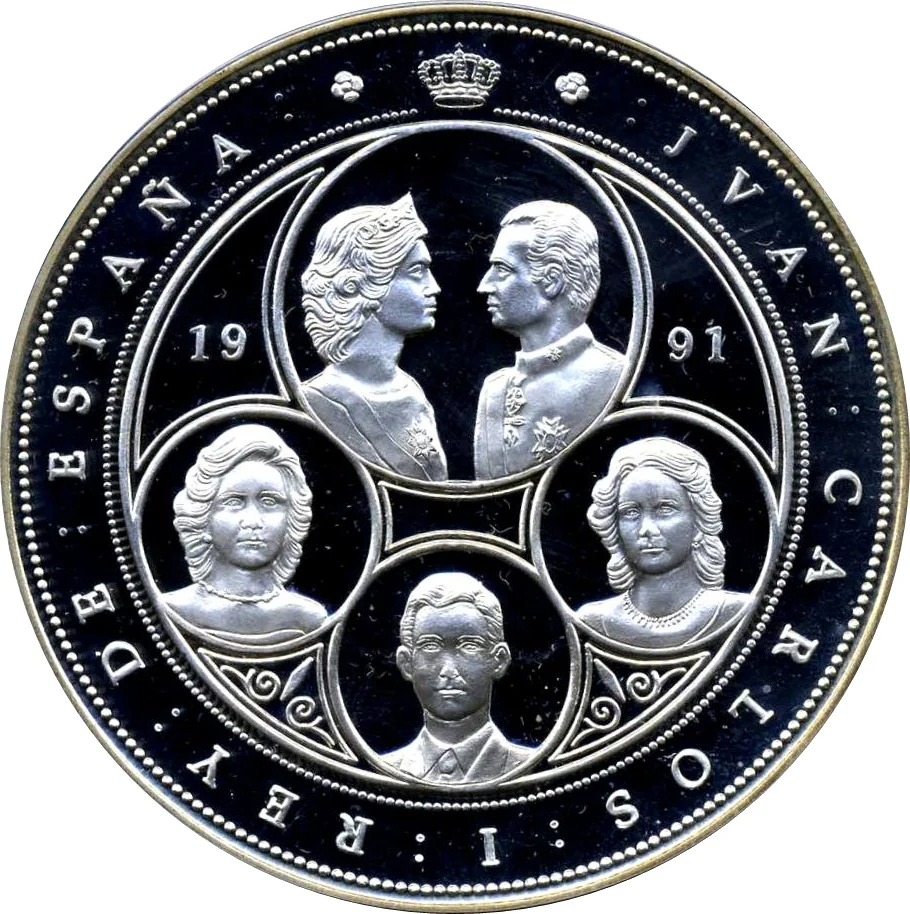
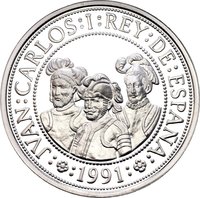
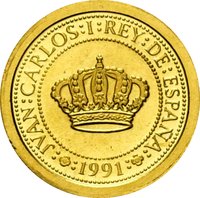
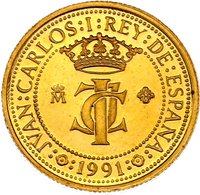
Royal Crown above circular portraits of the royal family.
Inscription:
🏵: JVAN : CARLOS : I REY : DE : ESPAÑA :🏵
19 91
19 91
Translation:
JUAN CARLOS I KING OF SPAIN 1991
Script: Latin
Language: Spanish
Engraver: Manuel Martinez Tornero
Reverse
Description:
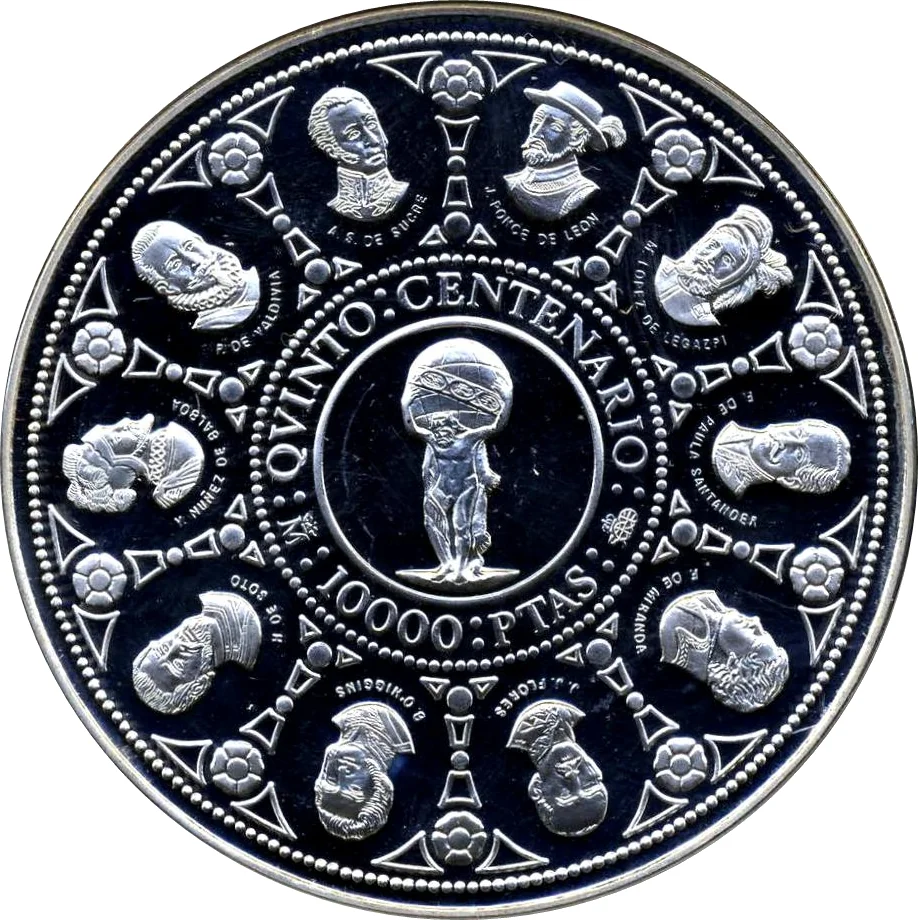
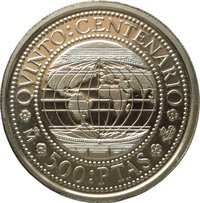
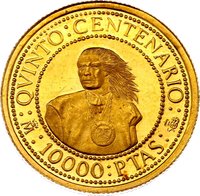
Atlas holding the world, encircled by ten busts of Spanish explorers.
Inscription:
: QVINTO : CENTENARIO :
M : 10000 : PTAS : 500
J. PONCE DE LEON
M. LOPEZ DE LEGAZPI
F. DE PAULA SANTAHOER
F. DE MIRANDA
J. J. FLORES
B. O'HIGGINS
H. DE SOTO
V. NUNEZ DE BALBOA
P. DE VALDIVIA
A. S. DE SUCRE
M : 10000 : PTAS : 500
J. PONCE DE LEON
M. LOPEZ DE LEGAZPI
F. DE PAULA SANTAHOER
F. DE MIRANDA
J. J. FLORES
B. O'HIGGINS
H. DE SOTO
V. NUNEZ DE BALBOA
P. DE VALDIVIA
A. S. DE SUCRE
Translation:
QUINTO: CENTENARIO:
M: 10000: PTAS: 500
J. PONCE DE LEON
M. LOPEZ DE LEGAZPI
F. DE PAULA SANTAHOER
F. DE MIRANDA
J. J. FLORES
B. O'HIGGINS
H. DE SOTO
V. NUNEZ DE BALBOA
P. DE VALDIVIA
A. S. DE SUCRE
M: 10000: PTAS: 500
J. PONCE DE LEON
M. LOPEZ DE LEGAZPI
F. DE PAULA SANTAHOER
F. DE MIRANDA
J. J. FLORES
B. O'HIGGINS
H. DE SOTO
V. NUNEZ DE BALBOA
P. DE VALDIVIA
A. S. DE SUCRE
Script: Latin
Engraver: Luis José Díaz Salas
Edge
Plain
Mints
| Name | Mark |
|---|---|
| Royal Mint of Madrid | (M) |
Mintings
| Year | Mint Mark | Mintage | Quality | Collection |
|---|---|---|---|---|
| 1991 | M | 17,024 | Proof |
Historical background
In 1991, Spain's currency situation was defined by its pivotal role within the European Monetary System (EMS) and its determined march toward European economic integration. The peseta was a member of the EMS Exchange Rate Mechanism (ERM), which required it to fluctuate within agreed bands against other European currencies, most importantly the Deutsche Mark. This membership was a cornerstone of Spain's economic policy, intended to import anti-inflationary credibility from the Bundesbank and signal the country's commitment to becoming a core European state following its accession to the European Community in 1986.
However, maintaining this fixed parity was challenging. Spain was grappling with higher inflation and interest rates than its northern European partners, particularly Germany, which was raising rates to manage the costs of reunification. This policy divergence created sustained pressure on the peseta, as investors were attracted to higher yields in Germany. Consequently, the Banco de España was forced to intervene frequently in foreign exchange markets and maintain high domestic interest rates to defend the peseta's ERM band, a strategy that came at the cost of dampening economic growth and exacerbating unemployment.
The tensions of 1991 set the stage for the severe currency crises that would follow in 1992 and 1993. While the peseta held its ERM parity that year, the underlying imbalances made it a prime target for speculative attacks. The background of 1991 is therefore one of a currency under growing strain, caught between the disciplined requirements of European convergence and domestic economic realities, ultimately leading to the inevitable devaluations that would occur in the subsequent years.
However, maintaining this fixed parity was challenging. Spain was grappling with higher inflation and interest rates than its northern European partners, particularly Germany, which was raising rates to manage the costs of reunification. This policy divergence created sustained pressure on the peseta, as investors were attracted to higher yields in Germany. Consequently, the Banco de España was forced to intervene frequently in foreign exchange markets and maintain high domestic interest rates to defend the peseta's ERM band, a strategy that came at the cost of dampening economic growth and exacerbating unemployment.
The tensions of 1991 set the stage for the severe currency crises that would follow in 1992 and 1993. While the peseta held its ERM parity that year, the underlying imbalances made it a prime target for speculative attacks. The background of 1991 is therefore one of a currency under growing strain, caught between the disciplined requirements of European convergence and domestic economic realities, ultimately leading to the inevitable devaluations that would occur in the subsequent years.
💎 Extremely Rare