


200 dollars – Australia
Add to wishlist
Australia
Context
Material

References
Numista: #295961
Value
Exchange value: 200 AUD
Bullion value: $9551.24
Inflation-adjusted value: 412.73 AUD
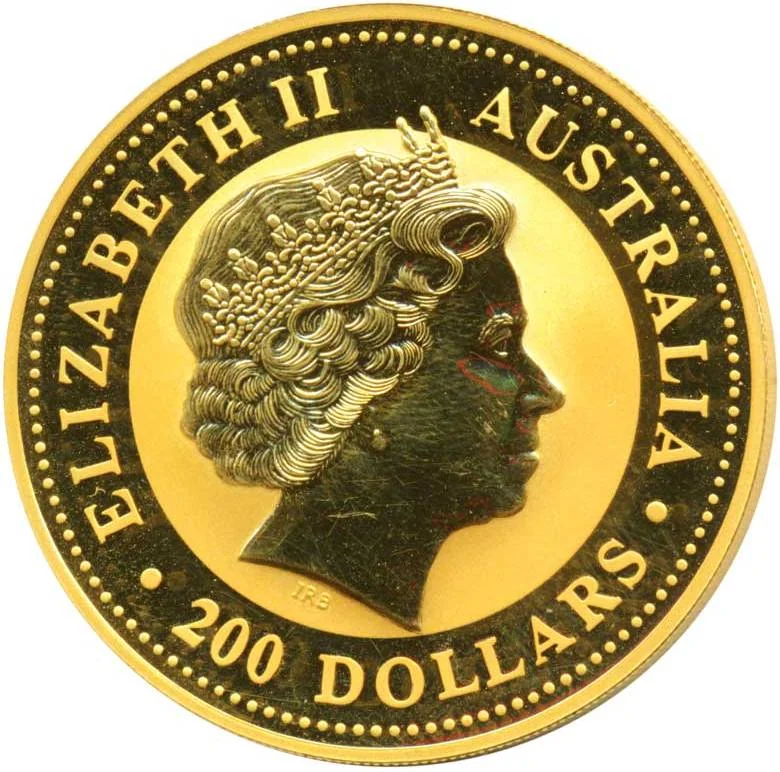
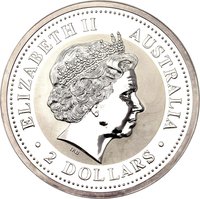
Obverse
Description:
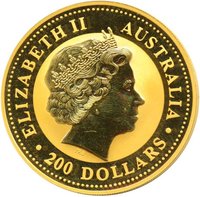
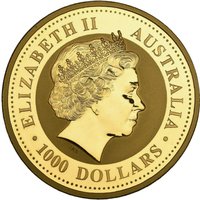
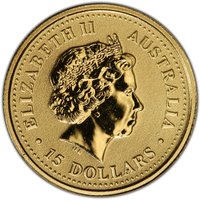
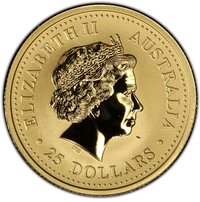
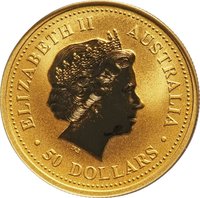
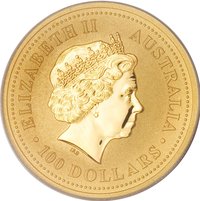
Queen Elizabeth IV, facing right, wearing the Girls of Great Britain and Ireland Tiara.
Inscription:
ELIZABETH II
AUSTRALIA
200 DOLLARS
IRB
AUSTRALIA
200 DOLLARS
IRB
Script: Latin
Designer: Ian Rank-Broadley
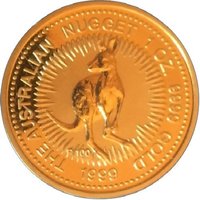
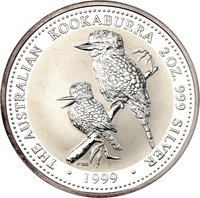
Reverse
Description:
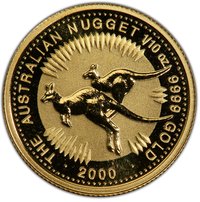
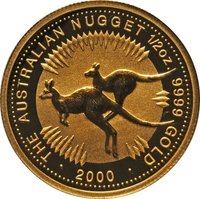
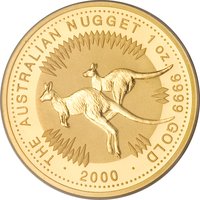
Red Kangaroo leaping left.
Inscription:
THE AUSTRALIAN NUGGET 2 OZ. 9999 GOLD
2008
RED KANGAROO
2008
RED KANGAROO
Script: Latin
Designer: Stuart Devlin
Edge
Reeded
Mints
| Name | Mark |
|---|---|
| Perth Mint | — |
Mintings
| Year | Mint Mark | Mintage | Quality | Collection |
|---|---|---|---|---|
| 1999 | — | 3,947 | BU | |
| 2000 | — | 2,023 | BU | |
| 2001 | — | 1,981 | BU | |
| 2002 | — | 1,633 | BU | |
| 2003 | — | 2,072 | BU | |
| 2004 | — | 1,766 | BU | |
| 2005 | — | 2,208 | BU | |
| 2006 | — | 2,760 | BU | |
| 2007 | — | 2,398 | BU | |
| 2008 | — | 3,671 | BU | |
| 2009 | — | 3,452 | BU |
Historical background
In 1999, Australia was in the final stages of a significant monetary transition, preparing to introduce a new series of banknotes. This was the second major change in a decade, following the 1996 release of the first polymer series. The 1999 issue, known as the "New Note Series," was not a currency reform but a technological and security upgrade. It featured the same denominations and key design elements as the 1996 series but incorporated enhanced, state-of-the-art security features to stay ahead of counterfeiting threats. This period underscored the Reserve Bank of Australia's (RBA) commitment to maintaining public confidence in the currency through innovation, solidifying Australia's global leadership in secure polymer banknote technology.
Economically, the Australian dollar (AUD) in 1999 was navigating a volatile global landscape, recovering from the aftershocks of the 1997-98 Asian Financial Crisis. The currency had depreciated significantly during the crisis, falling to historic lows near 55 US cents in 1998. By 1999, it was beginning a gradual recovery, buoyed by improving regional conditions and strong commodity exports. Domestically, the economy was stable under an inflation-targeting framework adopted by the RBA in the early 1990s, which provided a solid foundation for the currency's value. However, the AUD remained sensitive to shifts in global risk sentiment and commodity prices, establishing the pattern of a "commodity currency" that characterizes its modern behaviour.
This year also marked a pivotal moment in Australia's monetary history as the nation actively prepared for the upcoming introduction of the Goods and Services Tax (GST) in July 2000. While not a direct change to the currency, the GST's implementation had broad economic implications that influenced monetary policy and public perception of price stability. The RBA was attentive to potential inflationary effects, ensuring its policies would maintain the purchasing power of the dollar. Thus, the currency situation in 1999 was one of proactive stability—securing the physical notes against forgery, managing the dollar's recovery in foreign exchange markets, and calibrating policy for a major fiscal reform—all to ensure a robust monetary system for the new century.
Economically, the Australian dollar (AUD) in 1999 was navigating a volatile global landscape, recovering from the aftershocks of the 1997-98 Asian Financial Crisis. The currency had depreciated significantly during the crisis, falling to historic lows near 55 US cents in 1998. By 1999, it was beginning a gradual recovery, buoyed by improving regional conditions and strong commodity exports. Domestically, the economy was stable under an inflation-targeting framework adopted by the RBA in the early 1990s, which provided a solid foundation for the currency's value. However, the AUD remained sensitive to shifts in global risk sentiment and commodity prices, establishing the pattern of a "commodity currency" that characterizes its modern behaviour.
This year also marked a pivotal moment in Australia's monetary history as the nation actively prepared for the upcoming introduction of the Goods and Services Tax (GST) in July 2000. While not a direct change to the currency, the GST's implementation had broad economic implications that influenced monetary policy and public perception of price stability. The RBA was attentive to potential inflationary effects, ensuring its policies would maintain the purchasing power of the dollar. Thus, the currency situation in 1999 was one of proactive stability—securing the physical notes against forgery, managing the dollar's recovery in foreign exchange markets, and calibrating policy for a major fiscal reform—all to ensure a robust monetary system for the new century.
Series: Australian Nugget



✨ Legendary