

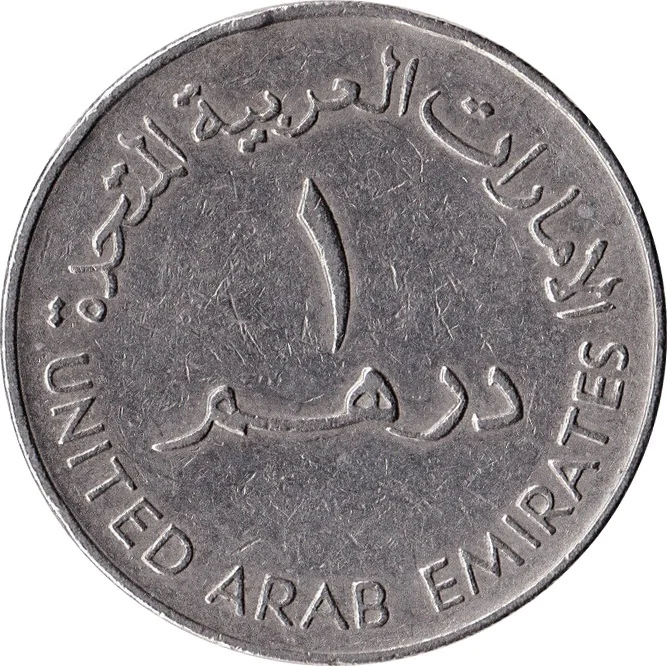
1 Dirham – United Arab Emirates
United Arab Emirates
Context
Years: 1973–1989
Issuer: United Arab Emirates 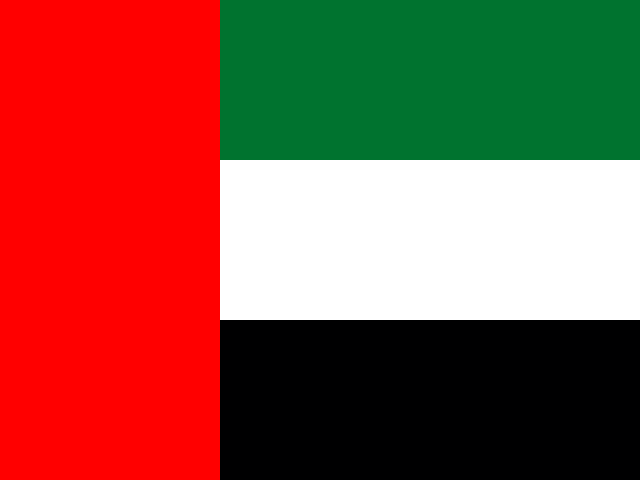
Ruler: Zayed bin Sultan Al Nahyan
Currency:
(since 1973)
Total mintage: 13,000,000
Material
Diameter: 28.5 mm
Weight: 11.3 g
Thickness: 2.3 mm
Shape: Round
Composition: Copper-nickel
Technique: Milled
Alignment: Medal alignment
flip
References
KM: #Click to copy to clipboard6.1
Numista: #2958
Value
Exchange value: 1 AED
Obverse
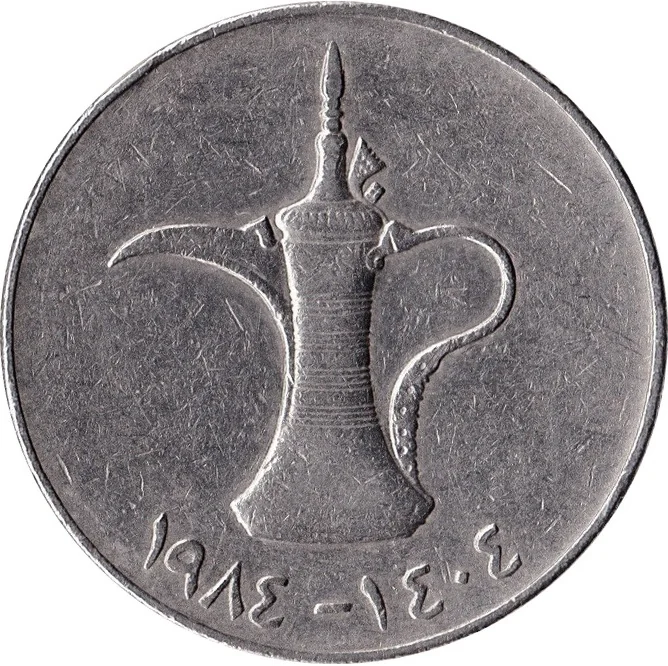
Reverse
Description:
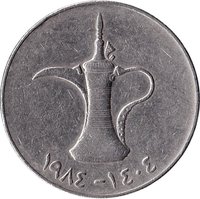
Dallah (traditional Arabic coffee pot) from the above dates.
Inscription:
١٤٠٤-١٩٨٤
Translation:
1404-1984
Script: Arabic
Language: Arabic
Engraver: Geoffrey Colley
Edge
Reeded
Categories
| Object> Container or tableware |
Mints
| Name | Mark |
|---|---|
| Royal Canadian Mint of Winnipeg | — |
| Royal Mint | — |
Mintings
| Year | Mint Mark | Mintage | Quality | Collection |
|---|---|---|---|---|
| 1973 | — | 13,000,000 | ||
| 1982 | — | — | ||
| 1984 | — | — | ||
| 1986 | — | — | ||
| 1987 | — | — | ||
| 1988 | — | — | ||
| 1988 | — | — | Proof | |
| 1989 | — | — | Proof | |
| 1989 | — | — |
Historical background
In 1973, the United Arab Emirates was navigating the complex monetary landscape of its early federal existence. The fledgling nation, formed just two years prior in 1971, had inherited a patchwork of currencies. The Gulf Rupee, issued by the Government of India and once dominant, had been largely replaced by the Saudi Riyal in some emirates and the Qatar and Dubai Riyal in others following India's devaluation of its currency in 1966. This lack of a unified national currency reflected both the recent union of the seven emirates and the region's historical economic ties to neighboring states and the Indian subcontinent.
The discovery and export of oil, particularly from Abu Dhabi, was rapidly transforming the economy, creating an urgent need for a stable and sovereign monetary system. The existing arrangement was seen as impractical for a nation asserting its economic independence and planning for massive development. Consequently, 1973 was a pivotal year of transition. The UAE Currency Board was established, and on May 19th, the UAE Dirham (AED) was introduced, replacing the Qatar and Dubai Riyal at par and the Bahraini Dinar (used in Abu Dhabi) at a rate of 10 dirhams to 1 dinar.
Thus, by the end of 1973, the UAE had successfully launched its own currency, a critical step in cementing federal unity and asserting financial sovereignty. The new dirham, initially pegged to the International Monetary Fund's Special Drawing Right (SDR), provided the stable foundation required to manage burgeoning oil revenues and finance the nation's ambitious modernization. This move marked the end of the fragmented currency era and laid the cornerstone for the UAE's modern financial system.
The discovery and export of oil, particularly from Abu Dhabi, was rapidly transforming the economy, creating an urgent need for a stable and sovereign monetary system. The existing arrangement was seen as impractical for a nation asserting its economic independence and planning for massive development. Consequently, 1973 was a pivotal year of transition. The UAE Currency Board was established, and on May 19th, the UAE Dirham (AED) was introduced, replacing the Qatar and Dubai Riyal at par and the Bahraini Dinar (used in Abu Dhabi) at a rate of 10 dirhams to 1 dinar.
Thus, by the end of 1973, the UAE had successfully launched its own currency, a critical step in cementing federal unity and asserting financial sovereignty. The new dirham, initially pegged to the International Monetary Fund's Special Drawing Right (SDR), provided the stable foundation required to manage burgeoning oil revenues and finance the nation's ambitious modernization. This move marked the end of the fragmented currency era and laid the cornerstone for the UAE's modern financial system.
🌱 Very Common