

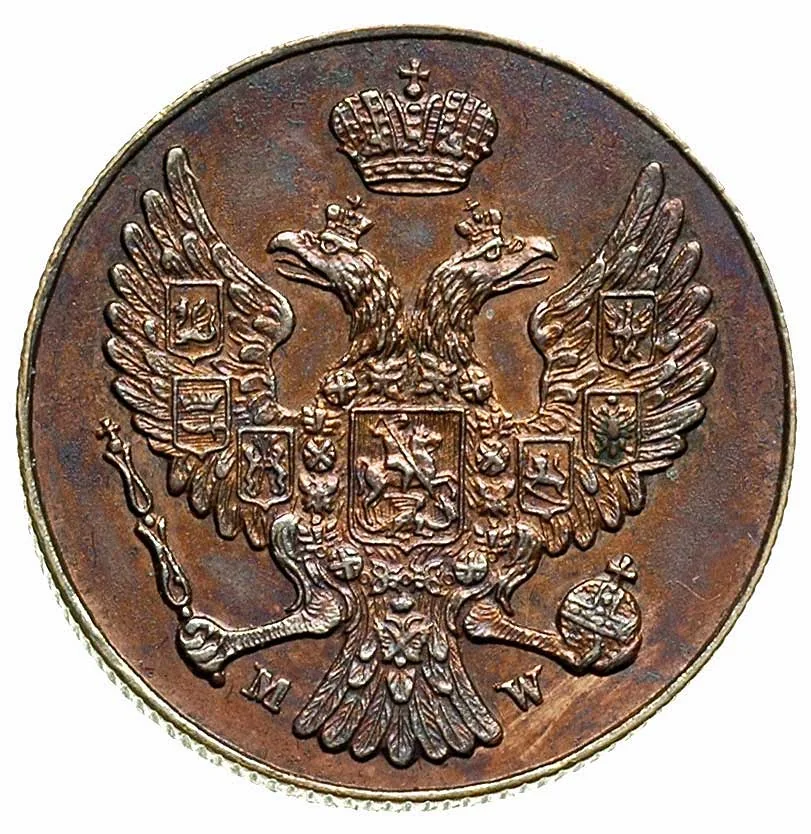
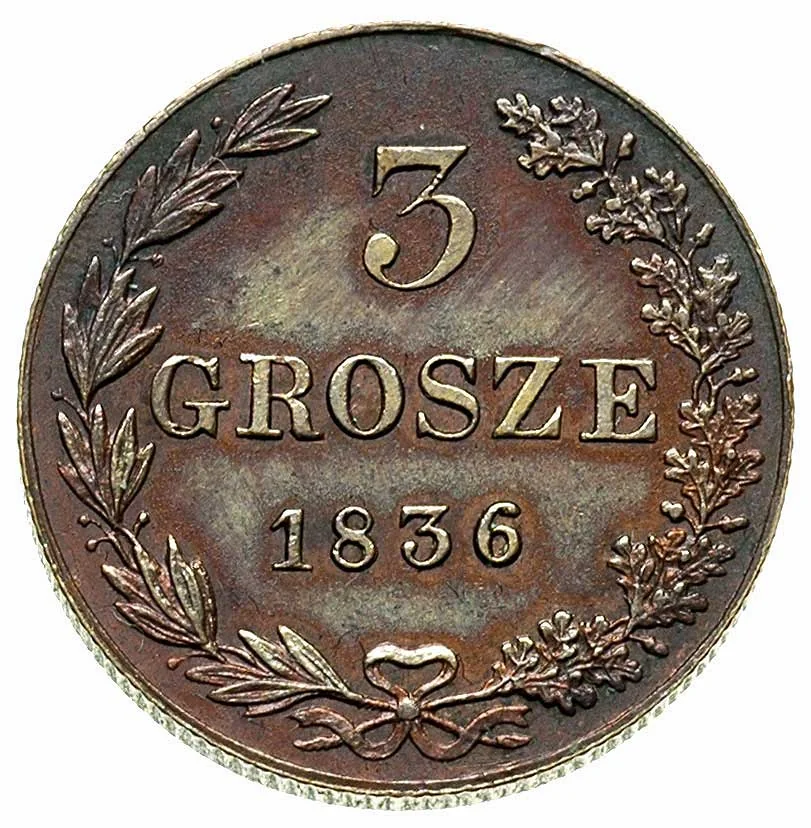
3 grosze – Congress Kingdom of Poland
Add to wishlist
Poland
Context
Years: 1835–1841
Country: Poland
Issuer: Congress Kingdom of Poland
Ruler: Nicholas I
Currency:
(1815—1841)
Demonetized: Yes
Total mintage: 1,808,700
Material
References
Numista: #29561
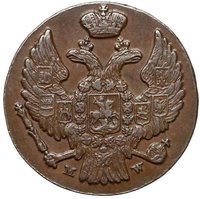
Obverse
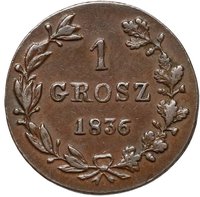
Reverse
Edge
Reeded
Mintings
| Year | Mint Mark | Mintage | Quality | Collection |
|---|---|---|---|---|
| 1835 | MW | 184,846 | ||
| 1836 | MW | 243,815 | ||
| 1837 | MW | 398,173 | ||
| 1838 | MW | 288,292 | ||
| 1839 | MW | 333,368 | ||
| 1840 | MW | 117,815 | ||
| 1840 | WW | — | ||
| 1841 | MW | 242,391 |
Historical background
By 1835, the currency situation in the Congress Kingdom of Poland was one of enforced integration and monetary stability under Russian imperial control, but it was also a symbol of lost autonomy. Following the November Uprising of 1830-1831, Tsar Nicholas I abolished the Kingdom's constitution and army, and this political subjugation extended directly to finance. The autonomous National Bank of Poland, established in 1828, was stripped of its independence and renamed the Bank of Poland, coming under the direct management of the Russian Ministry of Finance. Its role was reduced to that of a regional branch of the Russian financial system.
The currency in circulation remained the Polish złoty, a legacy of the Kingdom's earlier period, but its value was now irrevocably pegged to the Russian silver ruble at a fixed rate of 1 ruble = 6⅔ złoty. This peg created a stable exchange within the Russian Empire, facilitating trade and administrative integration. However, this stability was imposed from above and served Russian interests, ensuring the Kingdom's economy was seamlessly tied to the larger imperial market and treasury, with monetary policy dictated entirely from Saint Petersburg.
Consequently, while the physical Polish banknotes and coins continued to be used in daily life, they had ceased to be a symbol of sovereign economic policy. The monetary system functioned efficiently on a technical level, but it reflected the Kingdom's new political reality: it was a provincial currency within the Russian Empire. The period after 1831 saw the gradual erosion of the Kingdom's separate institutions, and its managed currency was a key component in binding its economy to Russia, a process that would continue until the complete abolition of the Kingdom's monetary distinctiveness following the January Uprising of 1863.
The currency in circulation remained the Polish złoty, a legacy of the Kingdom's earlier period, but its value was now irrevocably pegged to the Russian silver ruble at a fixed rate of 1 ruble = 6⅔ złoty. This peg created a stable exchange within the Russian Empire, facilitating trade and administrative integration. However, this stability was imposed from above and served Russian interests, ensuring the Kingdom's economy was seamlessly tied to the larger imperial market and treasury, with monetary policy dictated entirely from Saint Petersburg.
Consequently, while the physical Polish banknotes and coins continued to be used in daily life, they had ceased to be a symbol of sovereign economic policy. The monetary system functioned efficiently on a technical level, but it reflected the Kingdom's new political reality: it was a provincial currency within the Russian Empire. The period after 1831 saw the gradual erosion of the Kingdom's separate institutions, and its managed currency was a key component in binding its economy to Russia, a process that would continue until the complete abolition of the Kingdom's monetary distinctiveness following the January Uprising of 1863.

⭐ Somewhat Rare