

5 Centimes – Belgium
Belgium
Context

Material
Diameter: 19 mm
Weight: 2.5 g
Thickness: 1.21 mm
Shape: Round with a round hole
Technique: Milled
Alignment: Coin alignment
flip
References
KM: #Click to copy to clipboard67
Numista: #295
Value
Exchange value: 0.05 BEF
Obverse
Description:
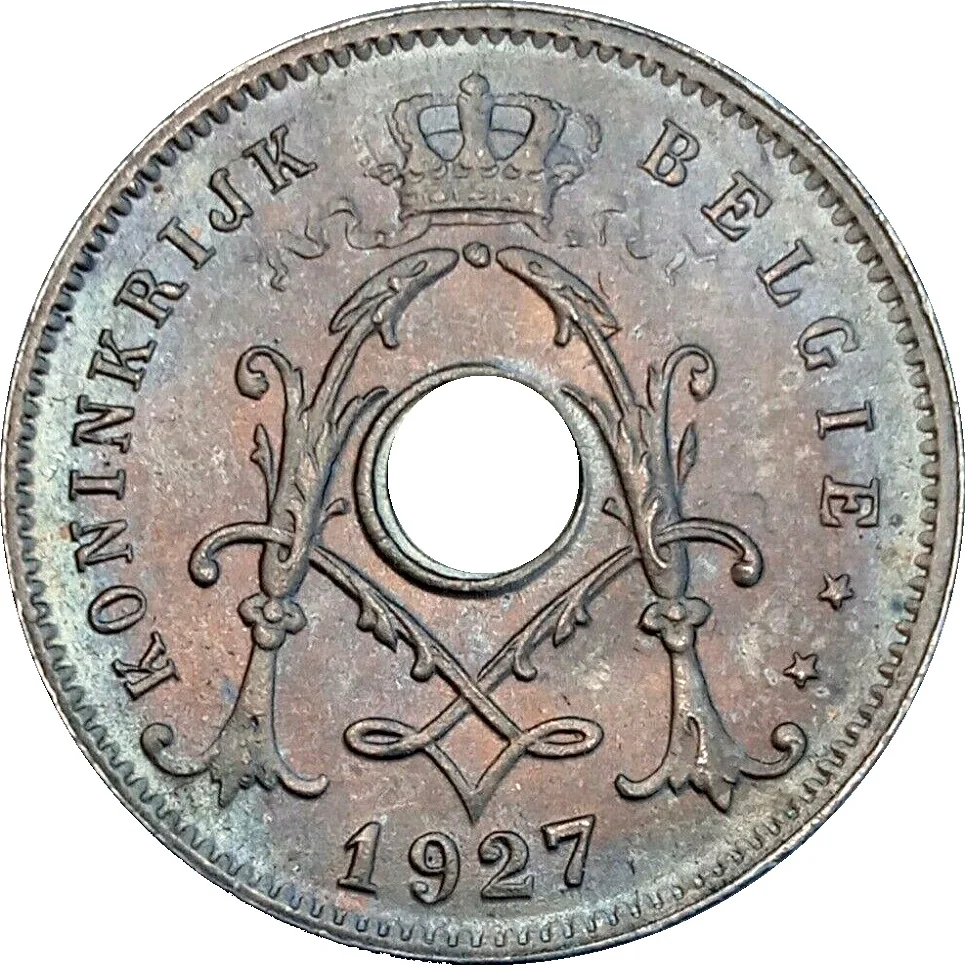
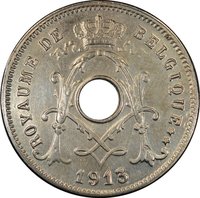
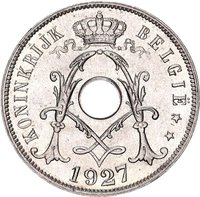
King Albert I's monogram, encircled by Dutch legend. Date below.
Inscription:
KONINKRIJK BELGIË ★★
1927
1927
Translation:
KINGDOM OF BELGIUM ★★
1927
1927
Script: Latin
Language: Dutch
Engraver: Alphonse Michaux
Reverse
Description:
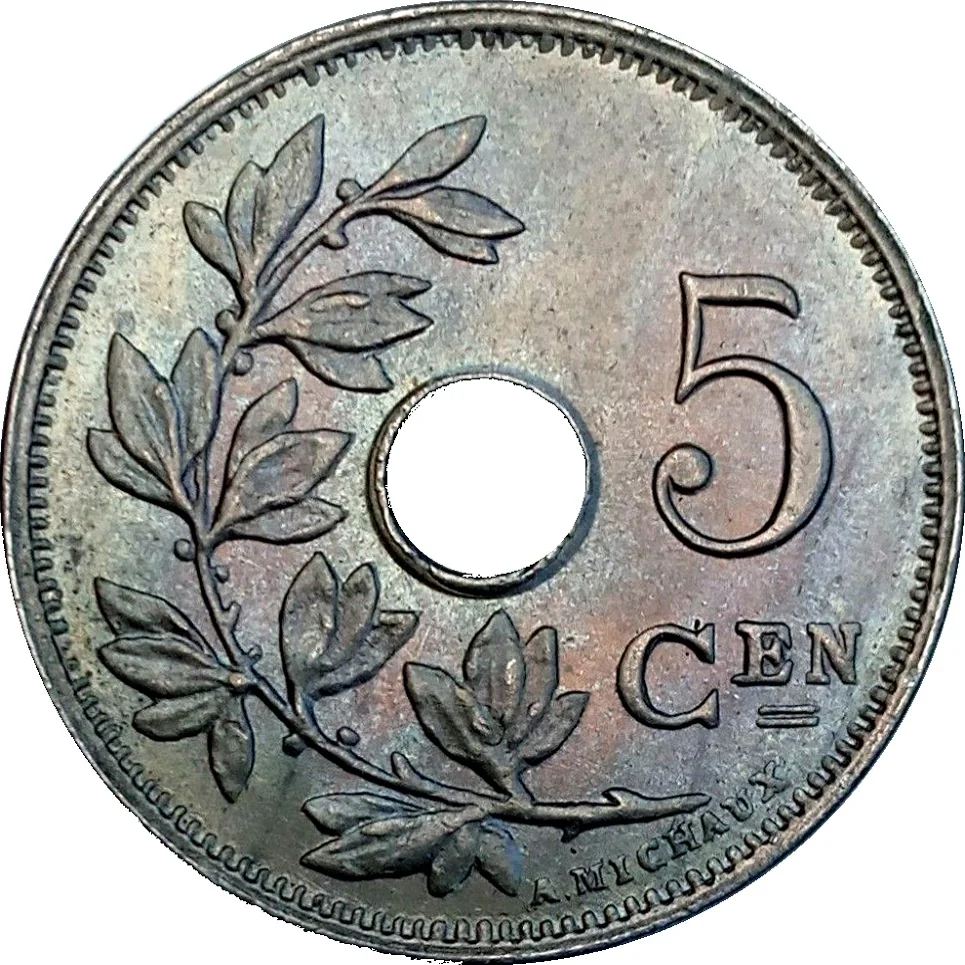
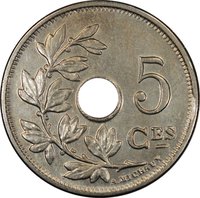
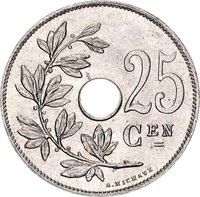
Center hole flanked by olive sprig and value.
Inscription:
5
CEN
A. MICHAUX
CEN
A. MICHAUX
Script: Latin
Engraver: Alphonse Michaux
Edge
Plain
Mints
| Name | Mark |
|---|---|
| Royal Mint of Belgium | — |
Mintings
| Year | Mint Mark | Mintage | Quality | Collection |
|---|---|---|---|---|
| 1910 | — | 8,032,999 | ||
| 1914 | — | 6,039,940 | ||
| 1920 | — | 10,030,000 | ||
| 1921 | — | 4,200,000 | ||
| 1922 | — | 13,180,000 | ||
| 1923 | — | 3,530,000 | ||
| 1924 | — | 5,260,000 | ||
| 1925 | — | 13,000,000 | ||
| 1927 | — | 6,938,000 | ||
| 1928 | — | 6,252,000 | ||
| 1930 | — | — | ||
| 1931 | — | — |
Historical background
In 1910, Belgium operated under a stable and well-established monetary system anchored by the Belgian Franc (BEF), which had been the national currency since the country's independence in 1832. The franc was part of the Latin Monetary Union (LMU), an international treaty established in 1865 that created a bimetallic standard, fixing the values of the Belgian, French, Swiss, and Italian francs to specific quantities of gold and silver. This union facilitated cross-border trade by ensuring the coins of member nations were accepted at par, a significant advantage for Belgium's export-oriented economy. Domestically, both gold and silver coins circulated freely alongside banknotes issued by the National Bank of Belgium, which held a monopoly on note issuance since 1850.
The period around 1910 represented the twilight of this system, as the LMU was under growing strain. While the fixed exchange rates and free circulation of member coins were beneficial, the union faced challenges from fluctuating bullion prices and member states over-issuing silver coins. Belgium, like its partners, had effectively moved to a gold standard in practice, as the fixed gold value of the franc became the primary anchor. The economy was prosperous, driven by industry, trade, and colonial exploitation in the Congo, which supported confidence in the currency. The National Bank maintained substantial gold reserves to back the franc, ensuring its stability and full convertibility.
However, the system's international dependencies also presented vulnerabilities. Belgium's monetary policy was not fully autonomous, being influenced by the actions of other LMU members and broader European financial currents. The looming geopolitical tensions that would erupt in World War I four years later would ultimately shatter this orderly monetary world. In 1910, though, the Belgian franc was a symbol of national sovereignty and economic maturity, providing a reliable foundation for one of Europe's most industrialized nations on the eve of catastrophic change.
The period around 1910 represented the twilight of this system, as the LMU was under growing strain. While the fixed exchange rates and free circulation of member coins were beneficial, the union faced challenges from fluctuating bullion prices and member states over-issuing silver coins. Belgium, like its partners, had effectively moved to a gold standard in practice, as the fixed gold value of the franc became the primary anchor. The economy was prosperous, driven by industry, trade, and colonial exploitation in the Congo, which supported confidence in the currency. The National Bank maintained substantial gold reserves to back the franc, ensuring its stability and full convertibility.
However, the system's international dependencies also presented vulnerabilities. Belgium's monetary policy was not fully autonomous, being influenced by the actions of other LMU members and broader European financial currents. The looming geopolitical tensions that would erupt in World War I four years later would ultimately shatter this orderly monetary world. In 1910, though, the Belgian franc was a symbol of national sovereignty and economic maturity, providing a reliable foundation for one of Europe's most industrialized nations on the eve of catastrophic change.
Series: 1910 Belgium circulation coins
🌱 Very Common