

50 avos – Macau
Add to wishlist
China
Context
Material
Diameter: 20 mm
Weight: 3.6 g
Shape: Round
Composition: Copper-nickel
Technique: Milled
Alignment: Coin alignment
flip
References
KM: #
Numista: #2941
Value
Exchange value: 0.50 MOP
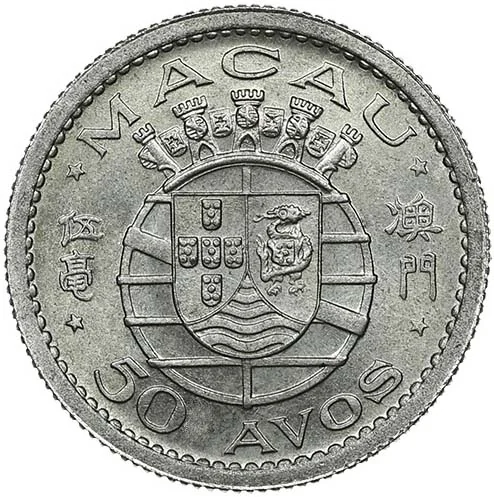
Obverse
Inscription:
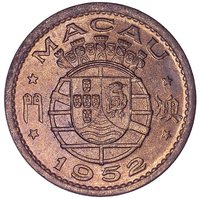
* MACAU *
伍毫
澳門
* 50 AVOS *
伍毫
澳門
* 50 AVOS *
Translation:
* MACAU *
Fifty Avos
Macau
* 50 AVOS *
Fifty Avos
Macau
* 50 AVOS *
Languages: Portuguese, Chinese
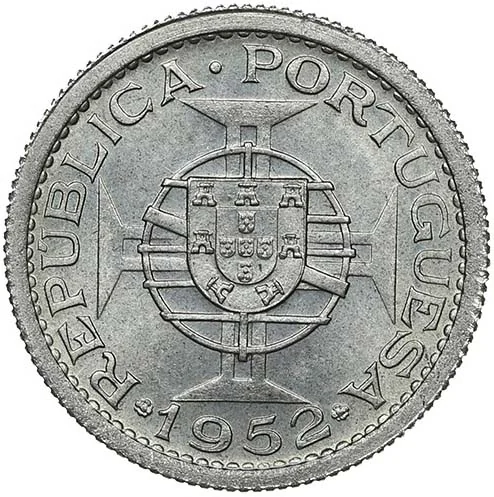
Reverse
Edge
Reeded
Mintings
| Year | Mint Mark | Mintage | Quality | Collection |
|---|---|---|---|---|
| 1952 | — | 2,560,000 |
Historical background
In 1952, Macau's currency situation was defined by its unique colonial status and regional economic turbulence. As a Portuguese-administered territory surrounded by a newly established and ideologically distinct People's Republic of China, Macau operated a dual-currency system. The official currency was the Macau Pataca (MOP), which was pegged to the Portuguese Escudo. However, in daily commerce, the Hong Kong Dollar (HKD) was widely circulated and often preferred due to Hong Kong's more robust and internationally connected economy. This created a practical environment where both currencies were used interchangeably, with the Pataca's stability largely dependent on its link to the Escudo and the implicit backing of Hong Kong's financial strength.
The period was further complicated by the aftermath of the Chinese Civil War and the Korean War, which prompted a United Nations-led trade embargo against China. Macau, while officially neutral, became a strategic point for circumventing this embargo, leading to a surge in grey-market trade and smuggling. This activity increased the flow of various currencies, including Hong Kong Dollars and even US Dollars, into the local economy. Consequently, the Macau Pataca faced challenges in maintaining its dominance, as merchants and residents often favored the more stable and widely accepted Hong Kong Dollar for significant transactions and savings, reflecting a lack of full confidence in the colonial administration's currency.
The monetary authorities, primarily the Banco Nacional Ultramarino which held the exclusive right to issue Pataca notes, had limited power to control this multi-currency environment. There was no central bank, and monetary policy was essentially passive. The system functioned on pragmatism rather than strict regulation, with exchange rates between the Pataca, the Hong Kong Dollar, and the Portuguese Escudo being managed through informal markets and official pegs. Thus, in 1952, Macau's currency landscape was one of informal duality, shaped more by geopolitical forces and regional trade dynamics than by formal financial policy, laying a foundational economic reality that would persist for decades.
The period was further complicated by the aftermath of the Chinese Civil War and the Korean War, which prompted a United Nations-led trade embargo against China. Macau, while officially neutral, became a strategic point for circumventing this embargo, leading to a surge in grey-market trade and smuggling. This activity increased the flow of various currencies, including Hong Kong Dollars and even US Dollars, into the local economy. Consequently, the Macau Pataca faced challenges in maintaining its dominance, as merchants and residents often favored the more stable and widely accepted Hong Kong Dollar for significant transactions and savings, reflecting a lack of full confidence in the colonial administration's currency.
The monetary authorities, primarily the Banco Nacional Ultramarino which held the exclusive right to issue Pataca notes, had limited power to control this multi-currency environment. There was no central bank, and monetary policy was essentially passive. The system functioned on pragmatism rather than strict regulation, with exchange rates between the Pataca, the Hong Kong Dollar, and the Portuguese Escudo being managed through informal markets and official pegs. Thus, in 1952, Macau's currency landscape was one of informal duality, shaped more by geopolitical forces and regional trade dynamics than by formal financial policy, laying a foundational economic reality that would persist for decades.
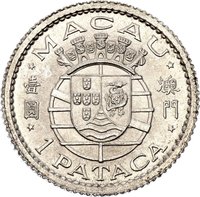
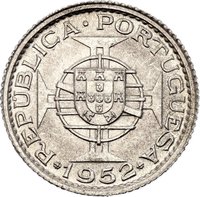
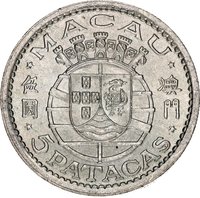
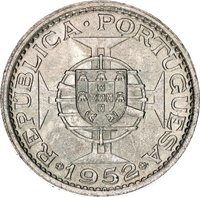
Series: 1952 Macau circulation coins
🌱 Common