

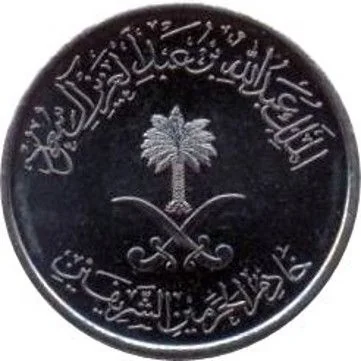
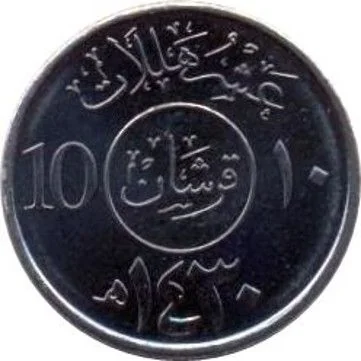
10 halalas – Saudi Arabia
Add to wishlist
Saudi Arabia
Context
Year: 2009
Islamic (Hijri) Year:: 1430
Issuer: Saudi Arabia
Ruler: Abdullah bin Abdulaziz
Currency:
(since 1960)
Material
Diameter: 21 mm
Weight: 4 g
Shape: Round
Composition: Copper-nickel
Technique: Milled
Alignment: Medal alignment
flip
References
KM: #
Numista: #29375
Value
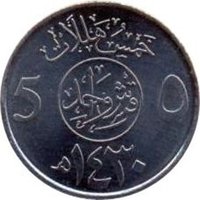
Exchange value: 0.10 SAR
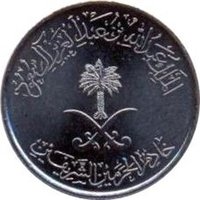
Obverse
Reverse
Edge
Categories
| Plant> Tree |
| Symbols> Coat of Arms |
| Object> Cold weapons |
Mints
| Name | Mark |
|---|---|
| Royal Mint | — |
Mintings
| Year | Mint Mark | Mintage | Quality | Collection |
|---|---|---|---|---|
| 2009 | — | — |
Historical background
In 2009, Saudi Arabia's currency situation was defined by its unwavering peg to the U.S. dollar, a policy maintained since 1986. The Saudi Riyal (SAR) was fixed at a rate of 3.75 to the dollar, a cornerstone of the kingdom's economic stability. This peg provided crucial predictability for the oil-dominated economy, as global oil prices are denominated in dollars, insulating government revenues and import costs from exchange rate volatility. The Saudi Arabian Monetary Authority (SAMA) maintained this peg through direct intervention in foreign exchange markets, backed by substantial foreign reserves accumulated during the preceding years of high oil prices.
The global financial crisis of 2008-2009 placed this peg under indirect pressure, though not to the point of existential threat. As the crisis unfolded, the U.S. Federal Reserve slashed interest rates to near zero, which, due to the peg, forced SAMA to follow suit to prevent massive capital inflows that could have destabilized the Riyal. This created a domestic dilemma: while low rates were intended to stimulate the global economy, they contributed to rising inflation in Saudi Arabia (which had peaked at 9.9% in 2008) and fueled a credit and asset bubble in the local stock market and real estate sector. Despite these internal imbalances and occasional market speculation about a possible revaluation, the kingdom's leadership and SAMA repeatedly and forcefully reaffirmed their commitment to the dollar peg as a non-negotiable pillar of policy.
Ultimately, the currency situation in 2009 was one of managed stability amidst global turbulence. High oil prices in the mid-2000s had built a formidable buffer of foreign assets, exceeding $400 billion, which gave SAMA immense firepower to defend the peg with absolute credibility. The policy choice prioritized long-term macroeconomic stability and alignment with the U.S. economy over the short-term benefits of a more flexible exchange rate that could have helped combat inflation. The year thus ended with the peg firmly intact, having successfully weathered the immediate storm of the financial crisis, though the accompanying low-interest-rate environment sowed the seeds for future inflationary and financial stability challenges.
The global financial crisis of 2008-2009 placed this peg under indirect pressure, though not to the point of existential threat. As the crisis unfolded, the U.S. Federal Reserve slashed interest rates to near zero, which, due to the peg, forced SAMA to follow suit to prevent massive capital inflows that could have destabilized the Riyal. This created a domestic dilemma: while low rates were intended to stimulate the global economy, they contributed to rising inflation in Saudi Arabia (which had peaked at 9.9% in 2008) and fueled a credit and asset bubble in the local stock market and real estate sector. Despite these internal imbalances and occasional market speculation about a possible revaluation, the kingdom's leadership and SAMA repeatedly and forcefully reaffirmed their commitment to the dollar peg as a non-negotiable pillar of policy.
Ultimately, the currency situation in 2009 was one of managed stability amidst global turbulence. High oil prices in the mid-2000s had built a formidable buffer of foreign assets, exceeding $400 billion, which gave SAMA immense firepower to defend the peg with absolute credibility. The policy choice prioritized long-term macroeconomic stability and alignment with the U.S. economy over the short-term benefits of a more flexible exchange rate that could have helped combat inflation. The year thus ended with the peg firmly intact, having successfully weathered the immediate storm of the financial crisis, though the accompanying low-interest-rate environment sowed the seeds for future inflationary and financial stability challenges.
⭐ Somewhat Rare