

25 cents – Netherlands Antilles
Add to wishlist
Netherlands
Context
Years: 1970–1985
Country: Netherlands
Issuer: Netherlands Antilles
Ruler: Juliana
Currency:
(since 1828)
Demonetization: 31 March 2025
Total mintage: 14,637,998
Material
References
KM: #
Numista: #2936
Value
Exchange value: 0.25 ANG
Inflation-adjusted value: 1.46 ANG
Obverse
Description:
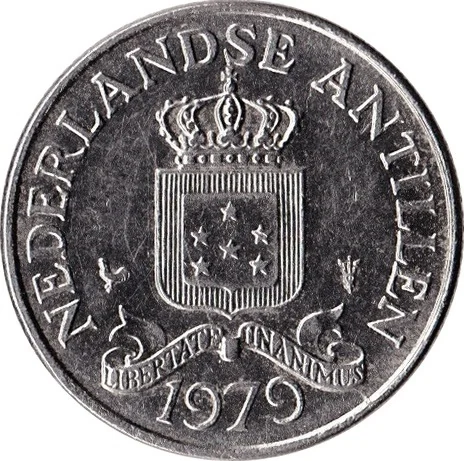
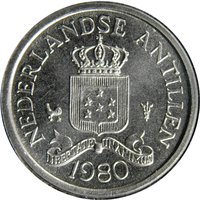
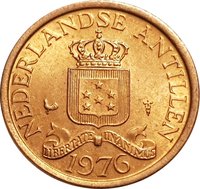
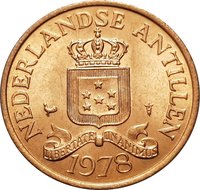
Netherlands Antilles arms and Latin motto.
Inscription:
NEDERLANDSE ANTILLEN
LIBERTATE UNANIMUS
1979
LIBERTATE UNANIMUS
1979
Translation:
Unanimous in Freedom
1979
1979
Script: Latin
Engraver: Geurt Brinkgreve
Reverse
Description:
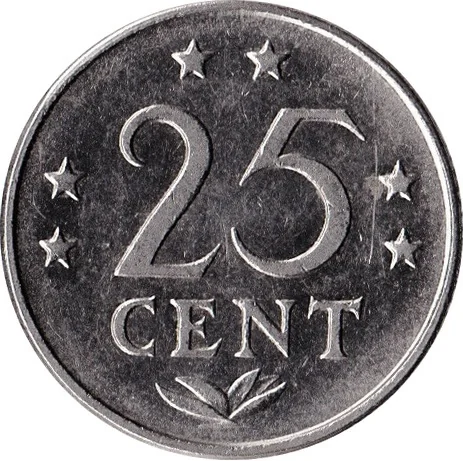
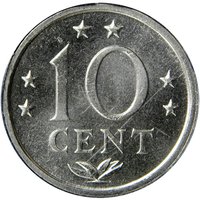
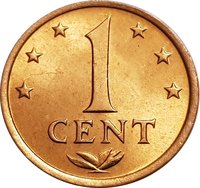
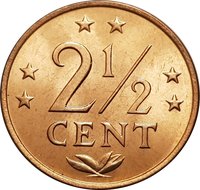
Face value with six stars in three groups, agave leaves below.
Inscription:
25
CENT
CENT
Script: Latin
Engraver: Geurt Brinkgreve
Edge
Reeded
Categories
| Symbol> Crown |
| Symbols> Coat of Arms |
Mints
| Name | Mark |
|---|---|
| Royal Dutch Mint | — |
Mintings
| Year | Mint Mark | Mintage | Quality | Collection |
|---|---|---|---|---|
| 1970 | — | 750,000 | ||
| 1970 | — | — | Proof | |
| 1971 | — | 3,000,000 | ||
| 1971 | — | — | Proof | |
| 1975 | — | 1,000,000 | ||
| 1975 | — | — | Proof | |
| 1976 | — | 1,000,000 | ||
| 1977 | — | 1,000,000 | ||
| 1978 | — | — | Proof | |
| 1978 | — | 1,000,000 | ||
| 1979 | — | 1,012,000 | ||
| 1979 | — | — | Proof | |
| 1980 | — | — | Proof | |
| 1980 | — | 1,018,000 | ||
| 1981 | — | 1,022,999 | ||
| 1982 | — | 1,010,000 | ||
| 1983 | — | 1,024,999 | ||
| 1984 | — | — | Proof | |
| 1984 | — | 1,026,000 | ||
| 1985 | — | 774,000 |
Historical background
In 1970, the currency situation in the Netherlands Antilles was defined by its use of the Netherlands Antillean guilder (NAƒ), which was pegged to the U.S. dollar at a fixed rate of 1.79 guilders per dollar. This peg, established in 1971 but prepared for in the preceding years, was a strategic shift from the previous link to the Dutch guilder. The change reflected the islands' growing economic and trade ties with the United States and the Americas, particularly through the vital oil refining industry on Curaçao and Aruba, which processed Venezuelan crude. The currency was issued by the central bank of the Netherlands Antilles (Bank van de Nederlandse Antillen), established in 1962, which managed monetary policy and held substantial foreign reserves to maintain the peg.
The economy supporting this currency was relatively prosperous but narrowly based, heavily dependent on the two large oil refineries and related transshipment activities. This created a vulnerability, as the currency's stability was closely tied to the fortunes of a single industry. Furthermore, the political relationship with the European Netherlands was evolving, with the islands retaining their status as a constituent country within the Kingdom of the Netherlands after the independence of Suriname in 1975. This autonomy extended to monetary affairs, allowing Willemstad, not Amsterdam, to set its own exchange rate policy.
Consequently, the monetary framework in 1970 was one of deliberate stability aimed at fostering international business and investment. The peg to the strong U.S. dollar provided a predictable environment for the key hydrocarbon sector and the emerging offshore financial services industry. However, this arrangement also imported U.S. monetary conditions and left the economy exposed to external shocks, setting the stage for future challenges as the global oil market and geopolitical landscape shifted in the decades to follow.
The economy supporting this currency was relatively prosperous but narrowly based, heavily dependent on the two large oil refineries and related transshipment activities. This created a vulnerability, as the currency's stability was closely tied to the fortunes of a single industry. Furthermore, the political relationship with the European Netherlands was evolving, with the islands retaining their status as a constituent country within the Kingdom of the Netherlands after the independence of Suriname in 1975. This autonomy extended to monetary affairs, allowing Willemstad, not Amsterdam, to set its own exchange rate policy.
Consequently, the monetary framework in 1970 was one of deliberate stability aimed at fostering international business and investment. The peg to the strong U.S. dollar provided a predictable environment for the key hydrocarbon sector and the emerging offshore financial services industry. However, this arrangement also imported U.S. monetary conditions and left the economy exposed to external shocks, setting the stage for future challenges as the global oil market and geopolitical landscape shifted in the decades to follow.
🌱 Very Common