

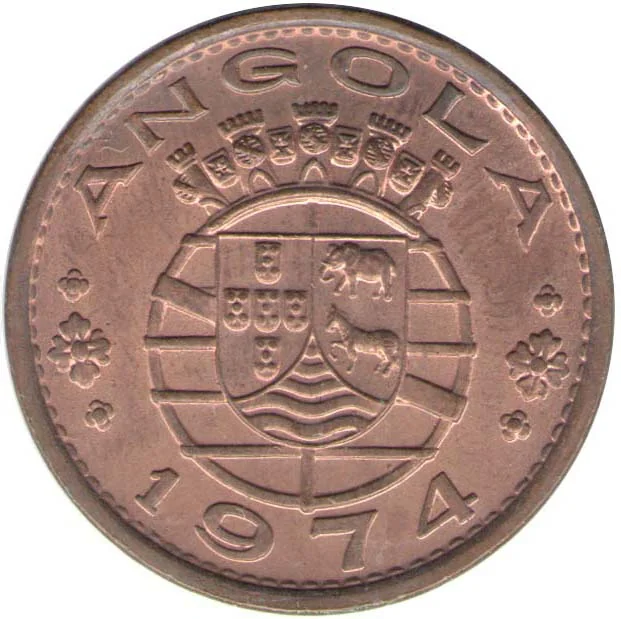
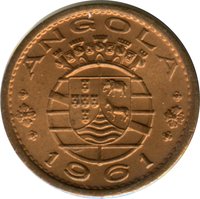
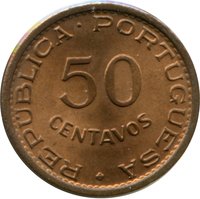
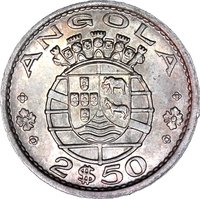
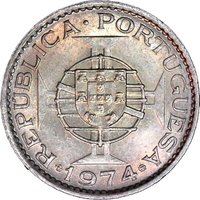
Obverse
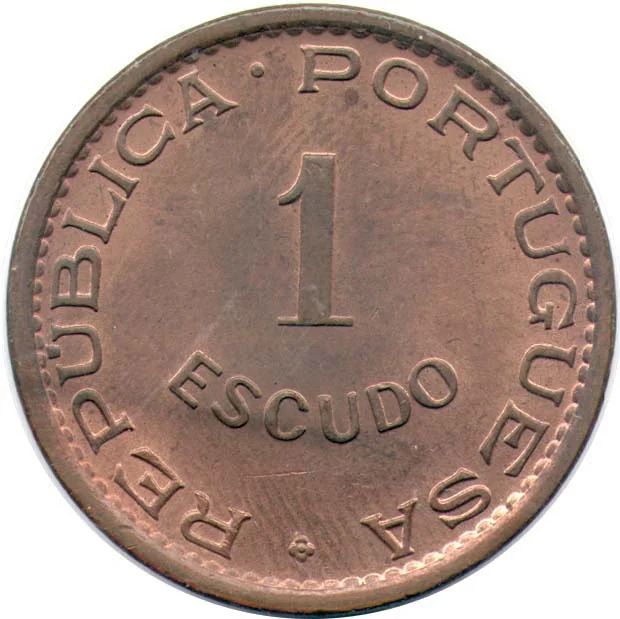
Reverse
Description:
Valuable
Inscription:
REPÚBLICA·PORTUGUESA
1
ESCUDO
1
ESCUDO
Translation:
PORTUGUESE REPUBLIC
1
ESCUDO
1
ESCUDO
Script: Latin
Language: Portuguese
Edge
Plain
Categories
| Symbols> Coat of Arms |
| Animal> Elephant |
| Animal> Horse |
| Building> Castle or fortification |
Mints
| Name | Mark |
|---|---|
| Imprensa Nacional - Casa da Moeda | — |
Mintings
| Year | Mint Mark | Mintage | Quality | Collection |
|---|---|---|---|---|
| 1953 | — | 2,001,000 | ||
| 1956 | — | 2,989,000 | ||
| 1963 | — | 5,000,000 | ||
| 1965 | — | 5,000,000 | ||
| 1972 | — | 10,000,000 | ||
| 1974 | — | 6,214,000 |
Historical background
In 1953, Angola’s currency situation was fundamentally defined by its status as a Portuguese colony, integrated into Portugal’s broader imperial monetary system. The official currency was the Angolan escudo (AOE), which had replaced the angolar just a few years prior, in 1948. This change was part of a deliberate policy by the Estado Novo regime to streamline and centralize economic control across its empire, creating a unified escudo zone that included metropolitan Portugal and its overseas territories. The Angolan escudo was pegged at par with the Portuguese escudo, and its issuance was controlled by the Bank of Angola (Banco de Angola), which acted as both a central and commercial bank for the colony.
Economically, this system was designed to tightly bind Angola’s economy to Portugal’s, facilitating trade and capital flows primarily for the benefit of the metropole. The fixed parity and centralized control meant that Angola’s monetary policy was not set in Luanda but in Lisbon, responding to Portugal’s economic needs rather than local conditions. This period saw increased Portuguese settlement and state-led development projects, funded in part by this controlled financial environment. The currency regime supported the export of key Angolan commodities—like coffee, diamonds, and sisal—while ensuring that the resulting foreign exchange earnings were managed within the Portuguese financial sphere.
However, this integrated system also reflected and reinforced the structural inequalities of colonial rule. The currency’s stability was contingent on Portugal’s own economic management, and the system primarily served the interests of the Portuguese administration, settler community, and large trading companies. For the majority of the Angolan population, engagement with the formal monetary economy was limited, with subsistence agriculture and local barter remaining widespread. Thus, the 1953 currency situation presents a picture of colonial control and economic integration, laying a financial foundation that would persist until the wars of independence began in the following decade.
Economically, this system was designed to tightly bind Angola’s economy to Portugal’s, facilitating trade and capital flows primarily for the benefit of the metropole. The fixed parity and centralized control meant that Angola’s monetary policy was not set in Luanda but in Lisbon, responding to Portugal’s economic needs rather than local conditions. This period saw increased Portuguese settlement and state-led development projects, funded in part by this controlled financial environment. The currency regime supported the export of key Angolan commodities—like coffee, diamonds, and sisal—while ensuring that the resulting foreign exchange earnings were managed within the Portuguese financial sphere.
However, this integrated system also reflected and reinforced the structural inequalities of colonial rule. The currency’s stability was contingent on Portugal’s own economic management, and the system primarily served the interests of the Portuguese administration, settler community, and large trading companies. For the majority of the Angolan population, engagement with the formal monetary economy was limited, with subsistence agriculture and local barter remaining widespread. Thus, the 1953 currency situation presents a picture of colonial control and economic integration, laying a financial foundation that would persist until the wars of independence began in the following decade.
Series: 1953 Angola circulation coins
🌱 Very Common