

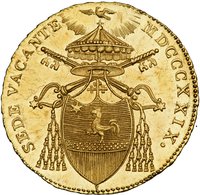
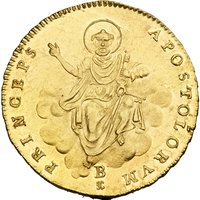
½ scudo – Papal States
Add to wishlist
Circulating commemorative coins
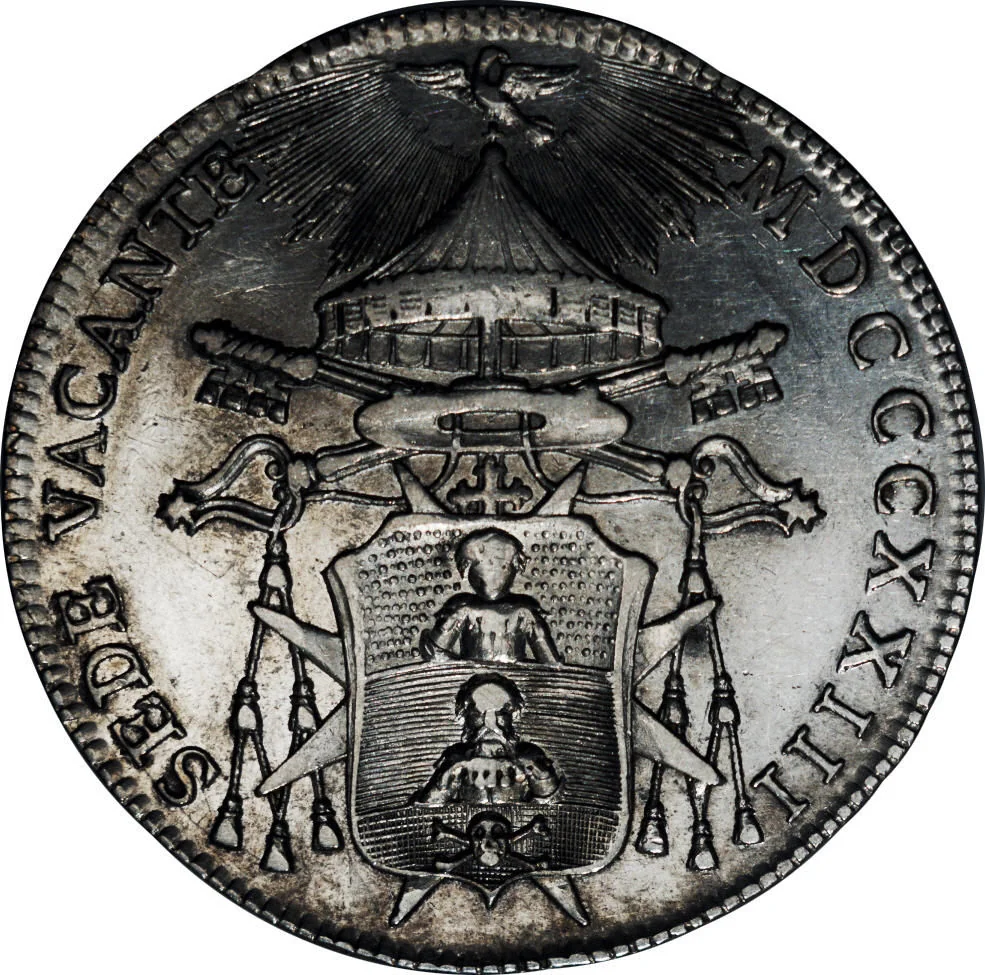
Commemoration: Vacant Seat 1823
Vatican City
Context
Year: 1823
Country: Vatican City
Issuer: Papal States
Currency:
(1534—1835)
Demonetized: Yes
Total mintage: 62,800
Material
References
KM: #
Numista: #29319
Value
Bullion value: $31.05
Obverse
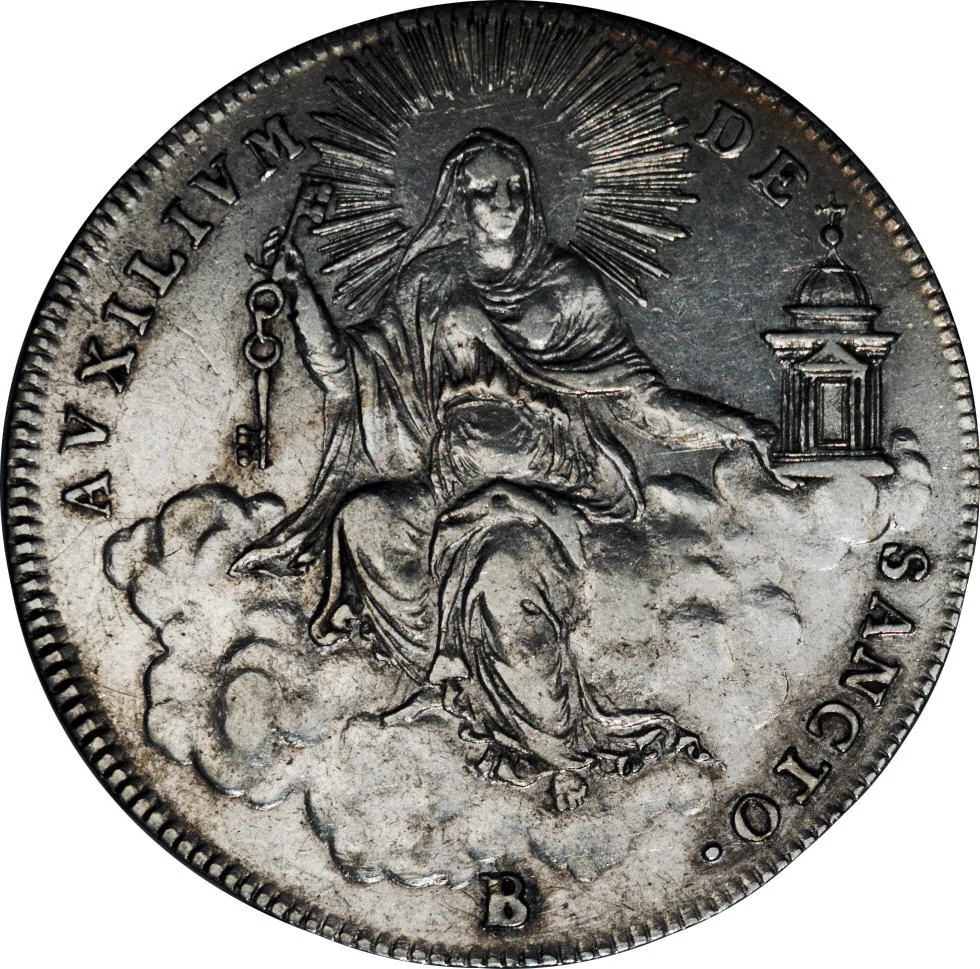
Reverse
Edge
Mints
| Name | Mark |
|---|---|
| Bologna | B |
Mintings
| Year | Mint Mark | Mintage | Quality | Collection |
|---|---|---|---|---|
| 1823 | B | 62,800 |
Historical background
By 1823, the Papal States faced a complex and deteriorating currency situation, a legacy of the Napoleonic Wars and subsequent restoration. The territory had been absorbed into the French Empire, which imposed the franc system, but after 1815, the restored papal government reintroduced its own historical monetary units: the scudo (divided into 100 baiocchi) for larger transactions and the copper baiocco for daily use. However, this restoration was not a clean return to the past. The state struggled with a severe shortage of precious metals, leading to a chronic inability to mint sufficient quantities of full-value silver scudi. Consequently, the economy became flooded with depreciated copper and low-grade token coinage, creating a dysfunctional bimetallic system where the official exchange rate between silver and copper bore little relation to their market value.
This instability was exacerbated by significant regional fragmentation. While the central monetary authority in Rome issued currency, several major papal provinces—such as Bologna and Ancona—retained the right to mint their own distinct coinage. This resulted in a lack of uniform currency across the Papal States, hindering trade and commerce. Furthermore, vast quantities of debased and foreign coins, particularly from neighbouring Italian states, circulated freely, further undermining confidence in the papal monetary system. The result was widespread confusion, frequent arbitrage by money-changers, and effective devaluation, which disproportionately burdened the poor who primarily used copper coins.
The financial strain was compounded by the papacy's reliance on deficit spending, funded through loans and the issuance of buoni del tesoro (treasury bonds). This fiscal weakness directly limited the government's capacity to reform the coinage. While Pope Pius VII (d. 1823) and his successor Leo XII (elected in 1823) were aware of the problems, comprehensive reform remained elusive. The currency crisis of 1823 was therefore a symptom of broader challenges: a weak fiscal state, a fragmented political economy, and the difficulty of managing a traditional monetary system in a post-revolutionary age. It would take decades and the loss of most papal territory before a unified, modern currency was finally achieved.
This instability was exacerbated by significant regional fragmentation. While the central monetary authority in Rome issued currency, several major papal provinces—such as Bologna and Ancona—retained the right to mint their own distinct coinage. This resulted in a lack of uniform currency across the Papal States, hindering trade and commerce. Furthermore, vast quantities of debased and foreign coins, particularly from neighbouring Italian states, circulated freely, further undermining confidence in the papal monetary system. The result was widespread confusion, frequent arbitrage by money-changers, and effective devaluation, which disproportionately burdened the poor who primarily used copper coins.
The financial strain was compounded by the papacy's reliance on deficit spending, funded through loans and the issuance of buoni del tesoro (treasury bonds). This fiscal weakness directly limited the government's capacity to reform the coinage. While Pope Pius VII (d. 1823) and his successor Leo XII (elected in 1823) were aware of the problems, comprehensive reform remained elusive. The currency crisis of 1823 was therefore a symptom of broader challenges: a weak fiscal state, a fragmented political economy, and the difficulty of managing a traditional monetary system in a post-revolutionary age. It would take decades and the loss of most papal territory before a unified, modern currency was finally achieved.
💎 Extremely Rare