

1 doppia – Papal States
Add to wishlist
Circulating commemorative coins
Commemoration: Vacant Seat 1829
Vatican City
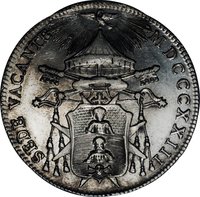
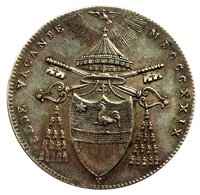
Obverse
Description:
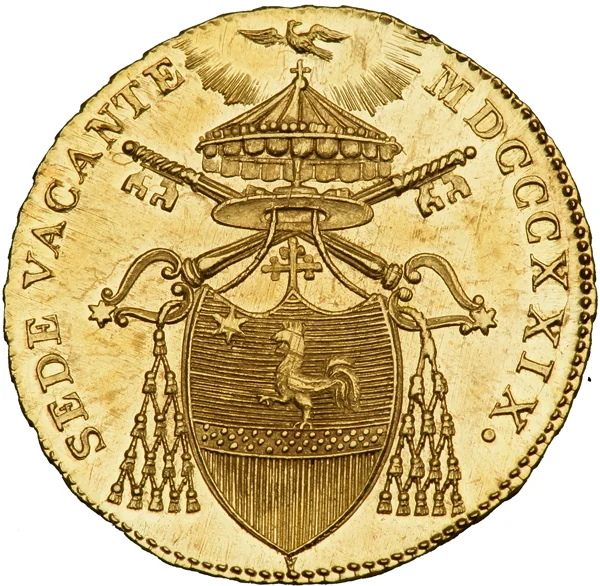
Cardinal's coat of arms.
Inscription:
SEDE VACANTE MDCCCXXIX.
Translation:
SEDE VACANTE MDCCCXXIX
During the Vacant See 1829
During the Vacant See 1829
Script: Latin
Language: Latin
Engraver: Giuseppe Cerbara
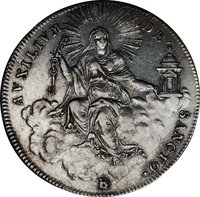
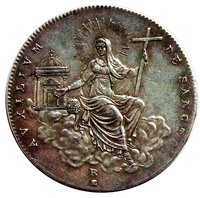
Reverse
Description:
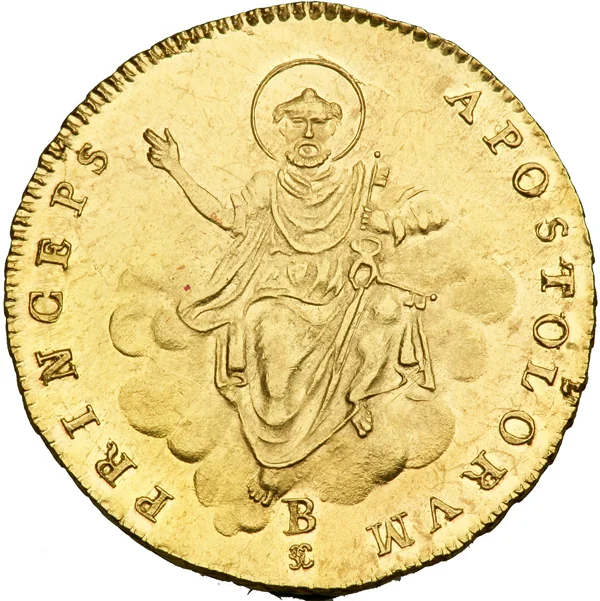
Saint Peter seated on clouds.
Inscription:
PRINCEPS APOSTALORVM
B
B
Script: Latin
Engraver: Giuseppe Cerbara
Edge
Historical background
In 1829, the Papal States faced a complex and fragmented monetary situation, a legacy of its decentralized political structure and the turbulent Napoleonic era. The territory lacked a unified, modern currency system. Instead, circulation was dominated by a confusing mix of old regional coinages from former constituent states like Bologna and Ravenna, alongside lingering French coins from the period of occupation (1809-1814). The official papal coinage, minted in Rome, struggled to establish supremacy, leading to a marketplace where values constantly fluctuated based on metal content and local custom, hindering trade and economic stability.
The primary unit of account was the Papal Scudo, divided into 100 Baiocchi. However, the actual physical scudo coin was rarely minted after 1823. Everyday transactions relied heavily on a bewildering array of subsidiary coins in copper and silver, such as baiocchi, grossi, and giulii, whose values relative to the scudo were officially set but often disputed in practice. Furthermore, different cities within the Papal States sometimes gave slightly different values to the same coin, and older coins from pre-restoration times remained in circulation, creating a paradise for money-changers and a headache for merchants.
This monetary chaos was symptomatic of the broader administrative and economic conservatism of the Papal government under Pope Leo XII (1823-1829) and his immediate successors. While there was a recognized need for reform to foster internal commerce and simplify state finances, decisive action was stalled by bureaucratic inertia and a reluctance to embrace modern economic principles. Consequently, in 1829, the Papal States remained financially archaic, with its currency system acting as a tangible barrier to economic integration and growth, a problem that would persist until the sweeping reforms of Pope Pius IX in the 1850s.
The primary unit of account was the Papal Scudo, divided into 100 Baiocchi. However, the actual physical scudo coin was rarely minted after 1823. Everyday transactions relied heavily on a bewildering array of subsidiary coins in copper and silver, such as baiocchi, grossi, and giulii, whose values relative to the scudo were officially set but often disputed in practice. Furthermore, different cities within the Papal States sometimes gave slightly different values to the same coin, and older coins from pre-restoration times remained in circulation, creating a paradise for money-changers and a headache for merchants.
This monetary chaos was symptomatic of the broader administrative and economic conservatism of the Papal government under Pope Leo XII (1823-1829) and his immediate successors. While there was a recognized need for reform to foster internal commerce and simplify state finances, decisive action was stalled by bureaucratic inertia and a reluctance to embrace modern economic principles. Consequently, in 1829, the Papal States remained financially archaic, with its currency system acting as a tangible barrier to economic integration and growth, a problem that would persist until the sweeping reforms of Pope Pius IX in the 1850s.
✨ Legendary