

5 centimes – Algeria
Add to wishlist
Circulating commemorative coins
Commemoration: FAO - 1st Quadrennial Plan (1970-1973)
Algeria
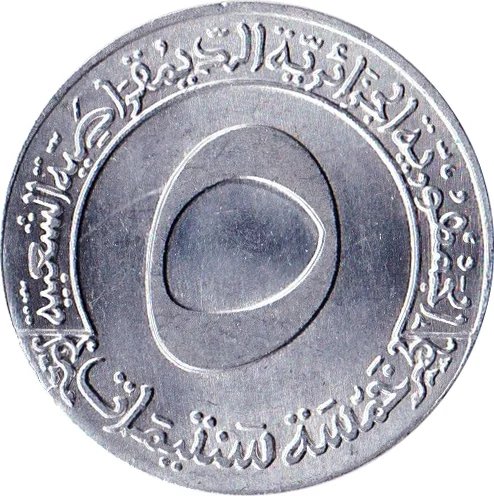
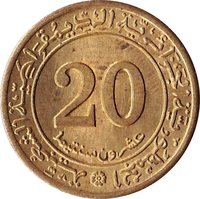
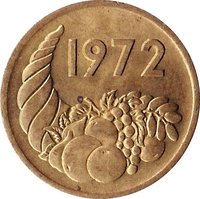
Obverse
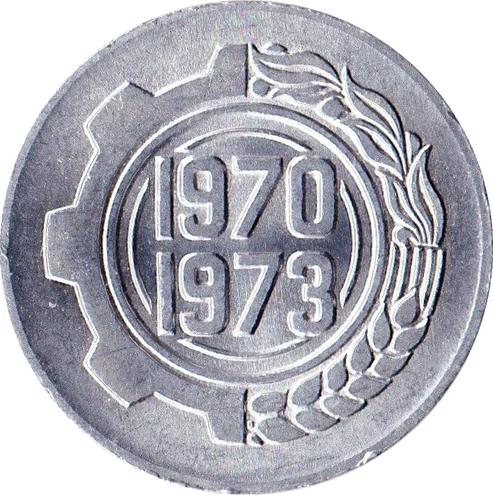
Reverse
Description:
First five-year plan dates in a gear, wheat, and olive wreath.
Inscription:
1970
1973
1973
Script: Latin
Engraver: Mohamed Temmam
Edge
Plain
Categories
| Organization> FAO |
| Symbol> Wreath |
Mints
| Name | Mark |
|---|---|
| Kremnica | — |
Mintings
| Year | Mint Mark | Mintage | Quality | Collection |
|---|---|---|---|---|
| 1970 | — | 50,000,000 |
Historical background
In 1970, Algeria's currency situation was fundamentally shaped by its recent independence and the state-led economic model adopted by the Houari Boumediene government. The Algerian dinar (DZD), introduced in 1964 to replace the Algerian new franc, was a non-convertible currency managed by the Banque Centrale d'Algérie. Its value and circulation were tightly controlled by the state, reflecting a broader policy of economic independence and insulation from former colonial influence. This period was characterized by a heavily centralized planned economy, with the state directing investment primarily towards heavy industry and nationalizing key sectors, including hydrocarbons.
The dinar's stability and value were largely underpinned by Algeria's growing hydrocarbon revenues, particularly from oil and natural gas exports. However, the currency was not traded on international markets, and its exchange rate was fixed administratively rather than determined by market forces. Foreign exchange was scarce and strictly allocated by the government to prioritize imports of capital goods for industrial development, often at the expense of consumer goods. This created a system where access to hard currency was a critical bottleneck for trade and investment, reinforcing the state's central role in all economic transactions.
Consequently, the currency regime of 1970 was a tool for implementing national economic policy rather than a facilitator of global financial integration. It supported the government's objectives of reducing dependence on France, building a domestic industrial base, and asserting sovereignty. However, it also led to inefficiencies, a burgeoning informal economy, and limited access to foreign goods for ordinary citizens. This controlled system would define Algeria's financial landscape for decades, with reforms only beginning tentatively in the late 1980s as the limitations of the planned economy became increasingly apparent.
The dinar's stability and value were largely underpinned by Algeria's growing hydrocarbon revenues, particularly from oil and natural gas exports. However, the currency was not traded on international markets, and its exchange rate was fixed administratively rather than determined by market forces. Foreign exchange was scarce and strictly allocated by the government to prioritize imports of capital goods for industrial development, often at the expense of consumer goods. This created a system where access to hard currency was a critical bottleneck for trade and investment, reinforcing the state's central role in all economic transactions.
Consequently, the currency regime of 1970 was a tool for implementing national economic policy rather than a facilitator of global financial integration. It supported the government's objectives of reducing dependence on France, building a domestic industrial base, and asserting sovereignty. However, it also led to inefficiencies, a burgeoning informal economy, and limited access to foreign goods for ordinary citizens. This controlled system would define Algeria's financial landscape for decades, with reforms only beginning tentatively in the late 1980s as the limitations of the planned economy became increasingly apparent.
🌱 Very Common