

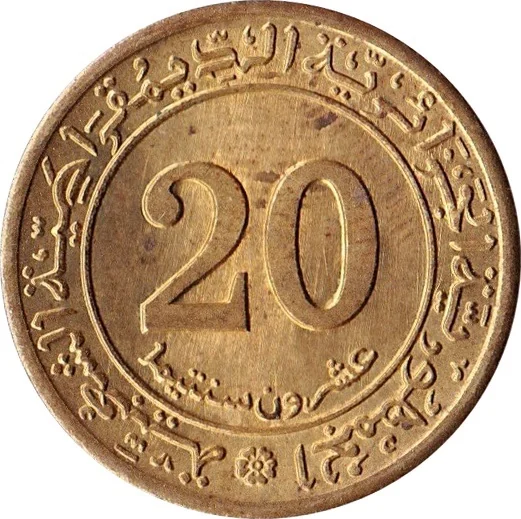
20 centimes – Algeria
Add to wishlist
Circulating commemorative coins
Commemoration: FAO - Agricultural Revolution
Algeria
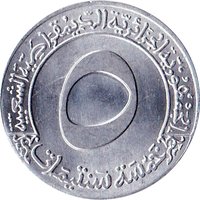
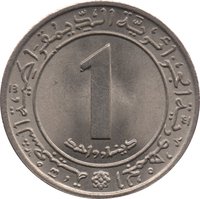
Obverse
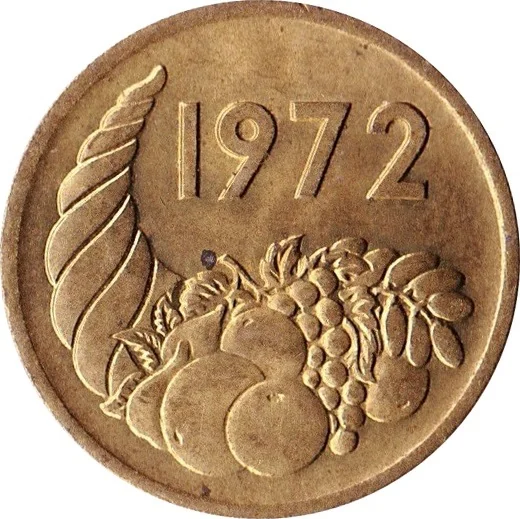
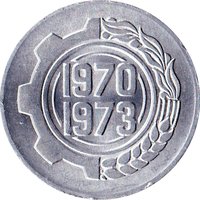
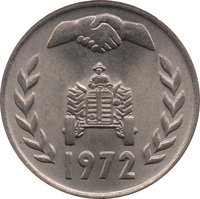
Reverse
Edge
Plain
Categories
| Organization> FAO |
| Agriculture |
| Symbol> Cornucopia |
Mints
| Name | Mark |
|---|---|
| Kremnica | — |
Mintings
| Year | Mint Mark | Mintage | Quality | Collection |
|---|---|---|---|---|
| 1972 | — | 20,000,000 |
Historical background
In 1972, Algeria's currency situation was fundamentally shaped by its recent independence and its chosen economic path. Having emerged from a brutal war of independence in 1962, the country was in the midst of implementing a state-led, socialist development model under President Houari Boumédiène. The Algerian dinar (DZD), introduced in 1964 to replace the Algerian new franc, was not a freely convertible currency. Its value and exchange were tightly controlled by the Banque Centrale d'Algérie as part of a broader system of centralized economic planning, aimed at reducing dependence on the former colonial power, France, and directing resources toward heavy industrialization.
This period was characterized by strict exchange controls and an official fixed exchange rate, which was pegged to a basket of currencies. The primary focus was on funding the ambitious "industrializing industries" policy, which prioritized capital-intensive sectors like steel, hydrocarbons, and machinery. Consequently, access to foreign currency was rationed and prioritized for state-owned enterprises importing essential capital goods. The significant revenues beginning to flow from the nationalized hydrocarbon sector, especially after the 1971 oil nationalization, provided a crucial source of hard currency, but these funds were channeled directly into the state's development plans rather than liberalizing the monetary system.
Therefore, the currency situation in 1972 reflected a closed, managed financial system designed to insulate the planned economy from external market pressures and prevent capital flight. There was little to no foreign exchange market as understood in liberal economies. This control allowed the government to direct investment but also created bottlenecks, a burgeoning informal economy for currency exchange, and long-term challenges with inefficiency and a lack of competitiveness that would become more apparent in subsequent decades.
This period was characterized by strict exchange controls and an official fixed exchange rate, which was pegged to a basket of currencies. The primary focus was on funding the ambitious "industrializing industries" policy, which prioritized capital-intensive sectors like steel, hydrocarbons, and machinery. Consequently, access to foreign currency was rationed and prioritized for state-owned enterprises importing essential capital goods. The significant revenues beginning to flow from the nationalized hydrocarbon sector, especially after the 1971 oil nationalization, provided a crucial source of hard currency, but these funds were channeled directly into the state's development plans rather than liberalizing the monetary system.
Therefore, the currency situation in 1972 reflected a closed, managed financial system designed to insulate the planned economy from external market pressures and prevent capital flight. There was little to no foreign exchange market as understood in liberal economies. This control allowed the government to direct investment but also created bottlenecks, a burgeoning informal economy for currency exchange, and long-term challenges with inefficiency and a lack of competitiveness that would become more apparent in subsequent decades.
🌱 Very Common