

1 Penny – Southern Rhodesia
Zimbabwe
Context
Years: 1949–1952
Country: Zimbabwe 
Issuer: Southern Rhodesia
Ruler: George VI
Currency:
(1932—1955)
Demonetization: 1 January 1973
Total mintage: 8,956,000
Material
Diameter: 27 mm
Weight: 6.48 g
Thickness: 1.55 mm
Shape: Round with a round hole
Composition: Bronze
Magnetic: No
Technique: Milled
Alignment: Medal alignment
flip
References
KM: #Click to copy to clipboard25
Numista: #13482
Obverse
Description:
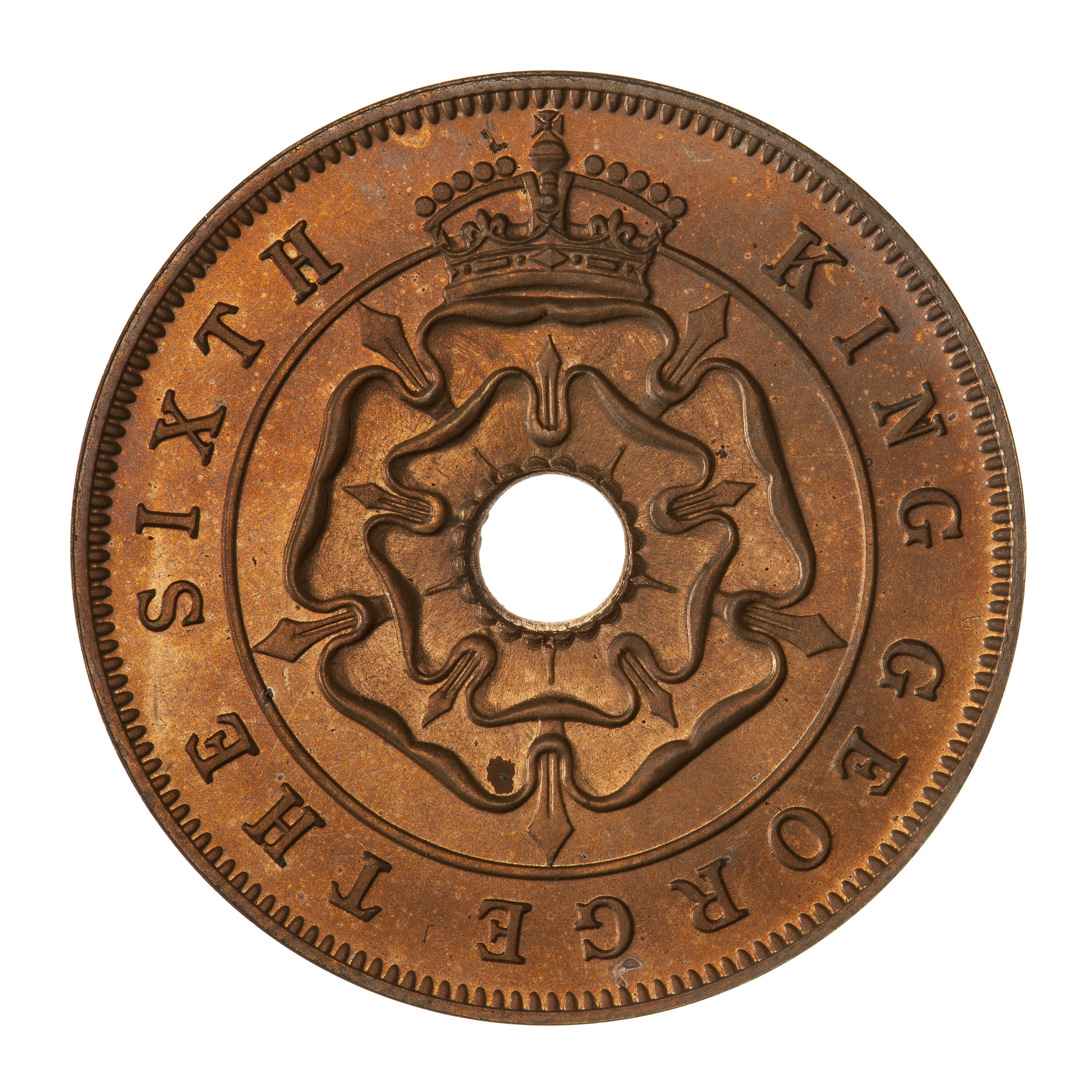
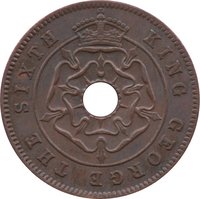
Crowned flower encircling hole, text around.
Inscription:
KING GEORGE THE SIXTH
Translation:
KING GEORGE THE SIXTH
Script: Latin
Language: English
Engraver: Derwent Wood
Reverse
Description:
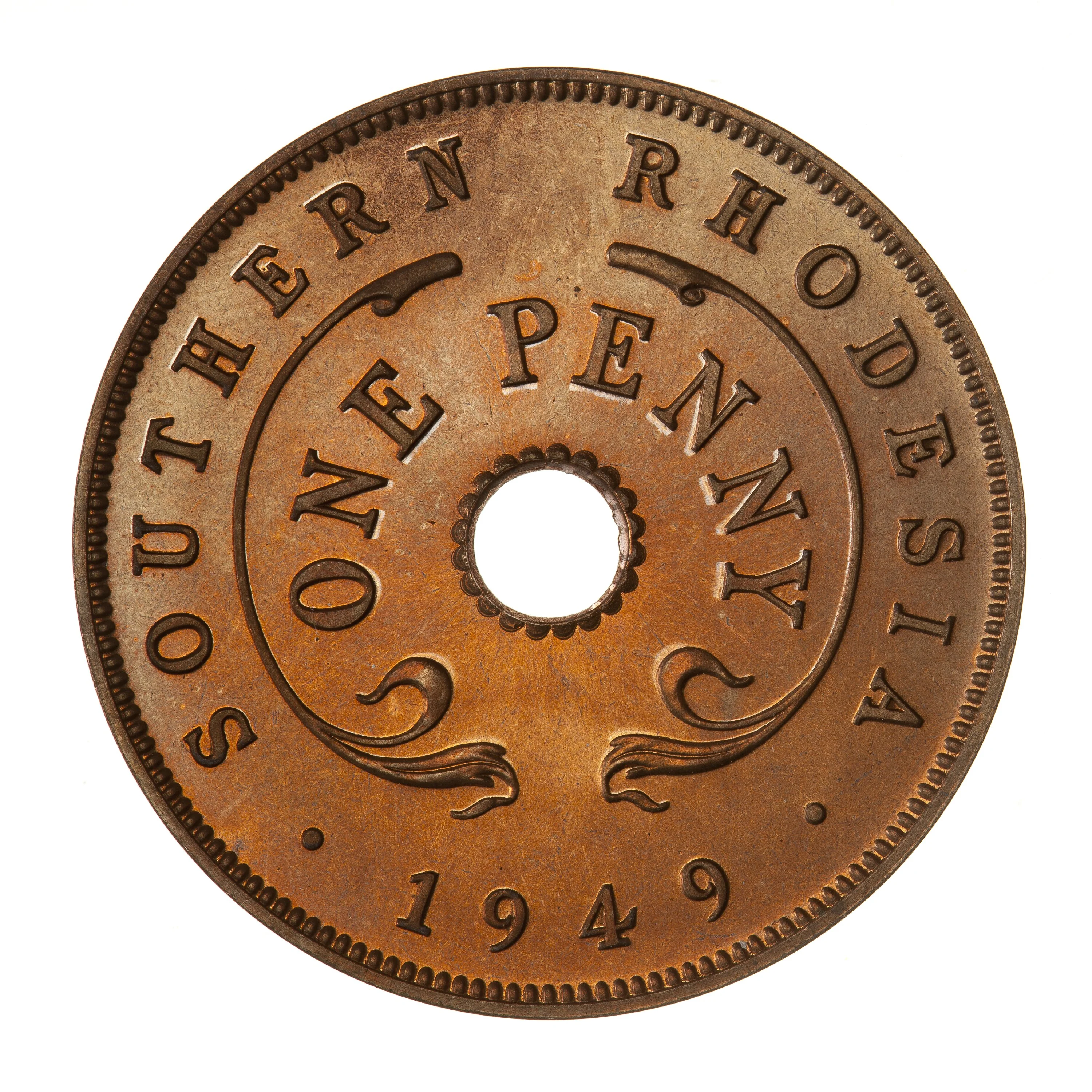
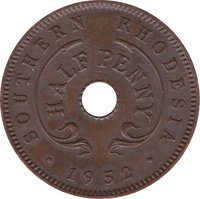
Sprig design: name encircles, date below, value in sprigs, central hole.
Inscription:
SOUTHERN RHODESIA
ONE PENNY
· 1949 ·
ONE PENNY
· 1949 ·
Script: Latin
Engraver: Royal Mint Engravers
Edge
Plain
Mints
| Name | Mark |
|---|---|
| Royal Mint (Tower Hill) | — |
Mintings
| Year | Mint Mark | Mintage | Quality | Collection |
|---|---|---|---|---|
| 1949 | — | 1,440,000 | ||
| 1949 | — | — | Proof | |
| 1950 | — | 720,000 | ||
| 1950 | — | — | Proof | |
| 1951 | — | 4,396,000 | ||
| 1951 | — | — | Proof | |
| 1952 | — | — | Proof | |
| 1952 | — | 2,400,000 |
Historical background
In 1949, Southern Rhodesia's currency situation was defined by its membership in the Sterling Area and its use of the Southern Rhodesian pound, which was pegged at par with the British pound sterling. This arrangement provided monetary stability and facilitated trade with the United Kingdom, the colony's dominant economic partner. The currency was issued by the Central Africa Currency Board, established in 1938, which also served Northern Rhodesia and Nyasaland, foreshadowing the later Federation. This system meant Southern Rhodesia held its sterling reserves in London, and its money supply was effectively backed by and convertible to British pounds.
Economically, the post-World War II period was one of significant growth and prosperity for Southern Rhodesia, driven by a booming tobacco industry and substantial foreign investment. The stable currency peg supported this development by providing confidence to settlers and international investors. However, this orthodox financial setup also meant the colony's monetary policy was largely dictated by the economic needs and decisions of the United Kingdom, limiting local autonomy. The territory's balance of payments was strong, but its economy remained vulnerable to fluctuations in the global price of its primary commodities.
The year 1949 was particularly significant due to the British government's decision to devalue the pound sterling by 30.5% against the US dollar in September. As a loyal Sterling Area member, Southern Rhodesia immediately followed suit, devaluing its own pound in lockstep. This move aimed to boost the competitiveness of Rhodesian exports, like tobacco and minerals, on world markets. While beneficial for exporters, it also increased the cost of imported manufactured goods, contributing to inflationary pressures. This event underscored the colony's deep financial integration with Britain, a relationship that would be challenged in the coming decades as the federation advanced and, later, as unilateral independence was declared.
Economically, the post-World War II period was one of significant growth and prosperity for Southern Rhodesia, driven by a booming tobacco industry and substantial foreign investment. The stable currency peg supported this development by providing confidence to settlers and international investors. However, this orthodox financial setup also meant the colony's monetary policy was largely dictated by the economic needs and decisions of the United Kingdom, limiting local autonomy. The territory's balance of payments was strong, but its economy remained vulnerable to fluctuations in the global price of its primary commodities.
The year 1949 was particularly significant due to the British government's decision to devalue the pound sterling by 30.5% against the US dollar in September. As a loyal Sterling Area member, Southern Rhodesia immediately followed suit, devaluing its own pound in lockstep. This move aimed to boost the competitiveness of Rhodesian exports, like tobacco and minerals, on world markets. While beneficial for exporters, it also increased the cost of imported manufactured goods, contributing to inflationary pressures. This event underscored the colony's deep financial integration with Britain, a relationship that would be challenged in the coming decades as the federation advanced and, later, as unilateral independence was declared.
🌱 Common