


Obverse
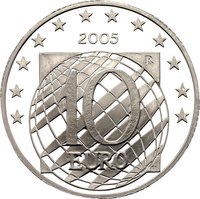
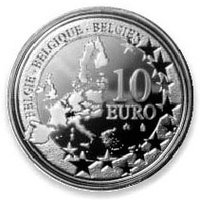
Description:
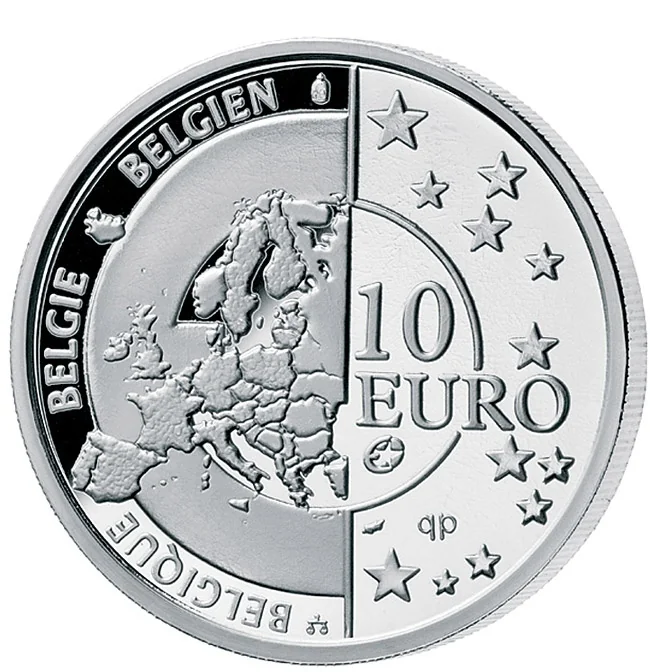
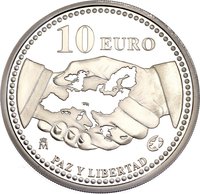
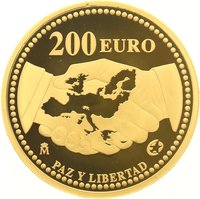
Map of the European Union.
Inscription:
BELGIQUE BELGIE BELGIEN
10 EURO
qp
10 EURO
qp
Translation:
BELGIUM BELGIUM BELGIUM
10 EURO
10 EURO
Script: Latin
Engraver: H. Veijalainen
Reverse
Edge
Reeded
Mints
| Name | Mark |
|---|---|
| Royal Mint of Belgium | — |
Mintings
| Year | Mint Mark | Mintage | Quality | Collection |
|---|---|---|---|---|
| 2005 | — | 50,000 | Proof |
Historical background
In 2005, Belgium was a fully integrated member of the Eurozone, having adopted the euro as its physical currency in 2002. The national currency, the Belgian franc, had been completely withdrawn from circulation, ending a transition period. Consequently, domestic monetary policy was no longer under Belgian control but was set by the European Central Bank (ECB) in Frankfurt, which focused on price stability for the entire Eurozone. This shift meant Belgium's economic fortunes were closely tied to the common monetary policy and the performance of its fellow member states.
The year was marked by a context of sluggish economic growth within the Eurozone, which also affected Belgium. A key domestic concern was the country's high public debt, which remained above 90% of GDP, one of the highest ratios in the Eurozone. This legacy of past deficits constrained the federal government's fiscal options, as it had to balance the need for economic stimulus with the requirements of the EU's Stability and Growth Pact. The pact, designed to enforce fiscal discipline, had been under strain, but Belgium still faced pressure to consolidate its budget.
Furthermore, the strong euro in the 2004-2005 period posed challenges for Belgium's significant export-oriented economy, particularly its industrial and chemical sectors. While the common currency eliminated exchange rate risks within the Eurozone, the euro's appreciation against the US dollar and other currencies made Belgian exports more expensive on the global market. Thus, the primary currency "situation" in 2005 was one of navigating the trade-offs of Eurozone membership: enjoying the benefits of a strong, stable currency and deep financial integration while managing the constraints of a one-size-fits-all monetary policy and the need for domestic fiscal prudence.
The year was marked by a context of sluggish economic growth within the Eurozone, which also affected Belgium. A key domestic concern was the country's high public debt, which remained above 90% of GDP, one of the highest ratios in the Eurozone. This legacy of past deficits constrained the federal government's fiscal options, as it had to balance the need for economic stimulus with the requirements of the EU's Stability and Growth Pact. The pact, designed to enforce fiscal discipline, had been under strain, but Belgium still faced pressure to consolidate its budget.
Furthermore, the strong euro in the 2004-2005 period posed challenges for Belgium's significant export-oriented economy, particularly its industrial and chemical sectors. While the common currency eliminated exchange rate risks within the Eurozone, the euro's appreciation against the US dollar and other currencies made Belgian exports more expensive on the global market. Thus, the primary currency "situation" in 2005 was one of navigating the trade-offs of Eurozone membership: enjoying the benefits of a strong, stable currency and deep financial integration while managing the constraints of a one-size-fits-all monetary policy and the need for domestic fiscal prudence.
Series: Europa Star
⭐ Somewhat Rare