

20 cents – South Africa
Add to wishlist
South Africa
Context
Years: 2004–2017
Issuer: South Africa
Period:
(since 1961)
Currency:
(since 1961)
Total mintage: 113,031,935
Material
References
KM: #
Numista: #2900
Value
Exchange value: 0.20 ZAR
Inflation-adjusted value: 0.56 ZAR
Obverse
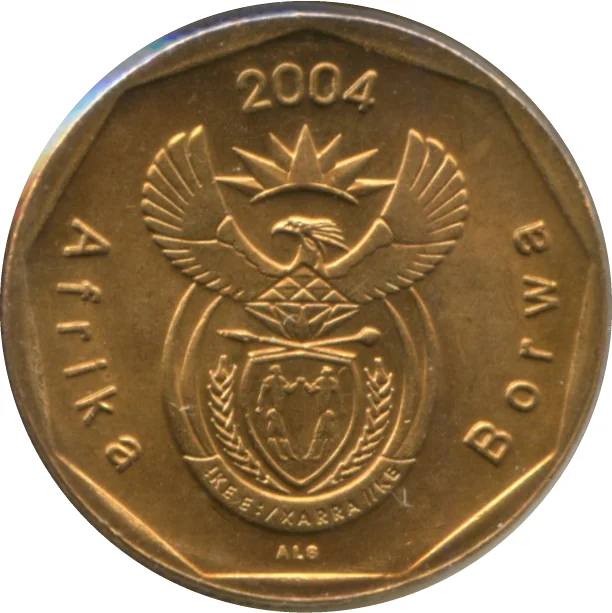
Description:
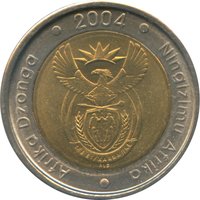
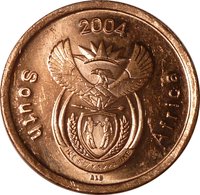
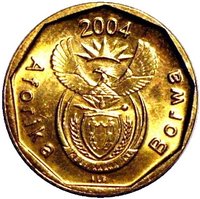
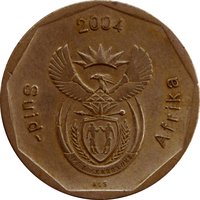
South African coat of arms with the motto in Khoisan and the country name in Sepedi/Sesotho.
Inscription:
Afrika Borwa 2004
ǃKE E: ǀXARRA ǁKE
ALS
ǃKE E: ǀXARRA ǁKE
ALS
Translation:
Unity in Diversity
South Africa 2004
South Africa 2004
Script: Latin
Engraver: Arthur Sutherland
Reverse
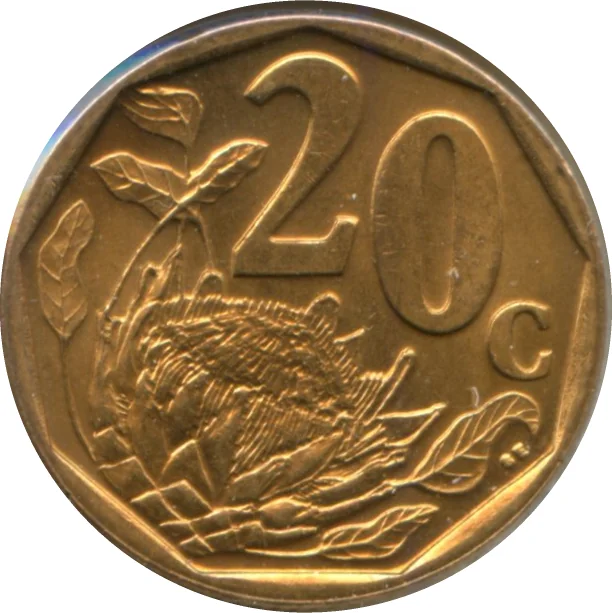
Description:
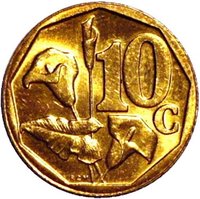
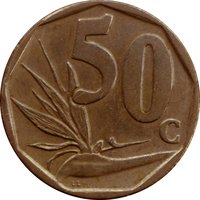
King Protea, South Africa's national flower.
Inscription:
20c
SE
SE
Translation:
Twenty Centimes
Script: Latin
Language: French
Engraver: Susan Erasmus
Edge
Reeded
Mintings
| Year | Mint Mark | Mintage | Quality | Collection |
|---|---|---|---|---|
| 2004 | — | 113,030,000 | ||
| 2004 | — | — | BU | |
| 2004 | — | 1,935 | Proof | |
| 2017 | — | — | BU | |
| 2017 | — | — | ||
| 2017 | — | — | Proof |
Historical background
In 2004, South Africa's currency, the rand, was in a period of remarkable recovery and strength following a period of extreme volatility. Just two years prior, in late 2001, the rand had collapsed to a historic low of nearly R13 to the US dollar, driven by a combination of domestic factors (such as perceptions of economic mismanagement and the broader impact of the Zimbabwe crisis) and global risk aversion post-9/11. This dramatic depreciation had triggered a sharp rise in inflation, forcing the South African Reserve Bank (SARB) to raise interest rates aggressively. By 2004, these corrective measures, coupled with a global commodities boom and sustained capital inflows into emerging markets, had engineered a powerful rebound. The rand appreciated to around R6 to the dollar, representing a more than 100% recovery from its lows, which was one of the strongest rallies of any currency in the world during that period.
This rapid appreciation presented a complex set of challenges for the South African economy, creating a policy dilemma for the government and the SARB. On one hand, the stronger rand helped to curb imported inflation, allowing interest rates to be lowered, which provided relief to indebted consumers. On the other hand, it severely pressured export-oriented and import-competing industries, particularly manufacturing and mining, which saw their rand-denominated revenues fall and their competitiveness erode in global markets. Job losses in these sectors became a significant political and economic concern. The government, under President Thabo Mbeki, and the SARB, under Governor Tito Mboweni, were thus walking a tightrope—celebrating the restored macroeconomic stability and investor confidence symbolized by the strong rand, while grappling with its negative consequences for growth and employment.
Overall, the currency situation in 2004 reflected South Africa's deepening integration into the global financial system and its status as a commodity-driven emerging market. The rand's strength was a double-edged sword, signaling successful stabilization after crisis but also highlighting structural vulnerabilities in the economy. The period underscored the ongoing tension between maintaining prudent fiscal and monetary policies to attract foreign investment and the urgent need for higher economic growth to address the country's profound socio-economic challenges, including poverty and unemployment, which remained pressing priorities for the ANC government.
This rapid appreciation presented a complex set of challenges for the South African economy, creating a policy dilemma for the government and the SARB. On one hand, the stronger rand helped to curb imported inflation, allowing interest rates to be lowered, which provided relief to indebted consumers. On the other hand, it severely pressured export-oriented and import-competing industries, particularly manufacturing and mining, which saw their rand-denominated revenues fall and their competitiveness erode in global markets. Job losses in these sectors became a significant political and economic concern. The government, under President Thabo Mbeki, and the SARB, under Governor Tito Mboweni, were thus walking a tightrope—celebrating the restored macroeconomic stability and investor confidence symbolized by the strong rand, while grappling with its negative consequences for growth and employment.
Overall, the currency situation in 2004 reflected South Africa's deepening integration into the global financial system and its status as a commodity-driven emerging market. The rand's strength was a double-edged sword, signaling successful stabilization after crisis but also highlighting structural vulnerabilities in the economy. The period underscored the ongoing tension between maintaining prudent fiscal and monetary policies to attract foreign investment and the urgent need for higher economic growth to address the country's profound socio-economic challenges, including poverty and unemployment, which remained pressing priorities for the ANC government.
🌱 Very Common