

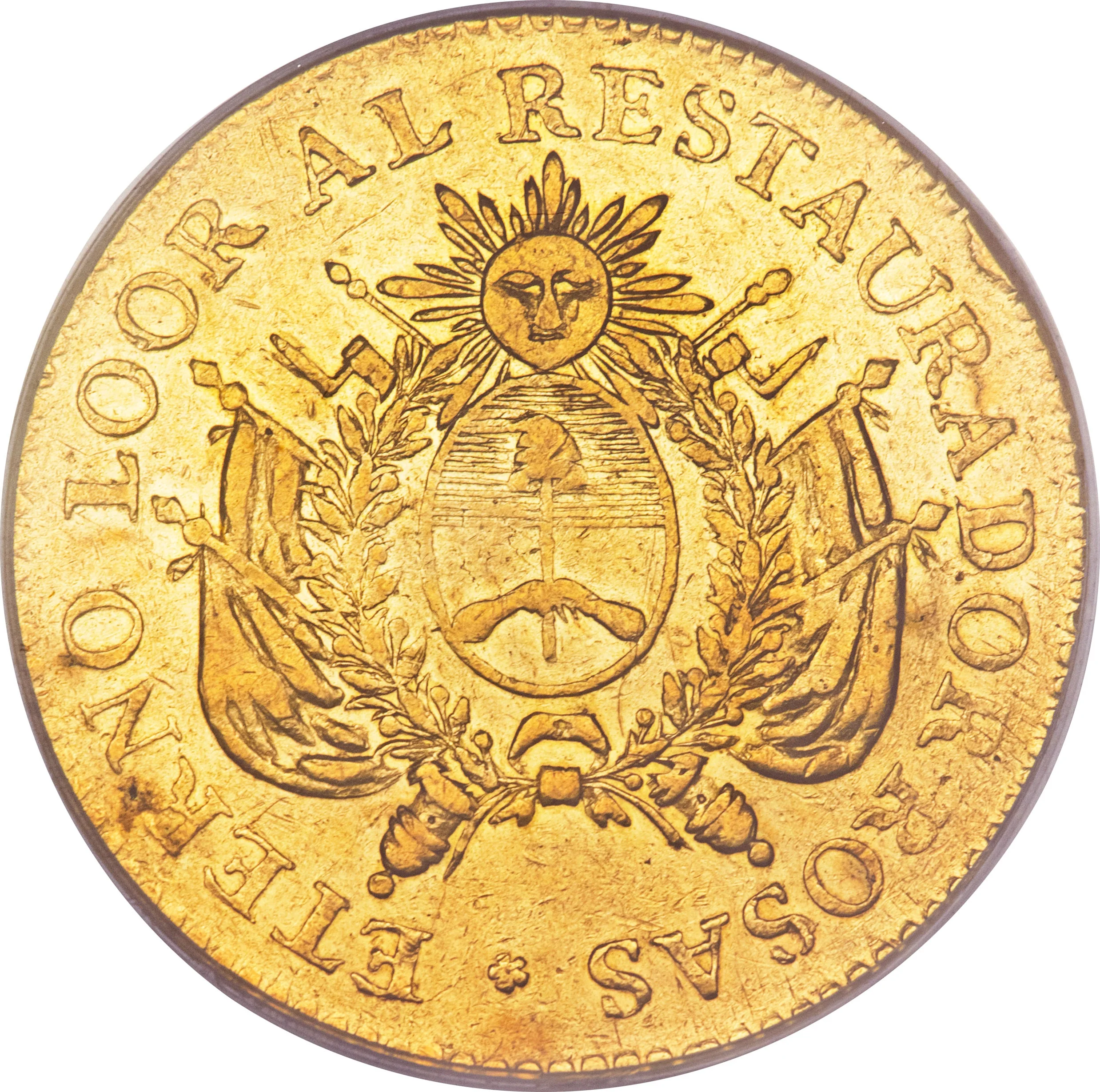
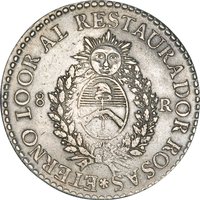
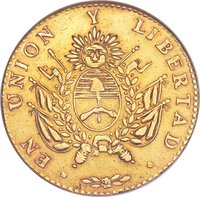
Obverse
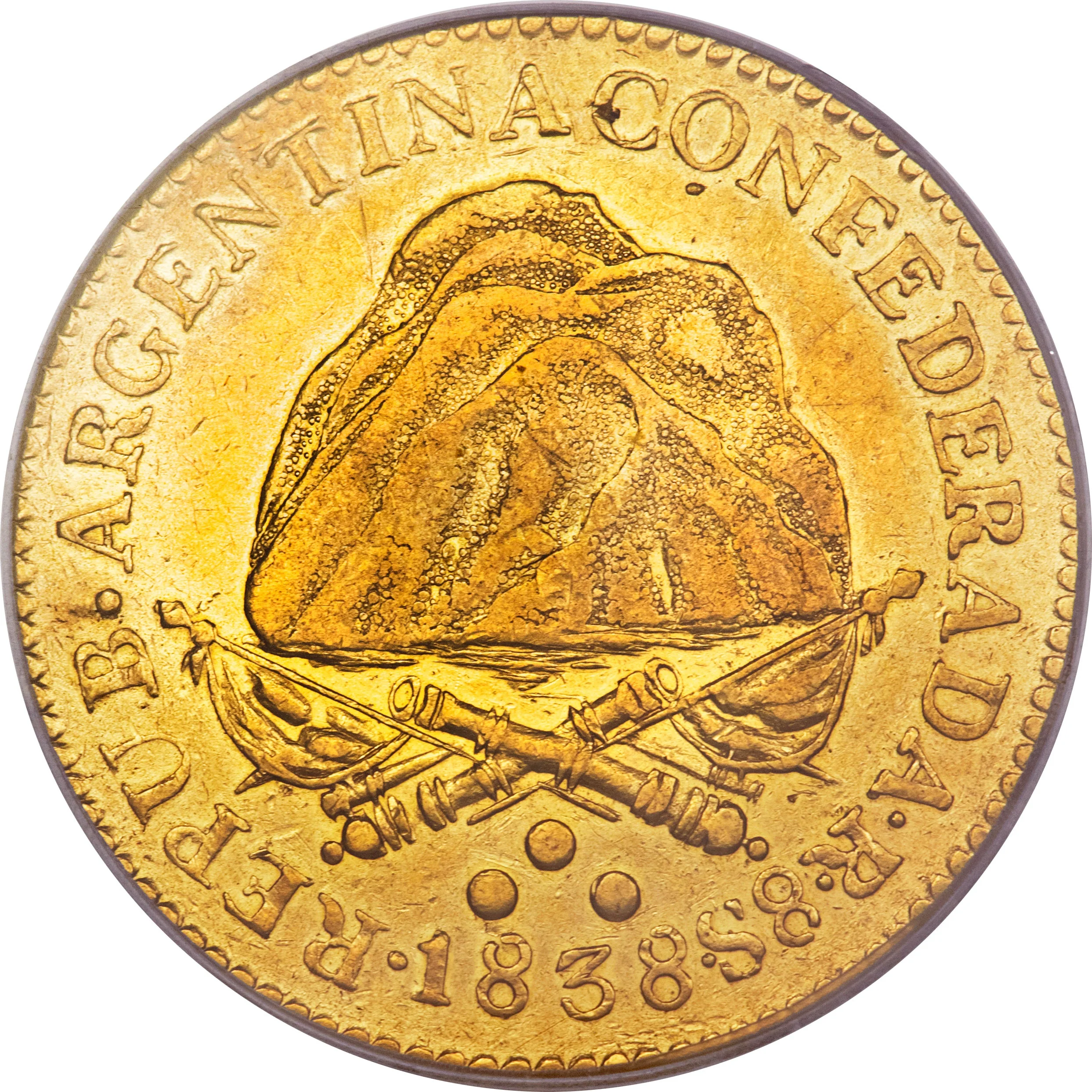
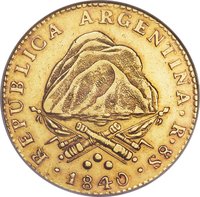
Reverse
Description:
Mountain with crossed cannons and flags below, encircled by legend.
Inscription:
·REPUB·ARGENTINA CONFEDERADA·R·
1838·S8·
1838·S8·
Script: Latin
Edge
Categories
| Object> Firearms |
| Symbol> Flag |
| Symbol> Hand |
| Geography> Mountain |
| Symbols> Coat of Arms |
| Symbol> Phrygian cap |
| Symbol> Sun |
Mintings
| Year | Mint Mark | Mintage | Quality | Collection |
|---|---|---|---|---|
| 1838 | R | — | ||
| 1840 | R | — |
Historical background
In 1838, La Rioja, a province in the interior of Argentina, was engulfed in the chaos of the Argentine Civil Wars, caught between the centralist authority of Buenos Aires and the federalist resistance led by powerful caudillos. Its economy, traditionally based on wine, livestock, and crafts, was shattered by constant military conflict, requisitions, and the disruption of trade routes. With the national treasury in Buenos Aires drained by war and unable to exert fiscal control over the rebellious interior, a vacuum of legitimate currency and credit emerged, leading to extreme monetary fragmentation.
To finance his federalist militia and provincial administration, the famed caudillo of La Rioja, Juan Facundo Quiroga (until his assassination in 1835), and his successors resorted to issuing their own primitive paper money. These were often simple promissory notes or vales, stamped with the provincial seal, which circulated by decree and the authority of the local leader. Simultaneously, a multitude of other currencies were in circulation: clipped and debased Spanish colonial coins, coins from other provinces like Salta, and even counterfeit "Potosi" pesos, creating a bewildering and unstable monetary environment where the value of any tender was highly localized and speculative.
This situation epitomized the broader political disintegration of the Confederation. The currency anarchy in La Rioja was not merely an economic issue but a direct manifestation of its sovereign defiance against Buenos Aires. The lack of a trusted, universal medium of exchange stifled what remained of formal commerce, encouraged barter, and deepened the province's isolation and poverty. Thus, in 1838, La Rioja's currency was a patchwork of improvised paper and suspect coin, a symbol of a province struggling to function amidst the violence and economic autarky of civil war.
To finance his federalist militia and provincial administration, the famed caudillo of La Rioja, Juan Facundo Quiroga (until his assassination in 1835), and his successors resorted to issuing their own primitive paper money. These were often simple promissory notes or vales, stamped with the provincial seal, which circulated by decree and the authority of the local leader. Simultaneously, a multitude of other currencies were in circulation: clipped and debased Spanish colonial coins, coins from other provinces like Salta, and even counterfeit "Potosi" pesos, creating a bewildering and unstable monetary environment where the value of any tender was highly localized and speculative.
This situation epitomized the broader political disintegration of the Confederation. The currency anarchy in La Rioja was not merely an economic issue but a direct manifestation of its sovereign defiance against Buenos Aires. The lack of a trusted, universal medium of exchange stifled what remained of formal commerce, encouraged barter, and deepened the province's isolation and poverty. Thus, in 1838, La Rioja's currency was a patchwork of improvised paper and suspect coin, a symbol of a province struggling to function amidst the violence and economic autarky of civil war.
💎 Extremely Rare