

Obverse
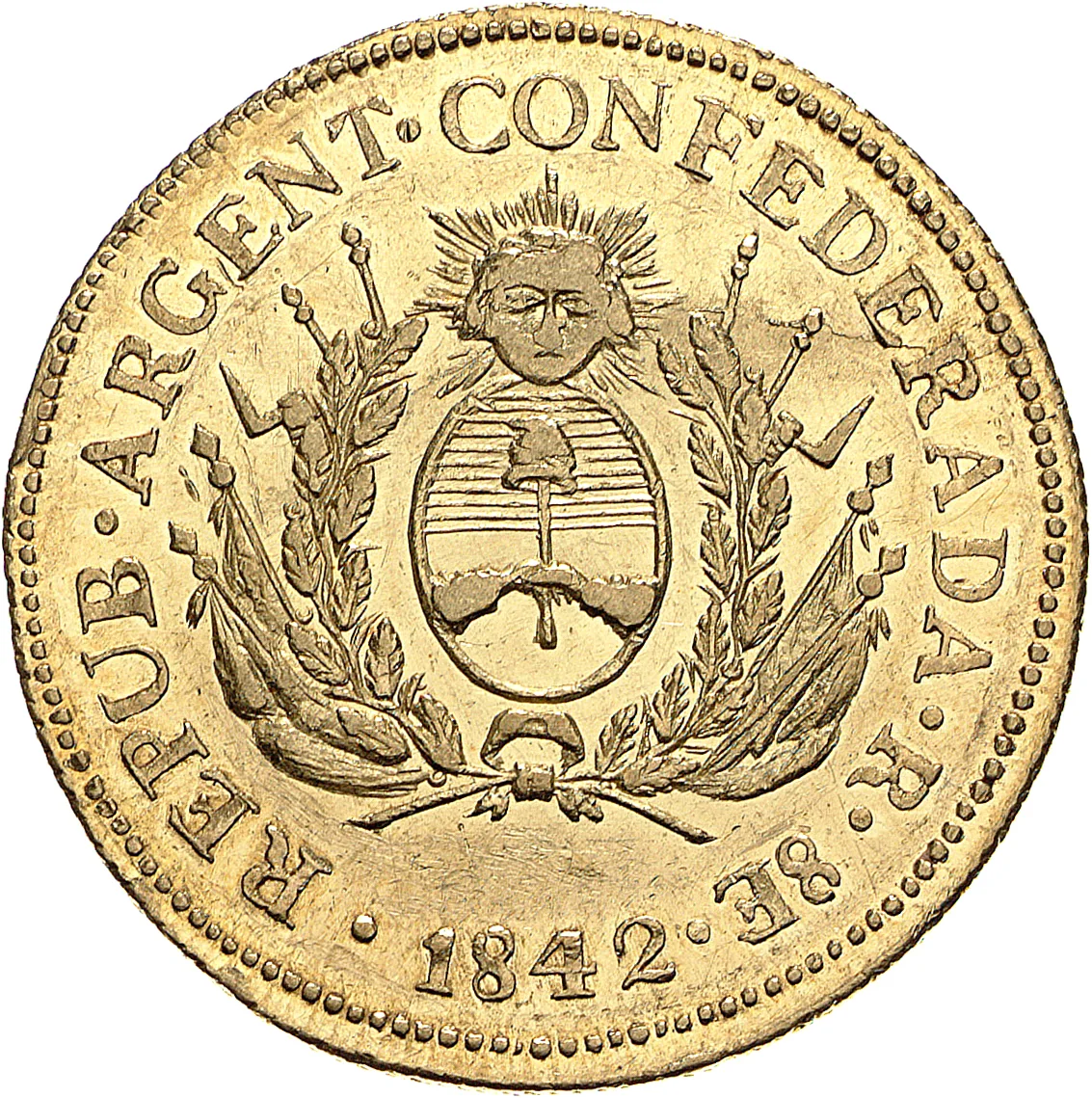
Description:
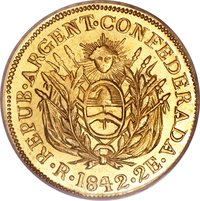
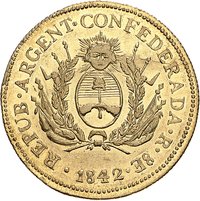
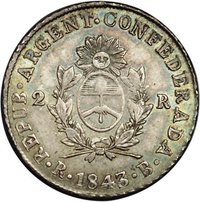
Coat of arms with encircling legend.
Inscription:
REPUB·ARGENT·CONFEDERADA·R·8E·
1842
1842
Script: Latin
Reverse
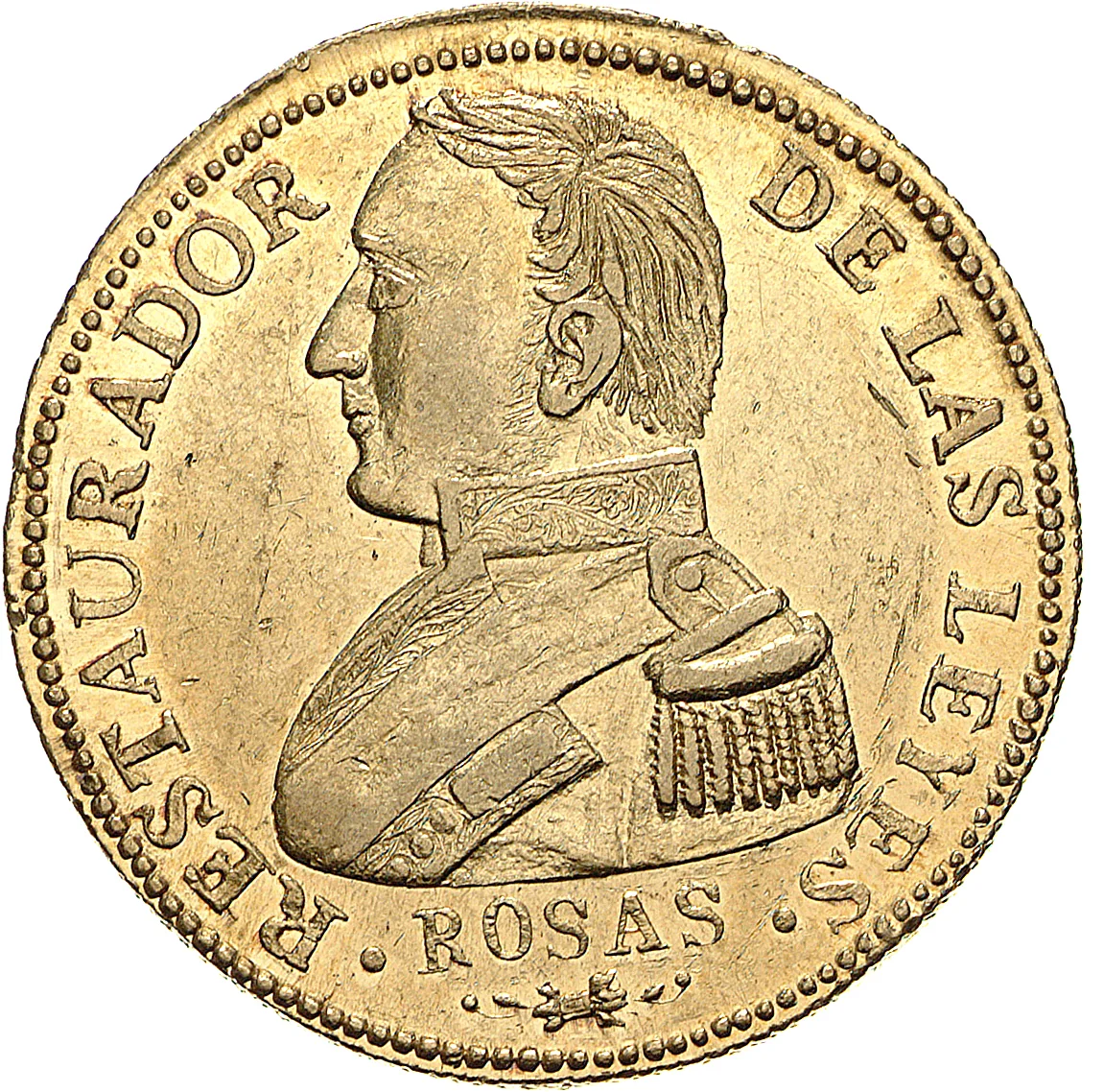
Description:
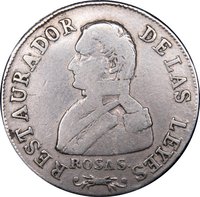
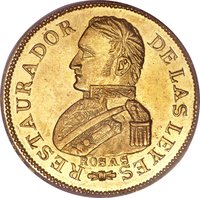
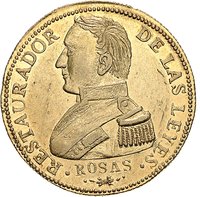
Uniformed bust of General Rosas left, legend encircling.
Inscription:
· RESTAURADOR DE LAS LEYES ·
ROSAS
ROSAS
Script: Latin
Edge
Categories
| Person> Military leader |
| Person> Politician |
| Symbols> Coat of Arms |
| Symbol> Phrygian cap |
| Symbol> Sun |
| Symbol> Hand |
| Symbol> Wreath |
Mintings
| Year | Mint Mark | Mintage | Quality | Collection |
|---|---|---|---|---|
| 1842 | R | — |
Historical background
In 1842, the Argentine province of La Rioja was embroiled in the broader civil wars between the Federalist forces of Juan Manuel de Rosas and the Unitarian opposition. Governor Tomás Brizuela, a Federalist nominally aligned with Rosas but often exercising autonomous power, led the province during a period of severe economic strain. The ongoing conflict had devastated local agriculture and mining, particularly the once-lucrative silver trade from the Famatina mines, strangling the province's primary source of wealth and tax revenue. This created a profound fiscal crisis, leaving the provincial government with scant resources to pay its militia and administrative costs.
Faced with this emergency, the La Rioja government resorted to issuing its own paper money, a common but destabilizing practice among provinces at the time. These notes, often called billetes or vales, were promissory notes intended to circulate as currency to cover public salaries and debts. However, with the provincial treasury's tangible assets (specie) nearly exhausted, this currency was fundamentally inconvertible—it could not be redeemed for gold or silver. Consequently, its value relied entirely on public confidence in Governor Brizuela's government, which was tenuous amidst the political and military uncertainty.
The result was rapid depreciation and economic dislocation. The currency's value fell sharply as soon as it entered circulation, leading to price inflation, a collapse in commercial credit, and widespread reluctance to accept the notes at their face value. This monetary chaos exacerbated the suffering of the population, deepening poverty and social unrest. The currency situation in La Rioja in 1842 thus stands as a stark microcosm of how Argentina's internal conflicts directly triggered fiscal desperation, leading to inflationary monetary policies that further crippled local economies.
Faced with this emergency, the La Rioja government resorted to issuing its own paper money, a common but destabilizing practice among provinces at the time. These notes, often called billetes or vales, were promissory notes intended to circulate as currency to cover public salaries and debts. However, with the provincial treasury's tangible assets (specie) nearly exhausted, this currency was fundamentally inconvertible—it could not be redeemed for gold or silver. Consequently, its value relied entirely on public confidence in Governor Brizuela's government, which was tenuous amidst the political and military uncertainty.
The result was rapid depreciation and economic dislocation. The currency's value fell sharply as soon as it entered circulation, leading to price inflation, a collapse in commercial credit, and widespread reluctance to accept the notes at their face value. This monetary chaos exacerbated the suffering of the population, deepening poverty and social unrest. The currency situation in La Rioja in 1842 thus stands as a stark microcosm of how Argentina's internal conflicts directly triggered fiscal desperation, leading to inflationary monetary policies that further crippled local economies.
💎 Extremely Rare