

1 Real – Buenos Aires
Argentina
Context
Year: 1840
Country: Argentina 
Issuer: Buenos Aires
Period:
(1831—1853)
Currency:
(1822—1861)
Demonetized: Yes
Material
References
KM: #Click to copy to clipboard7
Numista: #28983
Obverse
Description:
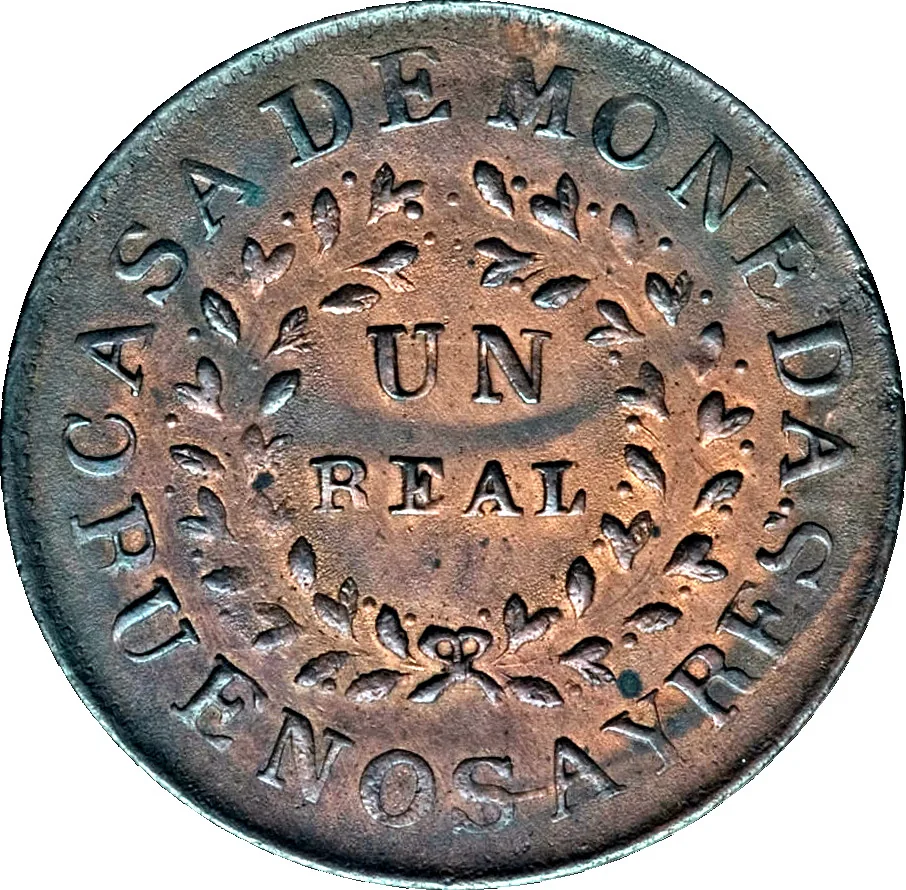
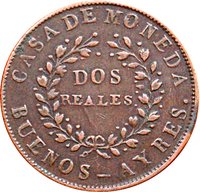
Superior perimeter: "CASA DE MONEDA." Inferior: "BUENOS AYRES" (with or without hyphen). Central field: Laurel wreaths with tied capes, "UN REAL" on two lines. Beaded border.
Inscription:
CASA DE MONEDA.
BUENOS AYRES
UN REAL
BUENOS AYRES
UN REAL
Translation:
MINT HOUSE.
BUENOS AIRES
ONE REAL
BUENOS AIRES
ONE REAL
Script: Latin
Language: Spanish
Reverse
Description:
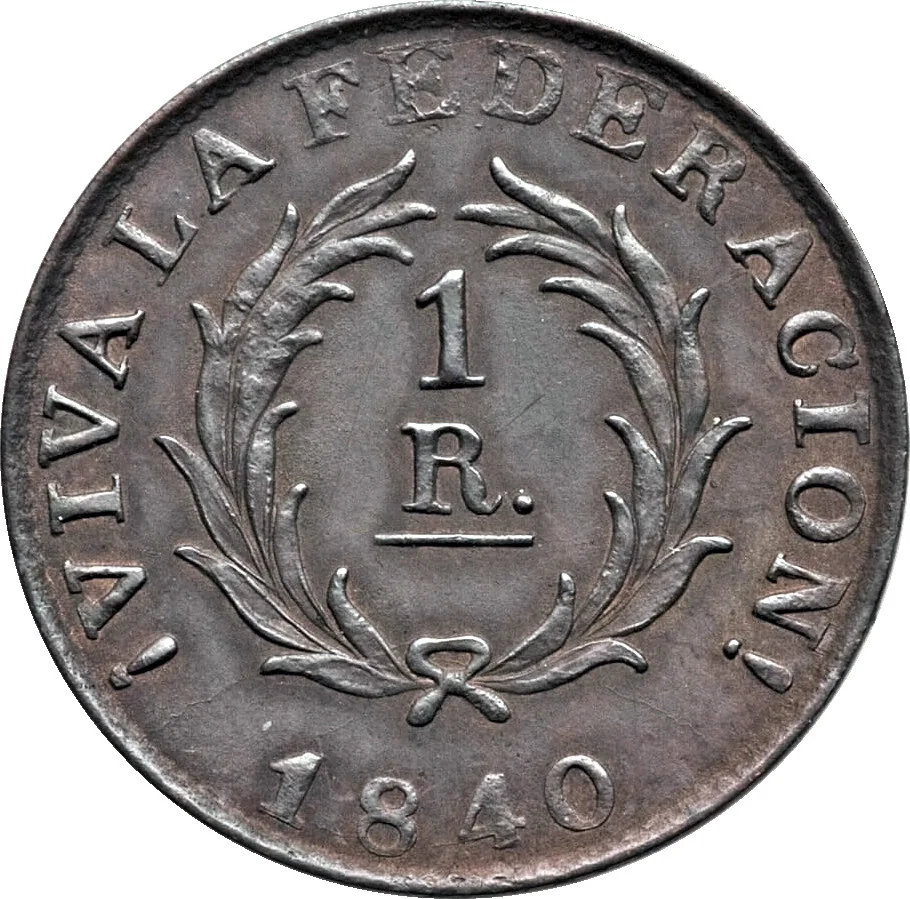
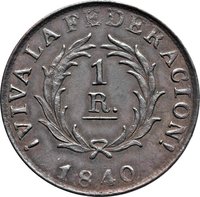
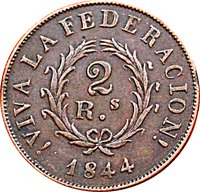
Perimeter: "¡VIVA LA FEDERACIÓN!" above, "1840" below. Center: "1 / R." within ribbon-tied palm wreaths. Beaded border.
Inscription:
¡VIVA LA FEDERACION!
1840
1/R.
1840
1/R.
Script: Latin
Edge
Mintings
| Year | Mint Mark | Mintage | Quality | Collection |
|---|---|---|---|---|
| 1840 | — | — |
Historical background
In 1840, Buenos Aires existed within the tumultuous political and economic landscape of the Argentine Confederation, a period defined by the rule of Governor Juan Manuel de Rosas. The currency situation was chaotic and fragmented, reflecting the deep political divisions of the time. The port city, as a separate province, issued its own paper money—pesos fuertes in notes—while the interior provinces under the Confederation often circulated their distinct, and frequently depreciated, currencies. This lack of a unified national monetary system severely hampered trade and economic stability.
The core of the crisis was the over-issuance of paper money (billetes) by the Buenos Aires government to finance its ongoing military campaigns, particularly the costly conflicts against the Unitarian opposition and the French blockade of the port (1838-1840). This led to severe inflation and a dramatic gap between the face value of paper currency and its real value in precious metal. A complex system of exchange rates emerged, with gold and silver commanding a significant premium over paper, effectively creating a dual-currency economy where daily transactions were fraught with uncertainty and loss.
Furthermore, public trust in paper money was exceedingly low. The notes, often crudely printed and easy to counterfeit, circulated alongside a variety of foreign coins, including Spanish, Brazilian, and British sterling, which were hoarded for their intrinsic value. This monetary anarchy stifled long-term investment and credit, placing a heavy burden on merchants and the populace. The currency chaos of 1840 was thus both a symptom and a cause of the broader instability, underscoring how Rosas’s political control was maintained at the expense of economic cohesion and prosperity.
The core of the crisis was the over-issuance of paper money (billetes) by the Buenos Aires government to finance its ongoing military campaigns, particularly the costly conflicts against the Unitarian opposition and the French blockade of the port (1838-1840). This led to severe inflation and a dramatic gap between the face value of paper currency and its real value in precious metal. A complex system of exchange rates emerged, with gold and silver commanding a significant premium over paper, effectively creating a dual-currency economy where daily transactions were fraught with uncertainty and loss.
Furthermore, public trust in paper money was exceedingly low. The notes, often crudely printed and easy to counterfeit, circulated alongside a variety of foreign coins, including Spanish, Brazilian, and British sterling, which were hoarded for their intrinsic value. This monetary anarchy stifled long-term investment and credit, placing a heavy burden on merchants and the populace. The currency chaos of 1840 was thus both a symptom and a cause of the broader instability, underscoring how Rosas’s political control was maintained at the expense of economic cohesion and prosperity.
🌟 Uncommon