

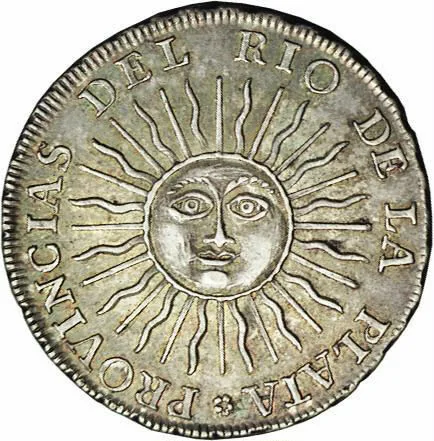
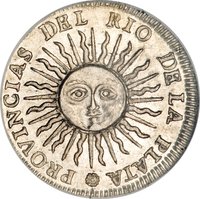
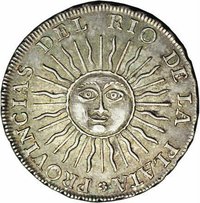
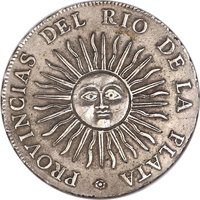
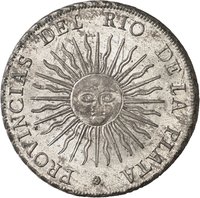
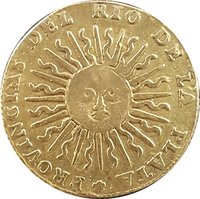
Obverse
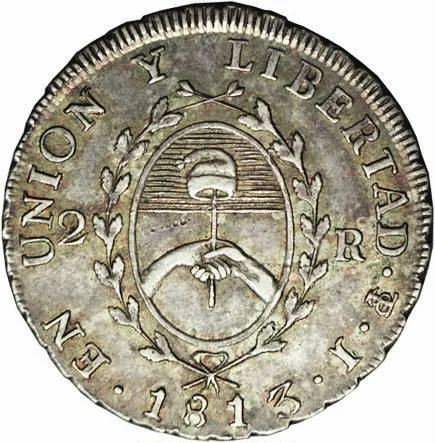
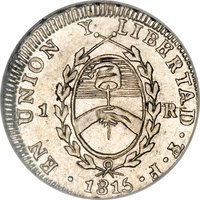
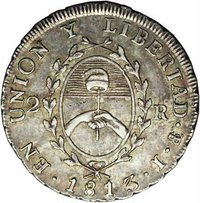
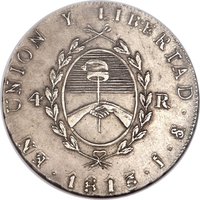
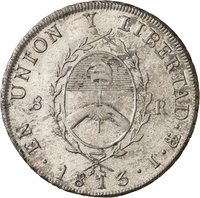
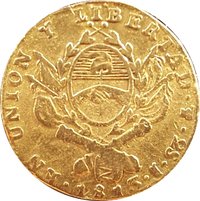
Reverse
Description:
National arms flanked by sprigs, date beneath.
Inscription:
EN UNION Y LIBERTAD ·TS · I
· 1813 ·
· 1813 ·
Script: Latin
Edge
Categories
| Symbols> Coat of Arms |
| Symbol> Phrygian cap |
| Symbol> Sun |
Mints
| Name | Mark |
|---|---|
| Potosi | PTS |
Mintings
| Year | Mint Mark | Mintage | Quality | Collection |
|---|---|---|---|---|
| 1813 | PTSJ | — | ||
| 1815 | PTSF | — |
Historical background
In 1813, Argentina was in the midst of the protracted War of Independence against Spanish royalist forces. This conflict, which began with the May Revolution of 1810, had severely disrupted the colonial economic system. The fledgling United Provinces of the Río de la Plata faced immense financial strain from funding its armies, leading to a critical shortage of precious metals for coinage. The Spanish colonial silver "real" remained in circulation but was increasingly scarce, as trade with Peru (the traditional source of silver) was cut off and bullion was hoarded or exported.
To address this crisis, the revolutionary government took a decisive step. On April 13, 1813, the Asamblea General Constituyente authorized the minting of the nation's first official coinage, a powerful symbolic and practical assertion of sovereignty. These first coins, minted in Potosí (in present-day Bolivia, then under Argentine control after the 1813 campaign), bore the national seal of the rising sun (Sol de Mayo) and the inscription "PROVINCIAS DEL RIO DE LA PLATA." They included silver coins of 2, 1, ½, and ¼ reales, and gold coins of 8 and 4 escudos. This move aimed to replace the Spanish royal effigy with national symbols and provide a stable medium of exchange for the war economy.
However, the currency situation remained precarious and complex. The new coins circulated alongside a confusing array of older Spanish colonial coins, foreign currencies (like Portuguese and Brazilian), and various forms of crude locally minted "siege coinage" from different provinces. More critically, the government's immense deficits soon led it to issue paper money—the first billetes—to pay its debts, setting a precedent for future inflationary pressures. Thus, while 1813 marked the birth of a national Argentine currency as an act of sovereignty, it was a birth into the turbulent and financially demanding environment of a fragmented and costly war for independence.
To address this crisis, the revolutionary government took a decisive step. On April 13, 1813, the Asamblea General Constituyente authorized the minting of the nation's first official coinage, a powerful symbolic and practical assertion of sovereignty. These first coins, minted in Potosí (in present-day Bolivia, then under Argentine control after the 1813 campaign), bore the national seal of the rising sun (Sol de Mayo) and the inscription "PROVINCIAS DEL RIO DE LA PLATA." They included silver coins of 2, 1, ½, and ¼ reales, and gold coins of 8 and 4 escudos. This move aimed to replace the Spanish royal effigy with national symbols and provide a stable medium of exchange for the war economy.
However, the currency situation remained precarious and complex. The new coins circulated alongside a confusing array of older Spanish colonial coins, foreign currencies (like Portuguese and Brazilian), and various forms of crude locally minted "siege coinage" from different provinces. More critically, the government's immense deficits soon led it to issue paper money—the first billetes—to pay its debts, setting a precedent for future inflationary pressures. Thus, while 1813 marked the birth of a national Argentine currency as an act of sovereignty, it was a birth into the turbulent and financially demanding environment of a fragmented and costly war for independence.
Series: 1813 Argentina circulation coins

💎 Very Rare