

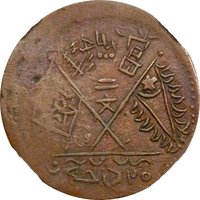
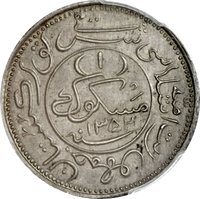
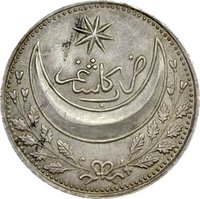
20 Cash – First East Turkestan Republic
China
Context
Year: 1934
Islamic (Hijri) Year: 1352
Country: China 
Issuer: First East Turkestan Republic
Period:
(1933—1934)
Demonetized: Yes
Material

References
Y: #Click to copy to clipboardE38.2
Numista: #288164
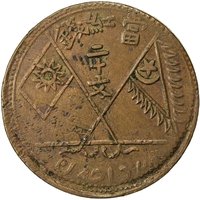
Obverse
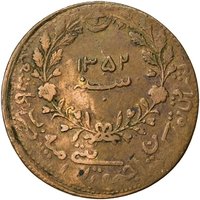
Reverse
Edge
Mints
| Name | Mark |
|---|---|
| Kashgar Mint | — |
Mintings
| Year | Mint Mark | Mintage | Quality | Collection |
|---|---|---|---|---|
| 1934 | — | — |
Historical background
The First East Turkestan Republic (ETR), proclaimed in 1933 and centered in Kashgar, faced a dire and chaotic currency situation by 1934 that reflected its political and military fragility. The republic's predecessor, the Uighur nationalist regime of the "Turkish-Islamic Republic of East Turkestan" (TIRET), had already destabilized the monetary system by overprinting vast quantities of old Chinese provincial banknotes to fund its operations, leading to severe hyperinflation. When the ETR under Khoja Niyaz took control, it inherited this worthless paper currency, which was rejected by the populace and contributed to economic paralysis.
In a desperate attempt to establish monetary sovereignty and stabilize the economy, the ETR government introduced its own official currency in early 1934. These notes, known as Sher or Qashgar puli, were printed in the Soviet Union and featured Islamic crescents and stars alongside Turkic text. However, this new currency failed almost immediately. It was not backed by substantial reserves of silver or goods, and its issuance coincided with the republic's final military collapse. As the Chinese provincial army, backed by the Soviet Union, advanced on Kashgar, public confidence evaporated, rendering the notes worthless.
Thus, by the time the republic was dissolved in April 1934, its currency experiment had completely failed. The brief circulation of the Sher ultimately symbolized the ETR's lack of stable governance and economic infrastructure rather than a functioning monetary system. The region reverted to a complex mix of physical goods (barter), old Chinese silver yuan, and Soviet-backed currencies, underscoring how the republic's financial turmoil was both a cause and a symptom of its short-lived existence.
In a desperate attempt to establish monetary sovereignty and stabilize the economy, the ETR government introduced its own official currency in early 1934. These notes, known as Sher or Qashgar puli, were printed in the Soviet Union and featured Islamic crescents and stars alongside Turkic text. However, this new currency failed almost immediately. It was not backed by substantial reserves of silver or goods, and its issuance coincided with the republic's final military collapse. As the Chinese provincial army, backed by the Soviet Union, advanced on Kashgar, public confidence evaporated, rendering the notes worthless.
Thus, by the time the republic was dissolved in April 1934, its currency experiment had completely failed. The brief circulation of the Sher ultimately symbolized the ETR's lack of stable governance and economic infrastructure rather than a functioning monetary system. The region reverted to a complex mix of physical goods (barter), old Chinese silver yuan, and Soviet-backed currencies, underscoring how the republic's financial turmoil was both a cause and a symptom of its short-lived existence.

✨ Legendary