

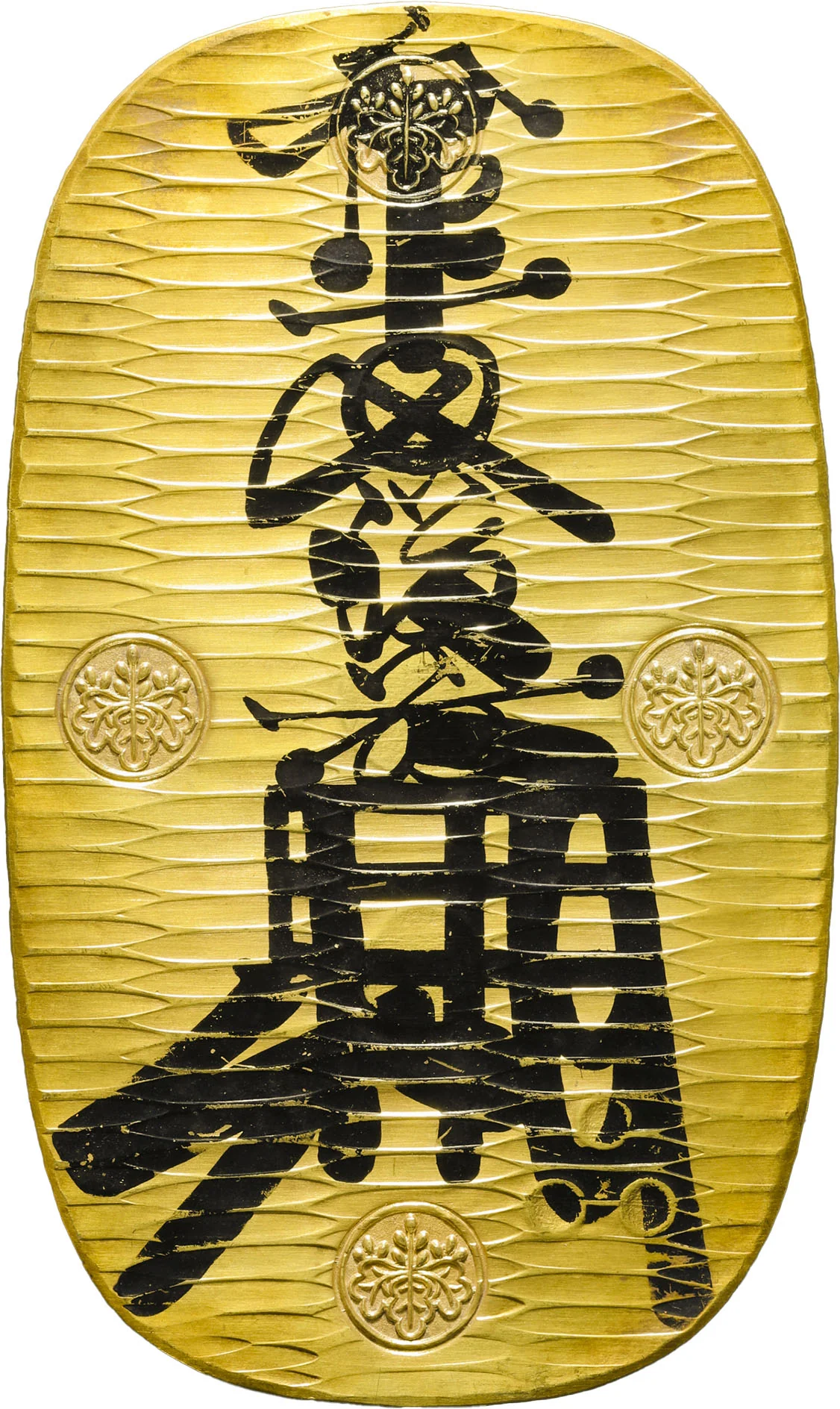
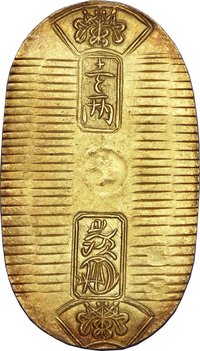
Obverse
Description:
Black ink vertical weight and signature. Four encircled 5-3 Paulownia seals at top, bottom, left, and right.
Inscription:
拾
両
後
藤
両
後
藤
Translation:
Ten Ryo
Goto
Goto
Language: Japanese
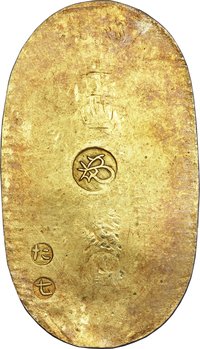
Reverse
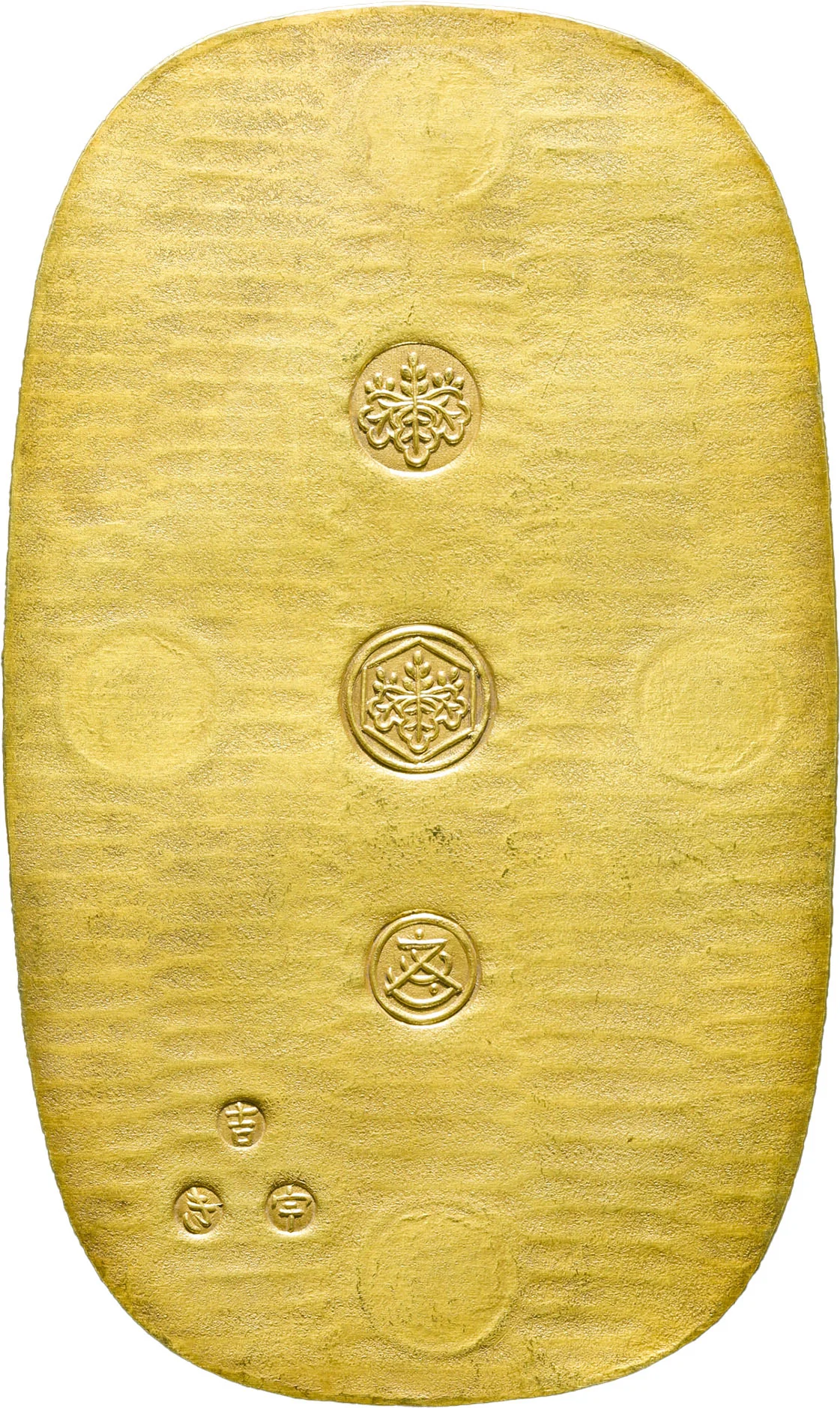
Description:
Upper-center: 5-3 Paulownia seal.
Center: 5-3 Paulownia seal in hexagon and circle.
Lower-center: Kaō signature seal.
Lower-left: Three Mint control character seals.
Center: 5-3 Paulownia seal in hexagon and circle.
Lower-center: Kaō signature seal.
Lower-left: Three Mint control character seals.
Inscription:
吉
き 宇
き 宇
Translation:
Good Fortune
Language: Japanese
Edge
Mintings
| Year | Mint Mark | Mintage | Quality | Collection |
|---|---|---|---|---|
| 1861 | — | — |
Historical background
In 1861, Japan's currency system was in a state of profound crisis and complexity, a direct reflection of the political turmoil of the late Edo period. The Tokugawa shogunate, its authority weakened by internal dissent and the forced opening of the country following Commodore Perry's arrival in 1853, faced severe financial strain. To fund its obligations and military modernization, the Bakufu had resorted to debasing its gold and silver coinage, repeatedly reducing the precious metal content. This led to a proliferation of different coinages—including Koban gold, Ichibu silver, and copper mon—with fluctuating and often arbitrary exchange rates, causing widespread confusion and economic instability.
Compounding this was the chaotic multi-currency system itself. The shogunate, over 200 regional domains (han), and even wealthy merchants all issued their own forms of money. Domains circulated often inconvertible paper scrip known as hansatsu to alleviate local debts, creating a patchwork of over 1,600 different types of notes with varying credibility. Furthermore, the unequal treaties forced on Japan, particularly the Ansei Commercial Treaties (1858), had fixed an unfavorable foreign exchange rate that triggered a massive outflow of gold. International traders exploited the vast difference between gold-silver ratios in Japan and the world, draining the Bakufu's specie reserves and further devaluing its currency.
This monetary disarray fueled inflation, eroded public trust in the shogunate's economic management, and became a significant point of contention for anti-Tokugawa forces, particularly the southwestern domains of Satsuma and Chōshū. The currency crisis was not merely an economic issue but a potent symbol of the Bakufu's failing governance. It underscored the urgent need for a centralized, modern financial system, a goal that would become a top priority for the Meiji government following the Restoration in 1868, leading to the creation of the yen in 1871.
Compounding this was the chaotic multi-currency system itself. The shogunate, over 200 regional domains (han), and even wealthy merchants all issued their own forms of money. Domains circulated often inconvertible paper scrip known as hansatsu to alleviate local debts, creating a patchwork of over 1,600 different types of notes with varying credibility. Furthermore, the unequal treaties forced on Japan, particularly the Ansei Commercial Treaties (1858), had fixed an unfavorable foreign exchange rate that triggered a massive outflow of gold. International traders exploited the vast difference between gold-silver ratios in Japan and the world, draining the Bakufu's specie reserves and further devaluing its currency.
This monetary disarray fueled inflation, eroded public trust in the shogunate's economic management, and became a significant point of contention for anti-Tokugawa forces, particularly the southwestern domains of Satsuma and Chōshū. The currency crisis was not merely an economic issue but a potent symbol of the Bakufu's failing governance. It underscored the urgent need for a centralized, modern financial system, a goal that would become a top priority for the Meiji government following the Restoration in 1868, leading to the creation of the yen in 1871.

✨ Legendary