

1 Mon – Japan
Japan
Context
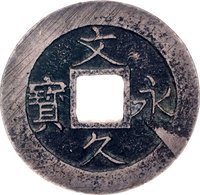
Material
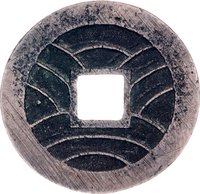
Shape: Round with a square hole
Composition: Iron
Technique: Cast
Alignment: Medal alignment

flip
References
Numista: #161647
Obverse
Reverse
Edge
Plain
Mintings
| Year | Mint Mark | Mintage | Quality | Collection |
|---|---|---|---|---|
| 1862 | — | — |
Historical background
In 1862, Japan's currency system was in a state of severe crisis, a direct reflection of the political and economic turmoil of the late Tokugawa shogunate. The country operated on a complex, tri-metallic system of gold koban, silver momme and chōgin, and copper mon, with exchange rates theoretically set by the shogunate. However, decades of fiscal mismanagement, including debasement of coinage to fund government operations, had led to rampant inflation and a loss of public confidence. Furthermore, the 1858 "Ansei Commercial Treaties" with Western powers had forced Japan onto a silver-based international exchange rate that was disastrously undervalued against its domestic gold standard, leading to a rapid and lucrative outflow of gold bullion exploited by foreign traders.
This monetary chaos was exacerbated by the proliferation of hansatsu, or feudal clan paper notes, issued by hundreds of domains to cover their own debts and stimulate local economies. These notes were of wildly varying credibility and were not legally convertible outside their domain of issue, crippling national commerce. The shogunate itself also issued paper money (shogunatsu), but without sufficient specie reserves, it too depreciated rapidly. The result was a bewildering patchwork of currencies, where exchange rates fluctuated not only between metals but between regions, stifling trade and creating widespread economic uncertainty for merchants and peasants alike.
The currency disorder was both a symptom and a cause of the shogunate's declining authority. It directly fueled social unrest as the cost of living soared, while impoverishing the samurai class who lived on fixed stipends. Economically, it hindered the shogunate's ability to modernize its military or centralize administration, key weaknesses as external pressure from Western powers and internal dissent from rival domains intensified. Thus, by 1862, the fractured monetary system had become a critical point of contention, underscoring the urgent need for a unified, modern financial system—a goal that would only be achieved after the Meiji Restoration several years later.
This monetary chaos was exacerbated by the proliferation of hansatsu, or feudal clan paper notes, issued by hundreds of domains to cover their own debts and stimulate local economies. These notes were of wildly varying credibility and were not legally convertible outside their domain of issue, crippling national commerce. The shogunate itself also issued paper money (shogunatsu), but without sufficient specie reserves, it too depreciated rapidly. The result was a bewildering patchwork of currencies, where exchange rates fluctuated not only between metals but between regions, stifling trade and creating widespread economic uncertainty for merchants and peasants alike.
The currency disorder was both a symptom and a cause of the shogunate's declining authority. It directly fueled social unrest as the cost of living soared, while impoverishing the samurai class who lived on fixed stipends. Economically, it hindered the shogunate's ability to modernize its military or centralize administration, key weaknesses as external pressure from Western powers and internal dissent from rival domains intensified. Thus, by 1862, the fractured monetary system had become a critical point of contention, underscoring the urgent need for a unified, modern financial system—a goal that would only be achieved after the Meiji Restoration several years later.
✨ Legendary