

Obverse
Description:
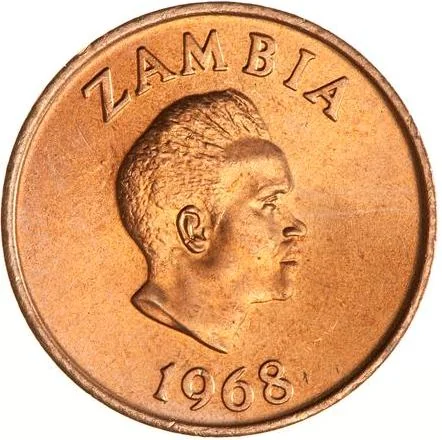
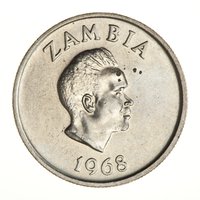
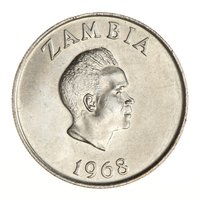
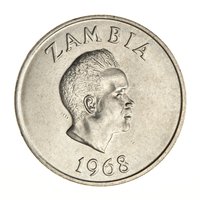
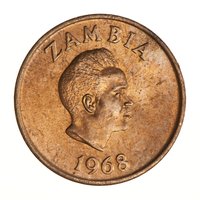
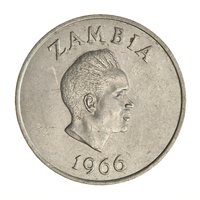
Kenneth Kaunda, Zambian president, facing right. Date below.
Inscription:
ZAMBIA
1968
1968
Script: Latin
Reverse
Edge
Plain
Categories
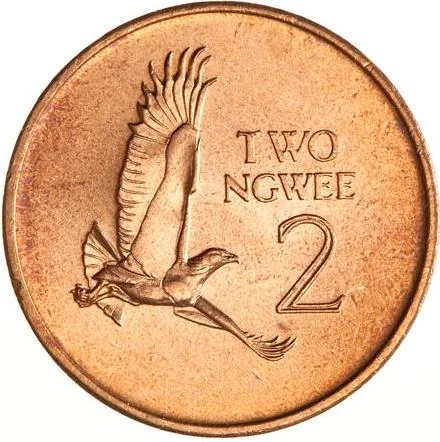
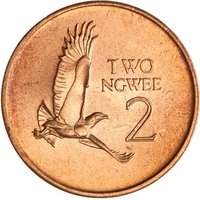
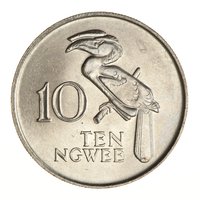
| Animal> Bird> Eagle |
| Person> Politician |
Mints
| Name | Mark |
|---|---|
| Royal Mint (Tower Hill) | — |
| Royal Mint | — |
Mintings
| Year | Mint Mark | Mintage | Quality | Collection |
|---|---|---|---|---|
| 1968 | London Mint | 19,000,000 | ||
| 1968 | London Mint | 4,000 | Proof | |
| 1968 | — | 19,000,000 | ||
| 1968 | London Mint | 19,000,000 | ||
| 1968 | London Mint | 4,000 | Proof | |
| 1968 | — | 4,000 | Proof | |
| 1978 | Llantrisant Mint | — | ||
| 1978 | Llantrisant Mint | 24,000 | Proof | |
| 1978 | Llantrisant Mint | — | ||
| 1978 | Llantrisant Mint | 24,000 | Proof | |
| 1978 | — | — | ||
| 1978 | — | 24,000 | Proof |
Historical background
In 1968, Zambia's currency situation was defined by its recent political independence and the enduring economic influence of the Southern African region. The country had introduced its own currency, the Zambian pound, in 1964 to replace the Rhodesia and Nyasaland pound, symbolizing its break from the colonial Federation. However, this new currency remained pegged to the British pound sterling and was thus indirectly tied to the monetary systems of its white-minority ruled neighbours, Southern Rhodesia (Rhodesia) and South Africa, through the Sterling Area. This created a fundamental vulnerability, as Zambia's economy was deeply integrated with the south for trade and transportation links.
The situation grew increasingly untenable following Rhodesia's Unilateral Declaration of Independence (UDI) in 1965. In response to British-led international sanctions against the rebel regime, Zambia faced severe economic pressure and the risk of its currency being used to circumvent those sanctions. To assert its sovereignty and align its monetary policy with President Kenneth Kaunda's "Zambian Humanism" and economic diversification plans, the government took a decisive step. On January 16, 1968, it introduced the Kwacha (meaning "dawn" in several local languages) and the Ngwee ("bright") to replace the Zambian pound, at a rate of 1 Kwacha = ½ Zambian pound (10 shillings).
This redenomination was more than a symbolic change; it was a critical move to gain full control over national monetary policy and insulate the economy from the Rhodesian crisis. The new currency was initially pegged to the US dollar, deliberately shifting Zambia's financial alignment away from the Sterling Area and the troubled southern bloc. The 1968 currency reform thus represented a pivotal moment in Zambia's post-colonial economic history, marking a determined, though challenging, effort to forge an independent financial path amidst regional political turmoil and the urgent need for domestic economic restructurin
The situation grew increasingly untenable following Rhodesia's Unilateral Declaration of Independence (UDI) in 1965. In response to British-led international sanctions against the rebel regime, Zambia faced severe economic pressure and the risk of its currency being used to circumvent those sanctions. To assert its sovereignty and align its monetary policy with President Kenneth Kaunda's "Zambian Humanism" and economic diversification plans, the government took a decisive step. On January 16, 1968, it introduced the Kwacha (meaning "dawn" in several local languages) and the Ngwee ("bright") to replace the Zambian pound, at a rate of 1 Kwacha = ½ Zambian pound (10 shillings).
This redenomination was more than a symbolic change; it was a critical move to gain full control over national monetary policy and insulate the economy from the Rhodesian crisis. The new currency was initially pegged to the US dollar, deliberately shifting Zambia's financial alignment away from the Sterling Area and the troubled southern bloc. The 1968 currency reform thus represented a pivotal moment in Zambia's post-colonial economic history, marking a determined, though challenging, effort to forge an independent financial path amidst regional political turmoil and the urgent need for domestic economic restructurin
Series: 1968 Zambia circulation coins
🌱 Very Common