

Obverse
Reverse
Description:
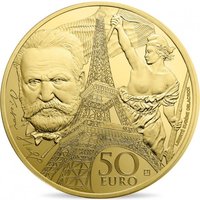
Portrait of Jean de la Fontaine and all animals of the Chinese zodiac.
Inscription:
Fables de la Fontaine
50 EURO
2017
50 EURO
2017
Edge
Plain.
Categories
| Animal> Bird |
| Astrology> Chinese calendar |
Mints
| Name | Mark |
|---|---|
| Monnaie de Paris | — |
Mintings
| Year | Mint Mark | Mintage | Quality | Collection |
|---|---|---|---|---|
| 2017 | — | 500 | Proof |
Historical background
In 2017, France remained a core member of the Eurozone, with the euro (€) as its sole legal tender. The broader currency situation was characterized by a period of relative stability for the euro itself, which was trading within a manageable range against major currencies like the US dollar. However, this stability existed against a backdrop of significant political uncertainty due to the presidential and legislative elections. The prospect of a victory for Marine Le Pen and her National Front party, which advocated for "Frexit" and a return to the French franc, introduced a tangible, albeit ultimately unrealized, risk to the currency's future in France. Financial markets watched the elections closely, with the euro fluctuating on polling news.
Domestically, monetary policy was not set by France but by the European Central Bank (ECB). Throughout 2017, the ECB continued its unconventional monetary policies, including historically low interest rates and a substantial quantitative easing program, to stimulate inflation and growth across the Eurozone. For France, this meant continued cheap borrowing costs for the government and businesses, supporting economic activity. However, these policies also contributed to low returns on savings and were a point of contention for critics who argued they fueled asset bubbles and reduced the incentives for structural reforms within member states like France.
The year concluded with the euro's position secure following Emmanuel Macron's decisive presidential victory, which was interpreted as a strong endorsement of France's commitment to the European Union and the single currency. The perceived "Frexit" risk dissipated rapidly, allowing focus to return to the shared challenges of the Eurozone, such as banking union negotiations and debates over fiscal integration. Thus, France's currency situation in 2017 was ultimately defined by the reaffirmation of the euro's permanence after a period of electoral suspense, leaving the nation to operate within the established framework of ECB-led monetary policy as it sought to address its economic challenges from within the Eurozone.
Domestically, monetary policy was not set by France but by the European Central Bank (ECB). Throughout 2017, the ECB continued its unconventional monetary policies, including historically low interest rates and a substantial quantitative easing program, to stimulate inflation and growth across the Eurozone. For France, this meant continued cheap borrowing costs for the government and businesses, supporting economic activity. However, these policies also contributed to low returns on savings and were a point of contention for critics who argued they fueled asset bubbles and reduced the incentives for structural reforms within member states like France.
The year concluded with the euro's position secure following Emmanuel Macron's decisive presidential victory, which was interpreted as a strong endorsement of France's commitment to the European Union and the single currency. The perceived "Frexit" risk dissipated rapidly, allowing focus to return to the shared challenges of the Eurozone, such as banking union negotiations and debates over fiscal integration. Thus, France's currency situation in 2017 was ultimately defined by the reaffirmation of the euro's permanence after a period of electoral suspense, leaving the nation to operate within the established framework of ECB-led monetary policy as it sought to address its economic challenges from within the Eurozone.
Series: Chinese Calendar









✨ Legendary